
Taps matter nowadays more than people think, though often hidden from attention. Well, in today’s eco-friendly buildings, this is no longer the case. Touchless faucets-no longer those sensor-driven fixtures of futuristic movies-are rapidly becoming a staple among architects who care about green design, hygiene, and smart use of resources.
Touchless faucets cut down on water waste, help keep public spaces cleaner, and make life easier for maintenance teams. They just make sense. For architects looking to take their sustainable designs up a notch, these faucets check all the boxes—practical, efficient, and stylish.

Making Touchless Faucets Part of Sustainable Design
What used to be a specialty feature is now front and center in green building. Touchless faucets bring together hygiene, water conservation, and smart tech, so they’ve become a must-have in sustainable architecture.
Below are practical ways through which to incorporate them into projects for measurable water savings, an improved user experience, and easier operations.

Why Touchless Faucets Make Sense for Sustainable Design
Touchless faucets aren’t just a cool tech upgrade. They blend smart technology with real-world practicality, cutting down on waste and making life easier for everyone who uses them. These faucets use sensors—infrared or proximity—so water only flows when you actually need it. That means you save water, lower your bills, and cut down on the spread of germs. It’s a win all around.
Swapping out old plumbing fixtures for sensor-based ones seriously shrinks a building’s environmental impact. You get better hygiene and a smoother user experience at the same time.
Here’s what stands out:
- They save a lot of water—up to 30 to 50% compared to regular faucets.
- You use less hot water, so you’re spending less on energy to heat it.
- No handles means fewer germs pass from person to person.
- With fewer moving parts, these fixtures just last longer and need less repair.
- Some advanced models even track water use and system performance, feeding that data straight into your smart building dashboard.
In short, touchless faucets are exactly the kind of responsive, sustainable design that helps you hit LEED and WELL Building Standard targets—and makes day-to-day life just a bit better.

Water Efficiency and LEED Contribution
Water Use Reduction (LEED WE Credit)
Touchless faucets contribute to Indoor Water Use Reduction under the LEED v4.1 WE category because they ensure that water flows only when hands are detected. With low-flow aerators of 0.35–0.5 gpm, they easily surpass the 20% reduction prerequisite.
Common Efficiency Metrics
- Public toilet facilities: ≤ 0.5 gpm @ 60 psi
- Private use (residential/commercial): ≤ 1.5 gpm @ 60 psi
- Automatic shut-off: After 10 seconds of inactivity
Touchless faucets meet the EPA WaterSense® specifications for water efficiency and user satisfaction.
Projects can earn up to 3–4 LEED points, depending on overall system performance, by specifying WaterSense-certified sensor faucets and then documenting predicted savings using the LEED Indoor Water Use Calculator.
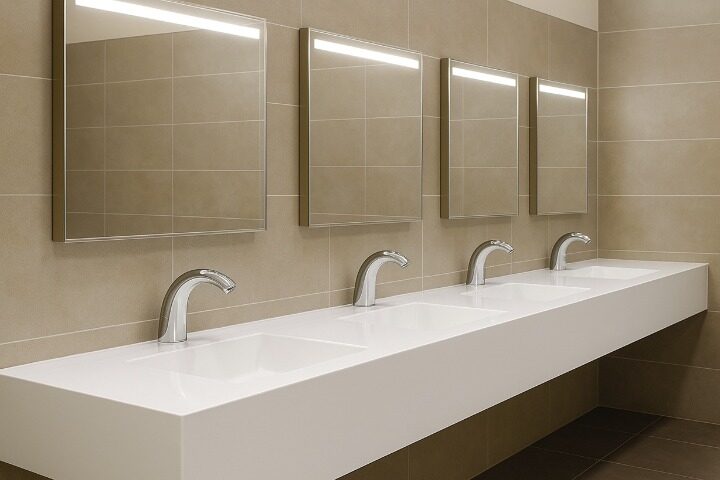
Integration of Design into Architectural Projects
Aesthetic and Spatial Coordination
Touchless faucets are a perfect match for both minimalist and high-performance interiors. Their clean, handle-free profile suits contemporary commercial washrooms and refined hospitality designs. For best results:
- Align faucet spout geometry with basin shape and drain centerline.
- Conceal power and sensor components in cabinetry or wall cavities.
- Coordinate with countertop materials to create visual minimalism.
Mounting and Rough-In Requirements
Sensor faucets may be either deck- or wall-mounted, depending on spatial and aesthetic priorities. Architects should specify:
- Rough-in depth & access panel location for the solenoid and power supply.
- Sensor range clearance: usually 2–5 inches.
- Battery or hardwired-allowing for future service access.

Power Systems and Smart Integration
Battery versus Hardwired
Touchless faucets can be powered by
- Battery (DC): Easier retrofit; replace every 2–3 years depending on use.
- Hardwired (AC/Low-Voltage): Good for new buildings and places where it will be used all the time.
Battery backup is a common feature of hybrid designs that lets them keep working during power outages
Smart Building Integration
Advanced sensor faucets can integrate into Building Management Systems or IoT dashboards so facility managers can:
- Monitor the water consumption in real time.
- Detects leaks or abnormal flow.
- Schedule Maintenance notifications.
Data-driven integration turns plumbing fixtures into measurable sustainability assets and important contributors within smart-building certification frameworks.

Touchless Faucets and the WELL Building Standard
WELL Building Standard v2 encourages design promoting the health, comfort, and hygiene of occupants. Touchless faucets contribute directly to:
- WELL Water Concept: Supporting clean and accessible water delivery. W01, W07
- WELL Comfort & Mind Concepts: Decrease occupant anxiety about shared surfaces and disease transmission.
These systems greatly enhance the user experience within healthcare and hospitality contexts while considering all the principles of wellness design.

Materiality, Maintenance, and Lifecycle Considerations
Durable and Sustainable Materials
The main priorities for sustainable touchless faucets need to be:
- Made of brass or stainless steel (preferably low-lead alloys).
- PVD or powder-coated finishes for extended corrosion resistance.
- Replaceable internal cartridges to extend the product’s life.
Maintenance and Serviceability
Architectural documentation would specify:
- Access panels for solenoid valves and battery compartments.
- Instructions on how to clean the sensor lenses and change filters.
- Long-term availability of spare parts.
Proper detailing ensures performance longevity, which is crucial in lifecycle sustainability and reduced waste.

Integration into Various Types of Projects
| Project Type | Integration Strategy | Sustainability Benefit |
|---|---|---|
| Commercial / Office | Centralized low-flow sensor faucets with hardwired supply | 30–40% water and energy savings |
| Hospitality / Hotels | Wall-mounted or integrated sensor faucets for sleek aesthetics | Enhancing guest hygiene and brand sustainability |
| Healthcare Facilities | Splash-mount faucets with sterilizable finishes and antimicrobial aerators | Risk of contamination reduced |
| Educational / Public Buildings | Tamper-resistant, battery-operated units | Long-term water savings; low maintenance |
| Smart Homes – IoT-enabled Faucets | Flow Analytics | Personalized Water Tracking and Conservation |
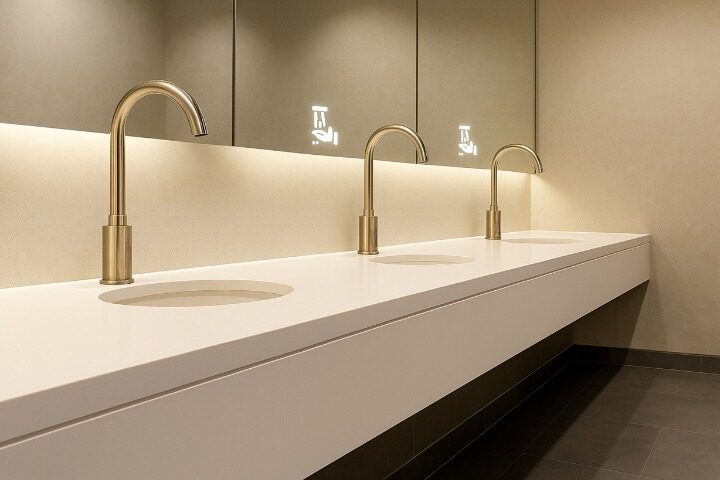
Specifier Checklist for Architects
- Verify flow rate: ≤ 0.5 gpm (public) or ≤ 1.5 gpm (private).
- Select certified products: WaterSense or equivalent.
- Specify mounting type: Deck, wall, or hybrid.
- Specify the power source: Battery, hardwired, or solar-assist.
- Coordinate clearances: sensor field and maintenance access
- Include LEED WE Credit documentation: flow rates, testing data, WaterSense certification.
- Integrate into BIM models: Include sensor and solenoid space allocation.
- Plan for maintenance: access panels and cleaning instructions.
- Commissioning step – Sensor range, flow, and shutoff delay verified
- Document sustainability contribution through water savings estimates in LEED Submittals.

Quantifying the Impact
Studies have shown that substituting touchless faucets rated at 0.5 gpm for standard manual faucets rated at 2.2 gpm can save up to 150,000 gallons per year per building in high-traffic restrooms.
Data of this nature is crucial for reports on sustainable design and could even be used directly in creating documentation for LEED and WELL scoring.

Smart Faucet Technology in Sustainable Building Design
Smart faucet technology is becoming an important part of sustainable building design because it connects water efficiency, hygiene, and long-term facility performance in one fixture. In commercial buildings, hospitality projects, healthcare spaces, and public restrooms, touchless smart faucets help reduce unnecessary water use while creating a cleaner and more dependable user experience.
For architects and specifiers, these systems do more than automate water flow. They support green building goals by improving control over flow rate, reducing wasted hot water, and making restroom planning more responsive to real occupancy needs. When smart faucets are paired with the right basin design, sensor range, and maintenance access, they can improve both sustainability results and day-to-day building operations.
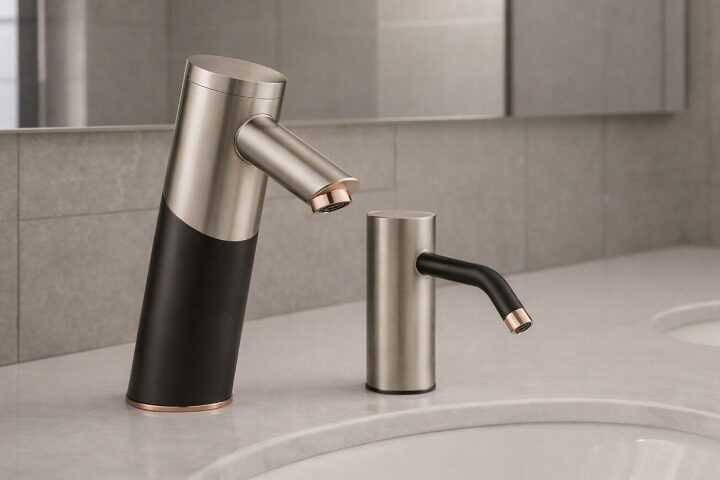
As more projects move toward intelligent and resource-conscious design, smart faucets are being specified as part of a broader strategy for healthier, more efficient buildings. They give project teams a practical way to support sustainability targets while also improving comfort, cleanliness, and operational consistency in high-use spaces.
Conclusion
Touchless faucets represent the shift in sustainable architecture, from static design to intelligent responsiveness. Architects can make a building more eco-friendly by adding these fixtures early in the planning process. This will also make the building cleaner, more comfortable for users, and more efficient in the long run.
As sustainability moves into systems thinking, every drop counts-and every design decision does, too. Integrating touchless faucet technology is a practical, measurable way to merge innovation, conservation, and human-centered design into one seamless experience.


Evan Mercer is a staff writer and editorial team member at architecturalfaucets.com. His work focuses on architectural faucet selection, finish coordination, specifications, and commercial applications, helping translate manufacturer documentation, standards, and industry sources into practical guidance for architects, designers, specifiers, and facility professionals.