Architect-focused, code-referenced, sustainability-driven. Full URLs are kept for transparent citation and specification workflows.

Water Efficiency by Design: Why Flow Rate Now Shapes Architecture
Water efficiency is a defining feature of contemporary architectural design. With increasing resource scarcity and regulation in cities, architects and specifiers are being called upon to incorporate water-saving technologies directly into plans. One of the simplest but most measurable ways to do this involves faucet flow rate management.
From international codes to voluntary sustainability frameworks like LEED and WELL, faucet flow rates today determine not only compliance but also long-term performance and certification outcomes. This article explores how flow rate regulations influence modern architecture, what architects must know to stay compliant, and how design can support efficiency without compromising aesthetics.

Understanding Faucet Flow Rate Regulations
The flow rate of a faucet, measured in gallons per minute or liters per minute at a given pressure, usually 60 psi, specifies how much water flows through it. Regulating this rate has become one of the cornerstones of water-conserving policies worldwide.
The Energy Policy Act of 1992 in the US requires that all lavatory faucets installed in new construction or renovation cannot exceed 2.2 gpm at 60 psi.
Still, sustainability programs and revised plumbing codes have since called for more stringent efficiency targets:
- WaterSense® Standard by EPA: ≤ 1.5 gpm (5.7 L/min) at 60 psi for private lavatories.
- Public lavatories: ≤ 0.5 gpm (1.9 L/min) at 60 psi (commonly referenced in modern code paths).
- California Title 20 (CEC): ≤ 1.2 gpm (4.5 L/min) at 60 psi for lavatory faucets.
- European standards (EN 816): performance and mechanical durability expectations for taps.

Why Flow Rate Regulation Matters in Architecture
Faucet efficiency impacts several design and performance dimensions:
- Environmental: Reduced consumption decreases the demand on municipal water systems.
- Operational: Reduced hot-water use lowers energy demand for heating.
- Economic: Facility owners benefit from reduced water bills and maintenance.
- Design integration: Low-flow technology has to be integrated into architectural aesthetics.
Design professionals have to balance regulatory requirements with functional comfort, user experience, and measurable conservation.

Flow Rate Benchmarks and Fixture Types
| Fixture Type | Baseline (EPAct 1992) | Current Efficient Standard | Ultra-Low Flow Option | Common Application |
|---|---|---|---|---|
| Private lavatory faucet | 2.2 gpm | ≤ 1.5 gpm (WaterSense) | 1.0–1.2 gpm | Residences, hotel suites |
| Public restroom faucet | 2.2 gpm | ≤ 0.5 gpm | 0.35 gpm | Offices, malls, airports |
| Kitchen faucet | 2.2 gpm | ≤ 1.8 gpm | 1.5 gpm | Residential and commercial kitchens |
| Metering faucet | 0.25 gallons per cycle | — | — | Institutional and public restrooms |

Designing with Low-Flow Faucets: Performance and Aesthetics
New low-flow faucets use aerators, laminar flow devices, and pressure-compensating valves to maintain usable performance with less water volume.
Key design techniques
- Aerators: Mix air with water to provide a fuller stream at reduced volume.
- Laminar flow: Useful for healthcare or lab environments requiring splash-free, non-aerated flow.
- Pressure compensators: Maintain consistent output across variable pressures.
Architectural coordination
- Confirm sink depth and spout height to prevent splash-back at low flows.
- Coordinate with mechanical engineers on supply pressure consistency.
- Detail faucet height and reach relative to basin geometry for usability.
Integrated properly, low-flow fixtures support both design quality and sustainability metrics without sacrificing comfort.

How Faucet Flow Rates Matter for LEED and WELL
LEED v4.1 Water Efficiency: Indoor Water Use Reduction
LEED rewards projects that reduce indoor water use by at least 20 percent, with additional points for higher reductions. Low-flow faucets and sensor systems are frequently among the easiest fixtures to standardize to hit these targets.
WELL Building Standard v2
WELL evaluates fixture performance and hygiene behaviors. Touchless and low-flow faucets can support compliance with WELL Water concept criteria, depending on project approach and documentation.

Global and Regional Code References
United States
- International Plumbing Code (IPC): Flow rate limits and performance requirements by fixture type.
- Uniform Plumbing Code: Related limits and performance testing references in many jurisdictions.
European Union
- EN 816: Performance and mechanical durability references for taps.
Australia and New Zealand
- WELS: Star ratings based on fixture flow rates.
Middle East
- Estidama and GSAS: Efficiency-driven systems that encourage low-flow fixture selection.
Each system reflects the same direction: water efficiency is now part of architectural quality and long-term performance.

Specifier Strategies for Architects
To hit compliance and real performance, keep these strategies in your spec workflow:
- Spell out flow rates in schedules and fixture notes.
- Require certification documentation: WaterSense, ASME A112.18.1 and CSA B125.1, or regional equivalents.
- Validate supply pressure assumptions with the mechanical team.
- Model indoor water use early if pursuing LEED points.
- Use sensor faucets where high traffic or hygiene goals justify them.
- Detail maintenance access for aerators and sensors.
- Verify flows after installation as part of commissioning.

Quantifying the Environmental Impact
Example calculation
A standard 2.2 gpm faucet replaced with a 0.5 gpm sensor faucet saves 1.7 gallons per minute. If used for 30 seconds per activation at 100 uses per day: daily savings = 85 gallons, or roughly 31,000 gallons per year per fixture.
- Reduced energy for water heating
- Lower operational costs
- LEED and WELL credit alignment support
- Cleaner reporting for sustainability targets

Specifier Checklist: Water Efficiency by Design
- Reference the governing code path: IPC, UPC, EN 816, or regional equivalent.
- Include flow-rate limits in the plumbing fixture schedule.
- Select certified products: WaterSense, CSA, ASME, WELS, and relevant local marks.
- Coordinate faucet and sink ergonomics to prevent splashback.
- Confirm pressure and aerator compatibility with the mechanical team.
- Align specifications with LEED WE and WELL Water criteria where applicable.
- Document savings using manufacturer data and modeling tools.
- Include commissioning and flow verification in closeout documentation.
- Standardize fixture selections by zone where possible.
- Review and update specs as regulations evolve.

Smart Faucet Technology and Intelligent Building Performance
Smart faucet technology is now a practical part of intelligent building design because it improves water control, touchless hygiene, and daily facility performance at the same time. In offices, hotels, healthcare spaces, airports, and other high-traffic buildings, these systems help reduce unnecessary water use while creating a cleaner and more reliable restroom experience.
For architects, specifiers, and facility teams, the benefit goes beyond automatic activation. Well-planned smart faucets can support sustainability goals, improve user comfort, and reduce maintenance issues through better sensor response, controlled flow timing, and easier access for service. That makes them a strong fit for projects focused on long-term efficiency and smarter building operations.
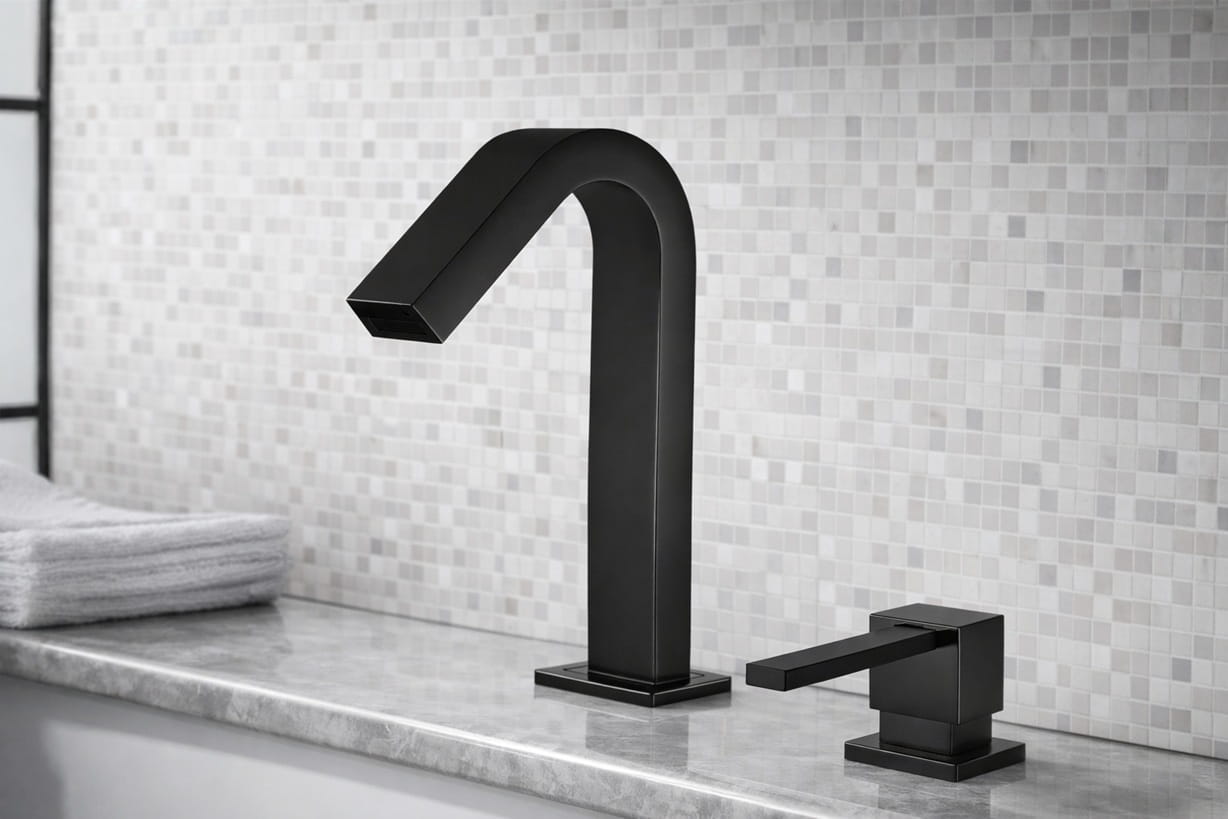
As intelligent buildings continue to prioritize performance-based design, smart faucet systems are becoming part of a wider strategy for healthier, more efficient spaces. When paired with the right sink layout and fixture specification, they can improve both occupant experience and overall restroom performance.
Conclusion
Flow rate regulation is no longer only a plumbing issue. It is a design decision that influences compliance, user experience, sustainability outcomes, and long-term operating cost. By specifying water-efficient faucets that meet local codes and recognized standards, architects can reduce environmental impact while keeping design intent intact.
Water efficiency by design is the hallmark of modern architecture: every detail, down to the drop, reflects purpose and responsibility.

