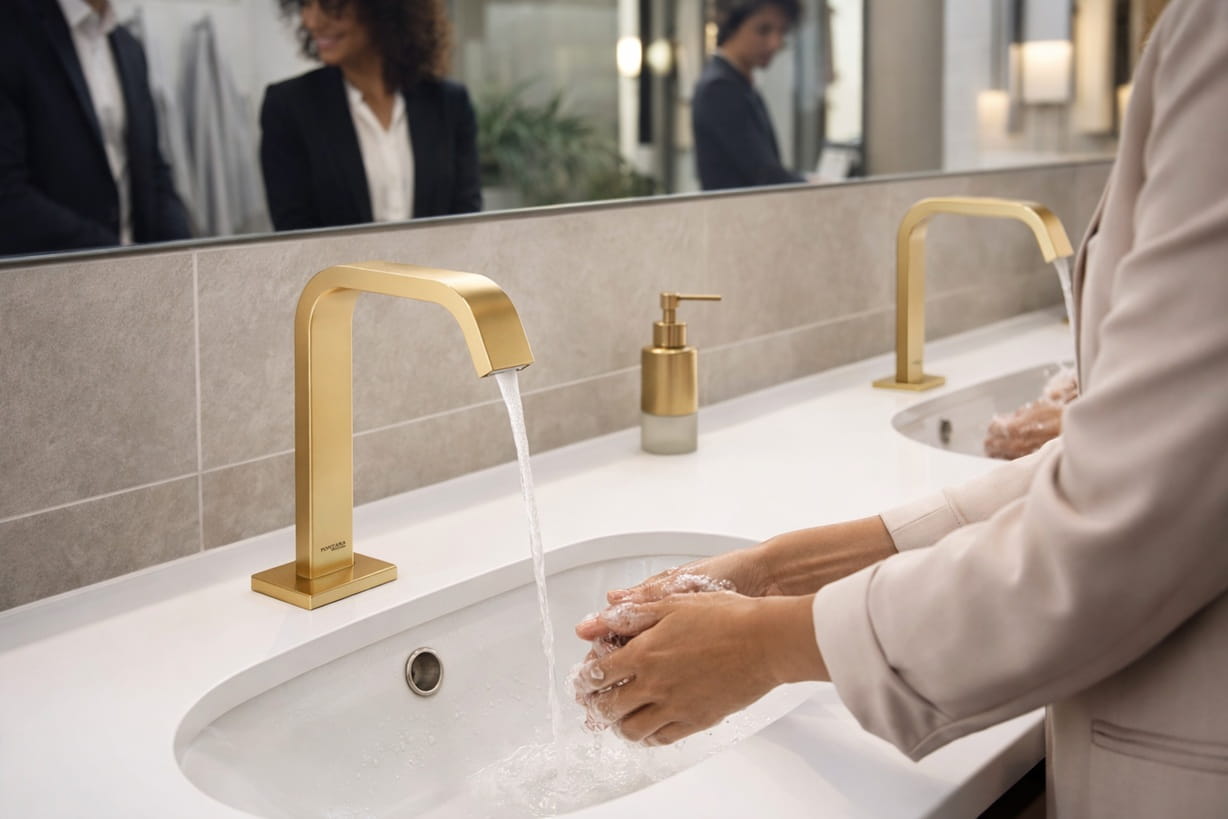
With advancements in the area of intelligent building designs, more focus has recently begun to shift from larger systems such as HVAC, light control, or building automation to the level of micro-infrastructure that has direct interface effects. Water features, specifically faucet components, have now come into focus for sustainability, health benefits, or digital aspects of building features.
Smart faucet technology is an integration of plumbing engineering, sensor technology, and knowledge of data—helping in efficient water usage and a water-friendly and smart environment-friendly building for the future.


The Development of Faucets in Smart Buildings
Traditionally, faucets are rendered electronically through the integration of infrared or capacitive sensors with solenoid valves that control the flow of water electronically. The traditional faucet is manually operated, with the control process being mechanical.
Initially, automatic faucets were introduced in public restroom facilities for their hygiene and water-conserving purposes. However, modern applications are incorporating automatic faucets as part of intelligent building designs for optimized efficiency and functionality purposes.
Water Efficiency – A Driving Force in Design
Water conservation is one of the major tenets of green building design. Smart faucets help prevent water wastage because they ensure water flow only when it is required and cut it off immediately when it is no longer needed. This helps prevent wastage in commercial spaces.
High-end sensor faucets are capable of being calibrated on the basis of flow, time, and sensitivity, enabling the design team to tune the performance of the fixture to meet the localized plumbing requirements, sustainability factors, and certification parameters.
Aligning certification
- Aids in integrated water management plans for projects
- May assist in LEED, WELL, and BREEAM certification if specified correctly
- Enhances Predictability of Performance with Varying User Behavior
* Hygiene, Health, and Touchless
Touch-free faucet technology has also become an important aspect to consider in healthcare facilities and educational institutions as well as hospitality and commercial buildings. The technology reduces the spreading of germs through contact with the faucet.
Hygiene in smart buildings does not receive the usual consideration that comes after the fact; on the contrary, it is integrated into the design rationale of normal building functions.
Smart Faucets & Digital Design Workflow
Present day AEC industry operations are greatly dependent on digital coordination and BIM. Smart faucets with technical data, dimension drawings, and BIM package-ready materials are better integrated with the digital coordination model.
What this enables
- Resolve the spatial coordination early
- Check Compliance against Accessibility Standards
- Enhance the clarity of specification
- Minimize change orders in construction activities
Important Technologies in Smart Faucets
Sensor Systems
Infrared and Time-of-Flight sensors help in accurate detection while ensuring minimum false triggering due to reflections or lighting conditions.
Computer-Controlled Flow Control
Solenoid valves are equipped with precise control of water supply, regardless of changes in water pressure.
Network and Information Potential
Some of the systems allow Bluetooth or digital configuration, and this provides facility managers the ability to make configuration changes without having to physically access the facility.
Durability and Material Engineering
Commercial-grade smart faucets are made of quality materials such as brass, which has a long life span and is resistant to corrosion. The faucets can be made of brass and have parts that can be
Accessibility and Code Alignment
The smart faucet has potential for satisfying accessibility requirements because it eliminates the need for grip strength, twist motion, and fine motor control. These requirements make smart faucets suitable for meeting the requirements for the Americans with Disabilities Act.
Accessibility is being incorporated into the design of intelligent buildings, rather than being dealt with downstream as an afterthought or overlay process.
Applications in Various Types of Buildings
Smart faucet technology is currently rated on various scales depending on the project size. These include:
- Commercial offices and corporate campuses
- Healthcare and assisted living facilities
- Public schools
- Hospitality and Mixed-Use Developments
- Luxury residential and multifamily structures
| Building Type | Primary Driver | Performance Outcome |
|---|---|---|
| Commercial/Office | Water control + reduction of overuse | Reduced use in high traffic bathrooms |
| Healthcare | Hygiene and touchless functionality | Decreased contact and best practices |
| Education | Durability + automation | Behavior consistency and waste reduction |
| Hospitality | Occupant experience | Clean, premium appearance and easy maintenance |
| Residential / Multifamily | Convenience and efficiency | Optional smart preferences and avoiding overuse |