
The Evolution of Sensor Faucets in Architectural Spaces
Sensor faucets moved from niche to baseline because they changed more than touch points. Today, you are selecting sensing behavior, control logic, power strategy, and service access.
In real projects, performance is not just a spec sheet number. A faucet can meet a rated flow and still frustrate users if activation is inconsistent or run time is too short. The best results come from treating the fixture as a small control system that has to work reliably in reflective finishes, mixed lighting, and tight basin layouts.
Use this page as a quick way to align design intent with install reality: predictable detection, water efficiency targets, access for service, and station workflow.


Why this evolution matters in real specifications
Sensor faucets used to be a specialty fixture reserved for airports and other high traffic restrooms. Now they are part of typical restroom packages. The key shift is that a sensor faucet is a small control system. It affects water delivery, hygiene support, and maintenance planning.
Early products reduced touch points and limited faucets left running, but field issues appeared fast: false activation, missed activation, short run times, and hard-to-access electronics.
Better performance came from shaping detection zones and improving control logic so hands in the wash position trigger reliably and background motion does not.
Flow rate and shutoff behavior matter in real use. Two faucets can share the same rated gpm and still use very different total water if false triggers and run-time behavior differ.
In commercial projects, stable activation and service access for solenoid, filter, and electronics are what reduce complaints and downtime.
Some newer approaches support flushing schedules, abnormal run-time alerts, and usage insights, especially in campuses, healthcare, and multi-site portfolios.
If activation is inconsistent or run time is too short, users shorten the wash. Soap and drying placement affects flow and bottlenecks. Treat the station as one workflow.
What to watch for
- Predictable activation in reflective and mixed lighting environments
- Adjustable sensing distance and timeout behavior
- Run time that supports complete handwashing
- Service access without removing the entire faucet
- Power strategy aligned to traffic and staffing
AEC specification checklist for sensor faucets
Standards and compliance
- Confirm alignment with ASME A112.18.1 and CSA B125.1 references.
- Confirm lead related compliance expectations, including NSF 372 where required.
Water performance
- Rated flow at project-relevant pressure
- Stable performance across expected pressure variation
- Anti-drip behavior and shutoff logic
Sensor and controls
- Adjustable sensing distance
- Adjustable timeout and maximum on-time
- False activation rejection in tight layouts
Power and maintenance
- Battery life assumptions aligned to traffic
- Hardwired option where appropriate
- Service access and clear troubleshooting steps
User experience
- Activation speed
- Run time that supports proper handwashing
- Temperature control strategy and mixing approach
Category page source links
All links open in a new tab. Button styling keeps the page clean and easy to scan.
FontanaShowers
JunoShowers
BathSelect
Note: Link provided as a category reference. Replace or add more BathSelect categories if needed.
fontanatouchlessfaucets
Support documents and reference links
Spec note: Treat the faucet as a maintainable system
Include commissioning controls, access to solenoid and filter, and a power plan that matches traffic. This reduces callbacks more than chasing extra sensor sensitivity.
Design note: Hygiene is a workflow
Fast activation and correct run time matter, but so does station layout. Place soap and drying so the user flow stays smooth and does not create a bottleneck.
How Smart Faucet Technology Supports Better Building Performance
Smart faucet technology is now a practical part of intelligent building design because it improves more than convenience. In commercial restrooms, healthcare spaces, hospitality projects, and public facilities, touchless faucets help reduce unnecessary water use, support cleaner user interaction, and create a more consistent handwashing experience.
For architects, specifiers, and facility teams, the value of a smart faucet is in how it performs every day. Reliable sensor activation, controlled run time, and easy service access can reduce waste, lower maintenance issues, and support long-term restroom efficiency. That makes these fixtures a strong fit for projects focused on sustainability, hygiene, and operational performance.
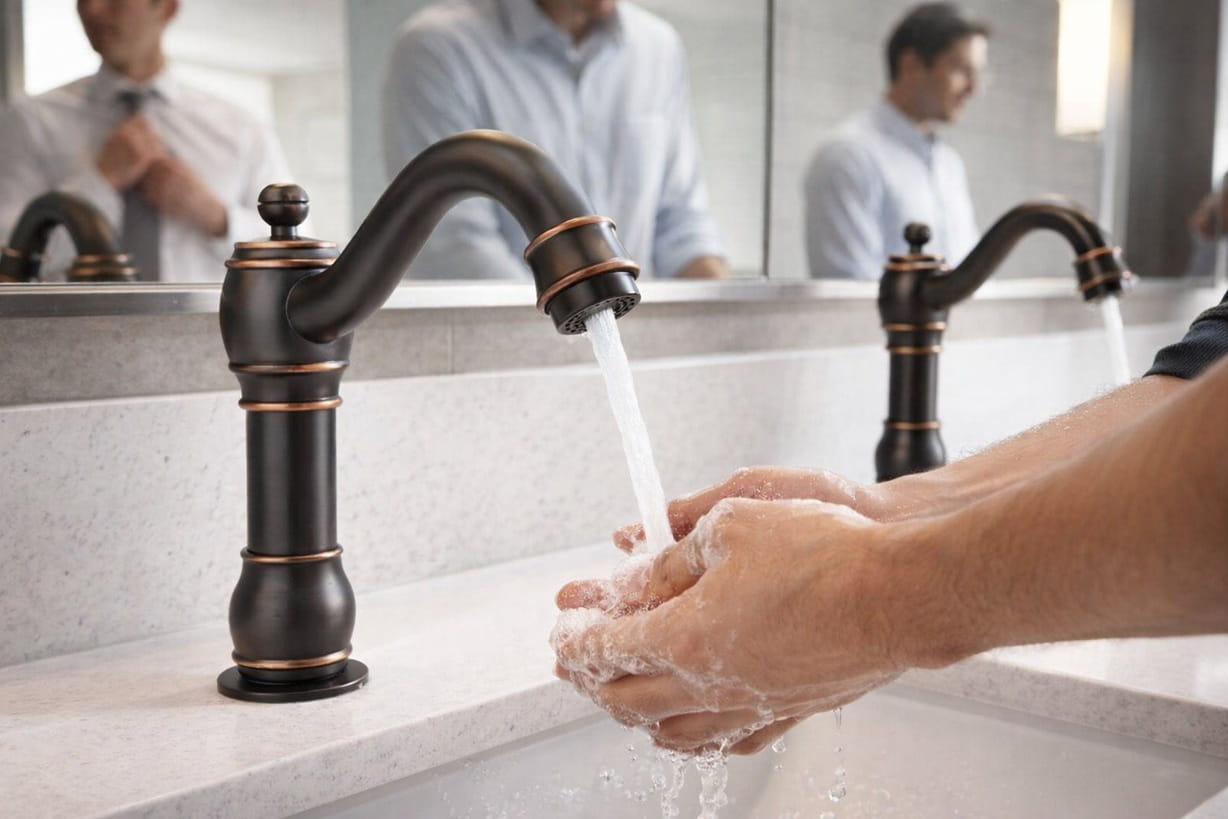
As more buildings move toward connected and performance-driven design, smart faucets are becoming part of a wider strategy that includes accessibility, user wellness, and better control over building resources. When selected carefully, they can support both design goals and day-to-day facility operations.

Karim Rashid is a globally celebrated industrial designer and creative visionary known for redefining contemporary interiors, product design, and commercial environments through his signature philosophy of “Sensual Minimalism.” With thousands of designs produced worldwide, his influence on the AEC industry spans hospitality, retail, residential, and public infrastructure projects where bold aesthetics, ergonomic functionality, and technology-driven experiences intersect. Karim’s expertise includes architectural interiors, furniture systems, lighting, bathroom fixtures, and immersive commercial spaces that combine fluid forms, vibrant materials, and user-focused innovation. Through his futuristic design approach and emphasis on accessible luxury, he provides valuable insight into modern restroom aesthetics, experiential commercial environments, integrated smart design solutions, and the evolving relationship between technology, emotion, and the built environment.