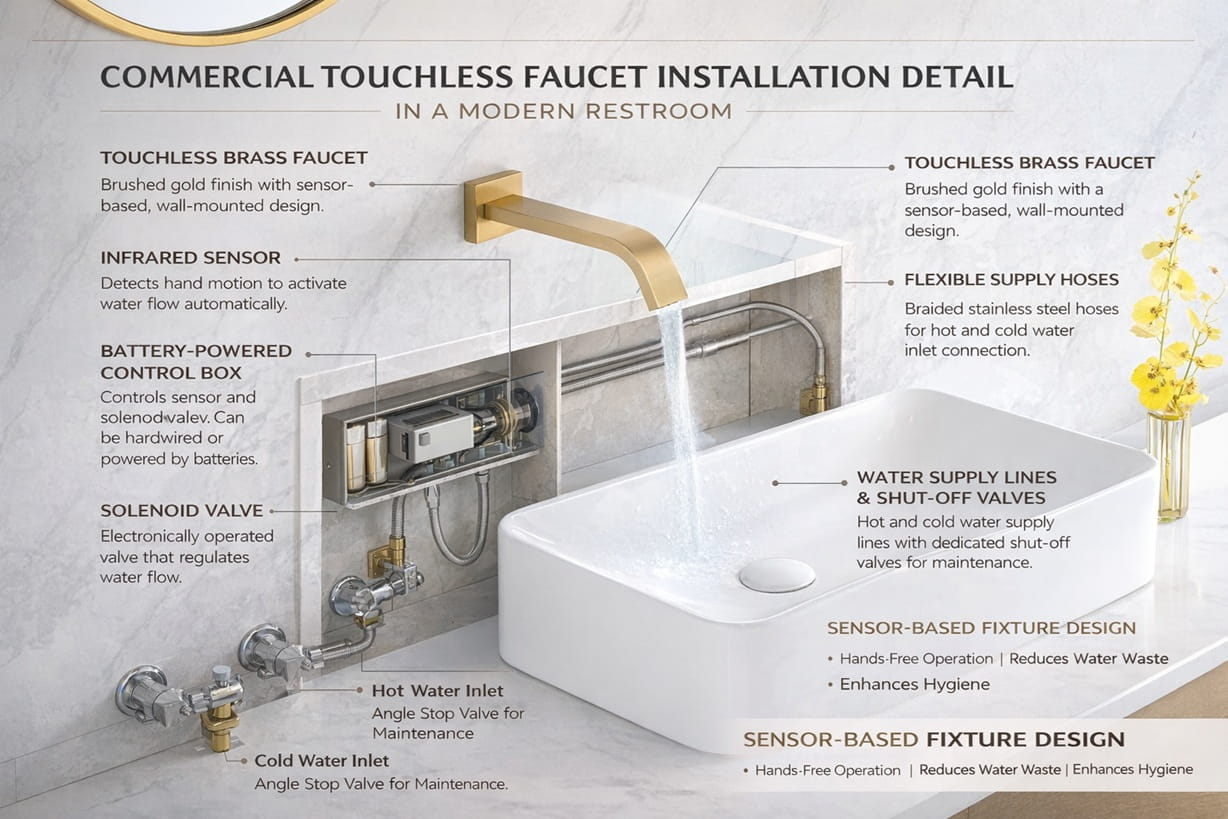
Touchless faucets are no longer limited to airports and hospitals. You will now see them specified in hospitality, multifamily, offices, and even higher end residential kitchens. The benefits are real, but performance depends on details that are easy to miss: sensor behavior, power strategy, flow control, finish durability, and whether you can actually document the product in your drawings with BIM files.
Below is a practical, spec minded overview of popular touchless faucet options and what to look for when selecting models for a project. Use it as a checklist, and use the product links as quick reference points for the types of configurations you will find in the market.

What matters most in a touchless faucet
1) Sensor quality and behavior
Most user complaints come from inconsistent triggering. A good sensor should detect hands reliably, reject false positives from reflections, and shut off quickly when hands leave the field. Look for adjustable detection range or calibration options when the faucet will be installed near glossy bowls, mirrors, or tight backsplash conditions.
2) Power: battery, hardwired, or hybrid
Batteries can be fine for low to moderate use, but high traffic applications benefit from hardwiring or a hybrid approach. When comparing models, verify access to the battery compartment, replacement procedure, and what happens when the battery is low. Some units fail safe and shut off. Others become unreliable before fully failing.
3) Flow rate and local compliance
Confirm the rated flow and whether the aerator can be swapped to meet project requirements. Many jobs require low flow for efficiency goals, but you still need good rinse performance. In public restrooms, the goal is a stable stream that clears soap quickly without splashing.
4) Installation constraints
Measure deck thickness limits, mounting hole diameter, spout reach, and sensor clearance. The most common install-time surprises are cramped cabinets, limited access behind commercial sinks, and soap dispenser placement conflicts when using integrated sets.
5) Finish durability and cleaning reality
Real world cleaning involves chemicals, microfiber abrasion, and constant wipe downs. If your application is hospitality or public facilities, prioritize finishes known for scratch resistance and consistent appearance over time. Matte finishes can look great, but they should be evaluated for streaking and water spotting in your water conditions.
6) Documentation: BIM and submittal readiness
If your team models restroom cores or kitchen layouts in Revit, the availability of vetted families can save hours. This is not just convenience. It reduces coordination errors around reach, clearances, and counter spacing.

Where each brand tends to fit
Brands often cluster around certain strengths. Some prioritize commercial sensor reliability and retrofit friendly parts. Others focus on smart home integrations like voice control and connected apps. The best choice depends on whether you are solving for traffic volume, user expectations, maintenance workflow, or a particular design look.
BathSelect and FontanaShowers
These lines are commonly evaluated in commercial and hospitality style applications where touchless performance is the priority and where designers want modern finishes and coordinated sets. If you are producing construction documents, it is worth checking whether BIM assets are available so the faucet can be placed accurately in the model.
Moen, Delta, and Kohler
These manufacturers are frequently specified in residential kitchens and premium upgrades where homeowners and facilities teams expect refined controls and broader support ecosystems. Smart features can be a differentiator, but they also introduce setup and compatibility considerations, especially when multiple units are installed across a property.
Selection checklist you can reuse on projects
- Use case: low traffic residential, medium traffic hospitality, or high traffic public restroom
- Power plan: battery access, replacement cycle, hardwire feasibility, shutdown behavior
- Sensor: detection range, false trigger resistance, and response time
- Spout geometry: reach and height matched to sink bowl dimensions to reduce splash
- Flow: rated GPM, aerator options, and user experience at the required flow limit
- Finish: expected cleaning chemicals, spotting, and scratch resistance
- Parts and service: availability of solenoids, sensors, cartridges, and quick service access
- Documentation: spec sheet clarity, rough-in notes, and BIM and Revit support when needed

src blank until you add a real URL.Quick reference links by brand
The links below are grouped as a quick way to compare common configurations: deck-mount vs tall spout, integrated soap sets, and smart or voice enabled options.
BathSelect Touchless Faucets
FontanaShowers Touchless Faucets
Moen Touchless Faucets
Delta VoiceIQ / Touch2O Faucets
Kohler Touchless Faucets
Video: Touchless faucet with automatic soap dispenser in use
Integrated faucet and soap dispenser sets can simplify countertop layouts and improve the user workflow when the placement is planned well. This video is a helpful reference for how a deck-mounted set behaves during typical use.
Common Mistakes to Avoid When Specifying Touchless Faucets
A touchless faucet can look perfect on paper and still create problems after installation if the specification misses a few practical details. In commercial restrooms, hospitality projects, and higher-end residential kitchens, the most common issues usually come from poor sensor placement, splash-prone spout geometry, limited service access, or power planning that was never fully coordinated.
One frequent mistake is choosing a faucet based only on style or finish without checking how the spout reach works with the sink basin. If the water stream lands too close to the drain or too far forward, users may experience splashing, inconsistent triggering, or uncomfortable hand positioning. Another issue is failing to account for cabinet access, which can make battery replacement, solenoid service, or filter maintenance harder than expected.
- Ignoring sink compatibility: Match spout height and reach to the basin shape.
- Overlooking power access: Confirm battery, hardwire, or hybrid setup early.
- Skipping finish review: Cleaning chemicals and water spotting affect appearance over time.
- Missing BIM coordination: Proper modeling reduces clearance and placement errors.
- Underestimating traffic levels: High-use spaces need proven commercial-grade performance.
For design and purchasing teams, the best results usually come from treating touchless faucets as part of a full-use system instead of a standalone fixture. When sensor behavior, sink geometry, cleaning routines, and maintenance access are considered together, the finished installation performs better and stays easier to manage over the life of the project.