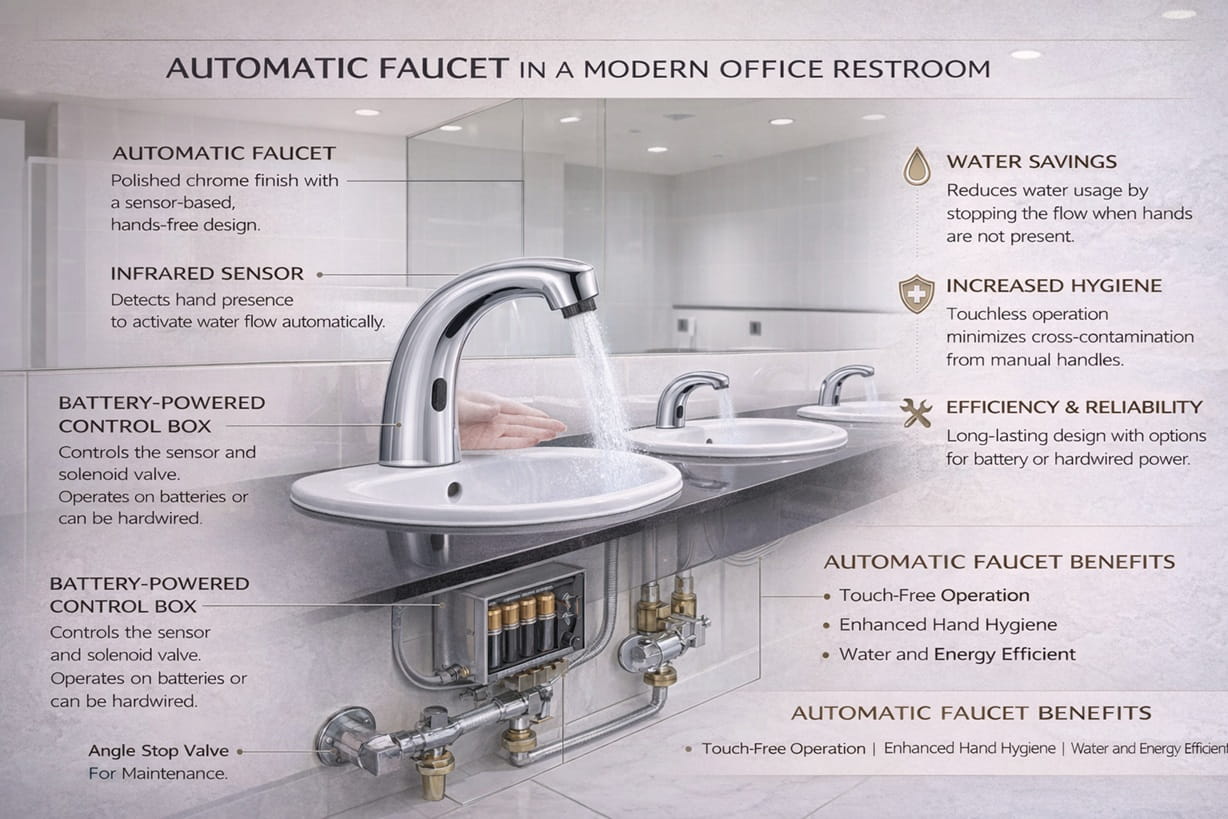
Which is better for contemporary office restrooms? Here is what research indicates regarding water usage, hygiene, costs, and maintenance.

Water Consumption: Varied Findings
A 2016 study conducted at Sacramento State University evaluated manual faucets against automatic models equipped with 0.5 and 0.35 GPM aerators. The results:
- Automatic at 0.5 GPM: Approximately 32% water savings compared to manual
- Automatic at 0.35 GPM: Approximately 54% water savings compared to manual
Nevertheless, previous research from Florida and the UK observed that when automatic faucets operated at higher flow rates, they sometimes consumed up to 30% more water than manual faucets.
Commercial Building Impact
FontanaShowers’ 2022 study across 15 commercial buildings found:
- Average water savings: ~35%
- Office-specific: ~32% reduction
- Hospitals: ~40% savings
Savings were driven by reduced run-on times due to automatic shut-off
National-Level Savings Examples
- Alliance for Water Efficiency: ~30% reduction in public restrooms
- UC Berkeley campuses: ~48% savings
- Chicago Public Schools: ~37% reduction
- Chicago office retrofits: ~45% savings
If you publish these percentages, keep a short “how measured” note (metered use vs modeled, time window, baseline fixtures).
Hygiene & Health Impacts
Touchless fixtures reduce contact and lower pathogen spread.
- Sensor-based systems cut bacterial surface counts by up to 90%
- Installations in offices show a 20–30% reduction in sick leave and improved employee satisfaction
Reminder: healthcare contamination findings are often tied to low-use conditions, aerators, and maintenance practices. Offices usually behave differently when fixtures see frequent use and programs include flushing and cleaning.

Pros & Cons Overview
| Aspect | Automatic Faucets | Manual Faucets |
|---|---|---|
| Water Usage | Can save 30–50% with proper aerators; may waste if poorly calibrated | User-controlled, may underflow or leave running |
| Hygiene | Touch-free reduces contamination | Handles can harbor pathogens |
| Cost & Maintenance | Higher upfront; needs sensors and batteries | Lower cost, simpler |
Conclusion for Office Buildings
Automatic faucets are generally better for:
- Automatic faucets tend to be better in offices when you care about water savings, especially if you use those low-flow aerators (anything between 0.35 and 0.5 GPM). You also get fewer germs floating around in shared restrooms, and, let’s be honest, they just feel a bit more modern.
However, success depends on:
- The key is picking sensor systems that actually use little water (low GPM) and aren’t junk. And yeah, you’ve got to keep up with maintenance, or you’ll be dealing with annoying malfunctions. Factor in up-front costs and the long haul, sometimes the savings take a while to show up.
Peer-reviewed studies and real-life building case series (2010–2022).
Best Practices for Office Restrooms
- Use automatic faucets with low-flow aerators (no more than 0.5 GPM).
- Ensure faucets are used frequently or flushed regularly to prevent stagnation and the growth of germs.
- Put sensor faucets in high-traffic spots for better hygiene.
- Look at the true lifetime costs: sensors, batteries, repairs versus how much water (and money) you save.

Video
Embed kept as-is, centered.
Source links used
All sources used are from solid institutional research and peer-reviewed or hospital-lab reports.
Related product pages
How Offices Get Better Results from Automatic Faucets
In office buildings, automatic faucets usually deliver the best results when they are selected as part of a broader restroom strategy instead of as a simple hardware upgrade. Water savings depend on more than the faucet being touch-free. Flow rate, shut-off timing, sink compatibility, traffic patterns, and maintenance routines all influence how well the system performs in daily use.
For many facilities teams, the biggest advantage is consistency. A well-calibrated sensor faucet can reduce unnecessary run time, improve hygiene in shared washrooms, and create a cleaner user experience for employees and visitors. In high-use office restrooms, this can support both sustainability goals and a more modern building standard.
- Low-flow setup: Models in the 0.35 to 0.5 GPM range often provide stronger water savings.
- Reliable shut-off: Better sensor timing helps reduce waste after handwashing is complete.
- Routine flushing: Regular use or scheduled flushing helps avoid stagnation in low-use restrooms.
- Easy maintenance: Clear access to power, sensors, and service parts keeps downtime lower.
- User perception: Offices often value the cleaner, more updated feel of touchless fixtures.
Manual faucets can still make sense in smaller or lower-budget spaces, but in most contemporary office environments, automatic faucets are often the stronger long-term option when performance, hygiene, and water control are priorities. The key is to specify products with dependable sensor behavior and a maintenance plan that matches the building’s traffic level.