
In today’s built environment, faucets are much more than plumbing accessories: key design components in contemporary interior architecture, integrating form, function, materiality, sustainability, and technology. Architects and specification professionals working on premium residential, hospitality, or commercial projects need to understand how faucets contribute to the architectural narrative.

Why Faucets Matter Architecturally
What seems like a small fixture becomes a juncture between human experience, material systems and architectural language. As one author concludes:
While essentially a functional fitting, bathroom faucets have become highly significant in contemporary architectural expression through their influence on design and integration with interior aesthetics, not to mention embracing the most advanced technology.
The faucet, in its contemporary usage within interior spaces, has to do much more: it needs to align with spatial proportions, reinforce the material palette, meet evolving performance standards for hygiene, water efficiency, and durability, and often acts as a subtle or dramatic design statement. Unmoored from mere utility, they’re components of architectural expression.

Faucets as Architectural Expression

>An increasing trend is for faucets to be designed as miniature sculptures that reflect the wider architecture of the space. One marketplace article highlighted how architects/designers are collaborating with faucet makers:
- Sculptural spouts whose geometries reflect architectural form or site-inspiration
- Finishes and textures that match or contrast with surrounding surfaces (including stone, tile, and metalwork)
- Installation types that change how the fixture sits in space: wall-mount, spout flush to slab, and deck-mounted
When specified with intentionality, a faucet can serve as a visual anchor, reinforcing the style-minimalist, industrial, luxury-spa-of the architecture rather than playing passive background.
Integration of Technology, Performance & Sustainability
Today, faucets are a building’s performance ecosystem, not just about aesthetics. Key trends include:
Water-efficient and low-flow designs reduce potable water usage while meeting green building certification criteria.Because architecture now emphasizes sustainability and performance, faucets are no longer optional accessories; they’re very much a part of the specification dialogue between design, plumbing, environmental/MEP, and facility teams.

Materiality, Finish and Scale in Architectural Context
From an architectural perspective, the selection of faucet material, finish and scale has tangible implications for spatial quality:
- Material harmony: Brushed brass could go well with warm wood or stone finishes while stainless steel or matte black would suit more industrial contexts.
- Finishes must be coordinated with other hardware and architectural metalwork.
Minimalistic restraint, elegant proportions, and refined craftsmanship.

The Role of Installation Type in Spatial Architecture
Installation style affects how the faucet relates to space and architecture:
- Wall-mount faucets: Keep countertops clear and accentuate wall planes.
- Deck-mounted faucets: Traditional but requires precise hole-spacing.
- Floor-mounted mixers: part of luxury architecture.

Specifier Checklist for Architects
- Confirm that the architectural style of the faucet coincides with the overall design language.
- Verify spout height, reach and installation type appropriate to basin.
- Ensure finish, material and texture coordinate with adjacent finishes.
- Request documentation for finish durability and water-efficiency rating.
- Review mounting and plumbing requirements early.
- Think about how the faucet will look with lighting.
- Ensure replacement part availability.
- Prioritize hygienic operation for high-use environments.

Smart Faucets and the Evolution of Interior Architecture
The rise of smart faucet technology is reshaping how architects think about fixtures in contemporary interiors. Touchless faucets combine precision engineering with discreet technology, allowing designers to maintain clean spatial compositions while introducing advanced functionality. In hospitality environments, offices, and high-end residential spaces, these systems support both aesthetic clarity and operational efficiency.
From an architectural standpoint, smart faucets contribute to a broader shift toward responsive environments. Sensors regulate water flow automatically, reducing waste while improving hygiene in shared spaces. Their minimal control interfaces—often eliminating visible handles—also support the visual simplicity that defines many contemporary interiors.
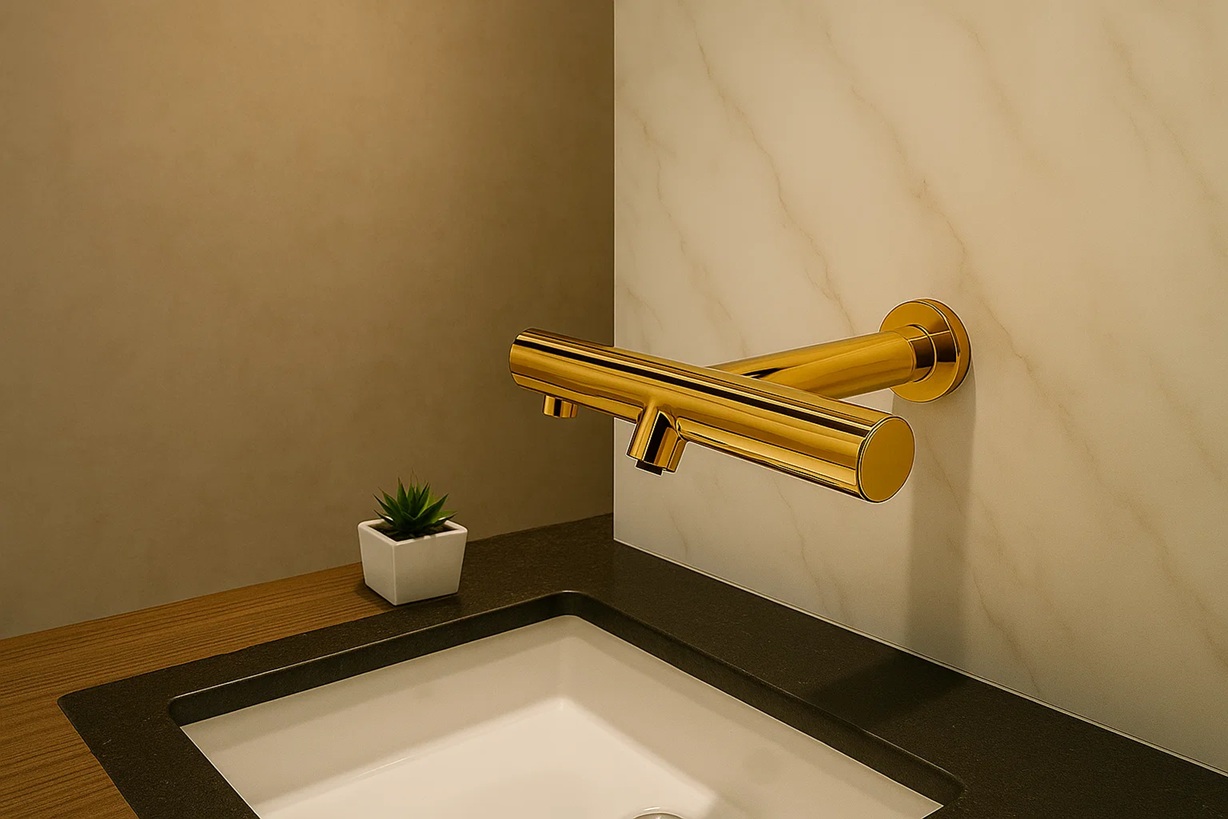
As interior architecture increasingly integrates technology, sustainability, and user experience, smart faucets represent a natural evolution of the fixture. When thoughtfully specified, they function not only as plumbing components but as subtle technological elements that reinforce the modern architectural language of the space.
Conclusion
The faucet is far more than a functional plumbing component in contemporary interior architecture; it is an integral piece of the design puzzle that links together aesthetics, materiality, ergonomics, performance, and building systems. Faucets that are specified and detailed thoughtfully can support the architectural narrative, elevate user experience, enhance sustainability performance, and reinforce the built quality of a space.
For professionals on ArchitecturalFaucets.com, it means treating the faucet not as an after-thought, but as a design element to be integrated early in the architectural process—from concept through documentation, installation and maintenance.


Karim Rashid is a globally celebrated industrial designer and creative visionary known for redefining contemporary interiors, product design, and commercial environments through his signature philosophy of “Sensual Minimalism.” With thousands of designs produced worldwide, his influence on the AEC industry spans hospitality, retail, residential, and public infrastructure projects where bold aesthetics, ergonomic functionality, and technology-driven experiences intersect. Karim’s expertise includes architectural interiors, furniture systems, lighting, bathroom fixtures, and immersive commercial spaces that combine fluid forms, vibrant materials, and user-focused innovation. Through his futuristic design approach and emphasis on accessible luxury, he provides valuable insight into modern restroom aesthetics, experiential commercial environments, integrated smart design solutions, and the evolving relationship between technology, emotion, and the built environment.