
In an increasingly water-scarce world, resource-efficient buildings are no longer optional; they are imperative. To architects and specification professionals, the design and selection of faucets represent more than aesthetics; they are a very real lever for water conservation and overall sustainable building performance. This article explores how faucet design and specification can support water-conservation goals and how architects can integrate best-practice strategies into their projects.

Why faucets matter in water-conservation strategy
“Water-saving technologies and design principles integrated into modern architectural projects have the ability to contribute much toward saving this precious resource.”
In other words, selecting efficient faucet design is not all about limiting flow; it is all about matching a building’s water-use strategy, reducing energy for water treatment/heating, lowering operating cost, and achieving green-building certifications.

1. Key design features of sustainable faucets
- Low-flow aerators and flow restrictors: Aerators mix air into the stream, reducing actual water volume while maintaining perceived pressure.
- WaterSense® or equivalent certification Faucets certified for water efficiency allow designers to document performance.
- Sensor/touchless operation: Reduces unattended flow and supports hygiene in public/commercial contexts.
- High-efficiency internal valve mechanisms that ensure minimal leakage and lifecycle efficiency.
- Durable materials and finishes: Longer service life means fewer replacements, less waste.
“Buildings for water conservation can also be designed with effective cooling systems that utilize the least amount of water.”

2. Architectural specification strategies for water conservation
Set performance criteria early
Specify maximum allowable flow rates for each zone: lavatory faucets ≤ 1.5 gpm, sensor faucets shut off within 10 s of inactivity, aerator design ≤ 0.5 gpm for high-use restrooms.
Correlate with water-use modeling
Roll in faucet counts, flow, and use hours in your project’s water-use budget to estimate savings aligned with LEED or WELL goals.
Specify durable product design
Durability means fewer replacements, less waste, and better long-term conservation. Ensure servicing access and document the specifications clearly.
Coordinate with plumbing and water-reuse systems
Ensure that faucets are greywater reuse compatible and installation drawings indicate as such.
“Water conservation in architecture is about designing buildings that reduce water usage as well as environmental impact significantly.”

3. Integration in architectural design and detailing
- Coordinate handle type and flow controls for efficient use.
- Ensure spout reach and basin relation to minimize splash.
- Align the faucet mounting with visual and functional design.
- Document the fixture groupings by zone.
- Design for retrofits that improve efficiency.

4. Sustainable metrics and case study insights
- Low-flow and sensor faucets reduce consumption by as much as 40%.
- Evaluate life-cycle (materials, manufacturing, servicing, replacement).

5. Specifier Checklist: Sustainable Faucet Design
- Specify maximum flow rate for each faucet type.
- Water-efficiency certification required (WaterSense® or equivalent).
- Choose models with aerators or sensors.
- Ensure that the materials and finishes are durable.
- The design of faucets should be aligned with the water strategy of the building.
- Include faucet data in water-use models.
- Coordinate installation details with the drawings.
- Specify commissioning and maintenance in the specifications.
- Specify cleaning and auditing routines.
- Document projected savings and behavioral design cues.

Smart Faucet Technology and Water Conservation in Modern Buildings
Smart faucet technology is increasingly supporting water-conservation strategies in modern buildings. In commercial offices, hotels, healthcare facilities, and public restrooms, sensor-based faucets help limit unnecessary water flow while maintaining consistent performance for daily users. By automatically activating only when needed, these fixtures reduce waste and support measurable efficiency goals.
For architects and specification teams, integrating smart faucets into sustainable design strategies can strengthen overall water-management planning. When paired with efficient aerators, low-flow valves, and durable materials, smart faucets help reduce potable water consumption while improving hygiene and maintenance efficiency in high-traffic environments.
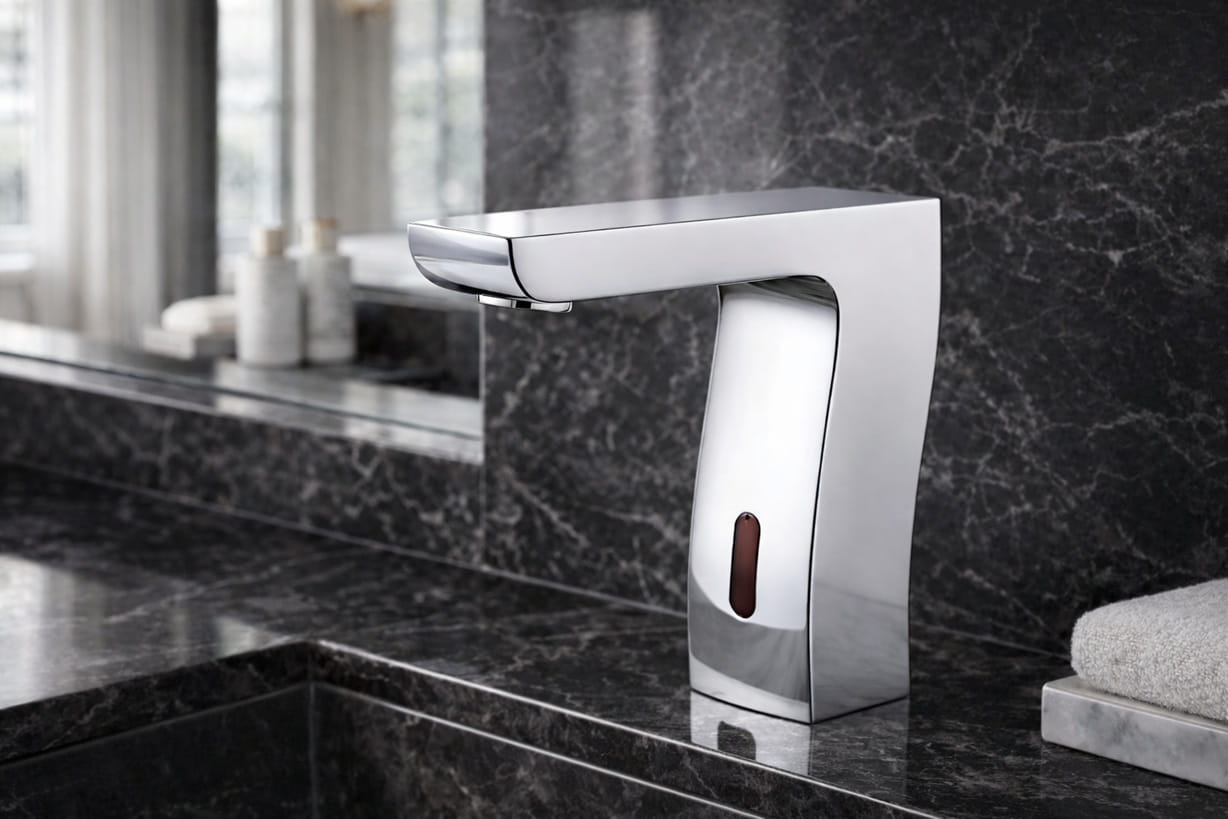
As sustainable architecture increasingly relies on performance-driven design, smart faucet systems are becoming an important tool for reducing water use while maintaining usability. When specified correctly, they allow architects to support environmental goals without compromising aesthetics, comfort, or long-term building performance.
Conclusion
Architects have a powerful opportunity to influence water consumption through faucet design and specification. When faucets are chosen not just on form but on performance, and when installation, commissioning, and maintenance are all aligned with conservation goals, the potential impact can be great.
Design for sustainable faucets means balancing system thinking-water flows, user behavior, and maintenance-with architectural thinking-materiality, form, and integration. For the professionals at ArchitecturalFaucets.com, taking a sustainability perspective on faucet specification raises the fixture well above “just a tap” to a strategic building component-and meaningfully contributes to conserving our planet’s most vital resource.


Philippe Starck is a world-renowned French designer and architect celebrated for his groundbreaking influence on contemporary architecture, product design, and hospitality environments within the global AEC industry. Known for his philosophy of “Democratic Design,” he combines creativity, functionality, and accessibility to create spaces and products that merge technological innovation with everyday human experience. His expertise spans luxury hospitality, residential developments, modular architecture, furniture systems, lighting, and premium bathroom fixture design that emphasize minimalism, sustainability, and emotional connection. Through his visionary and unconventional design approach, Philippe provides valuable insight into modern commercial restroom aesthetics, experiential interior environments, eco-conscious product integration, and the evolving relationship between technology, design, and human-centered architecture in contemporary built spaces.