
Touchless Restroom Design Standards for Modern Stadium Architecture
Modern stadium restroom design is no longer a back-of-house issue. It is part of the fan journey, the accessibility strategy, the maintenance plan, the sustainability brief, and the long-term operating model. For architects, engineers, owners, and construction teams, touchless restroom systems now sit at the intersection of crowd movement, hygiene, water control, ADA coordination, finish durability, and lifecycle cost.
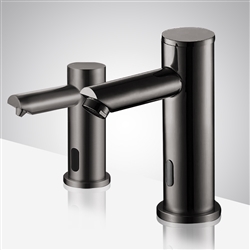
This AEC blog page connects contemporary stadium restroom planning with Fontana touchless faucets, coordinated automatic soap dispensers, chrome commercial finishes, and venue-ready fixture standards. The goal is to help stadium project teams create restrooms that feel clean on opening day and remain efficient through years of event traffic, cleaning cycles, seasonal peaks, and future renovations.



Why stadium restroom standards must start at the master-planning level
Stadium restrooms are exposed to unusual demand curves. A typical commercial building spreads restroom use throughout the day, while a stadium compresses demand into short windows: pre-event arrival, halftime, inning breaks, intermissions, rain delays, post-event exit, and concert changeovers. These peaks place pressure on every part of the restroom system: entry visibility, queuing depth, fixture count, faucet activation, soap access, counter layout, custodial reach, waste collection, floor drainage, and post-event reset time.
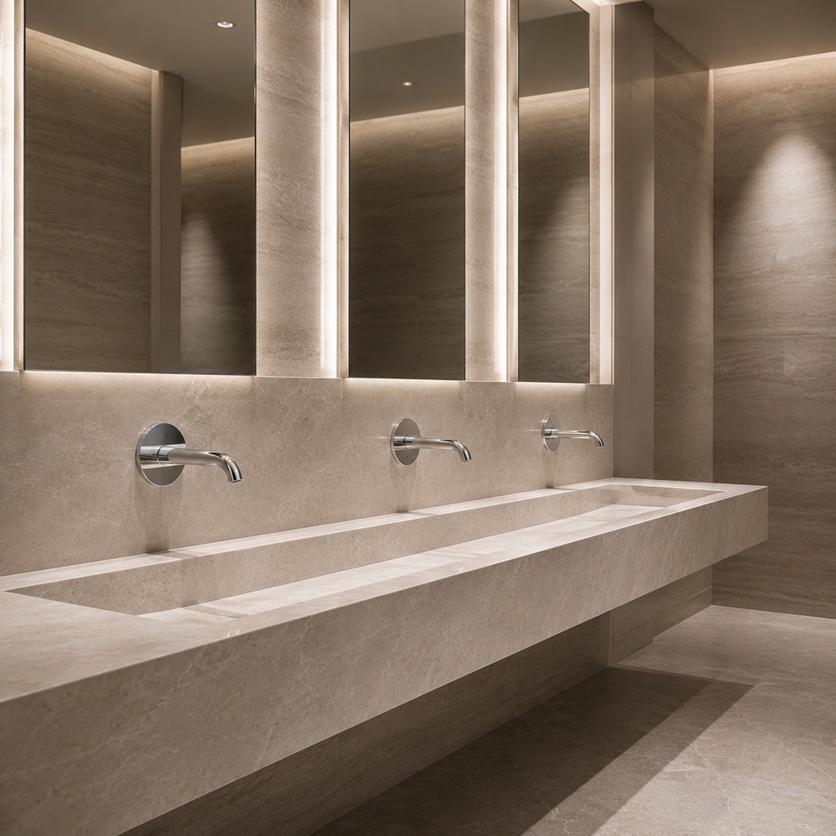
Because of those surges, restroom design standards should be documented early with the same discipline used for seating bowls, concourses, concessions, and egress. The lavatory zone should not be treated as a row of sinks inserted after the plan is complete. It should be a coordinated service wall with touchless water delivery, soap placement, mirror heights, lighting, maintenance access, durable finishes, and accessible approaches. When the lavatory wall is standardized, the facility team can inspect, clean, and repair it faster across multiple concourse levels.
Fontana touchless faucet systems support this planning model because they allow AEC teams to specify a consistent hands-free user experience across premium clubs, general-admission concourses, family restrooms, staff areas, suites, locker-adjacent spaces, and back-of-house zones. Consistency matters in stadiums. It helps fans understand how to use fixtures quickly, reduces lingering at the sink line, and gives operations teams fewer variations to maintain.

Minimum touchless restroom design criteria for AEC teams
| Design area | AEC standard to coordinate | Fontana connection | Operational benefit |
|---|---|---|---|
| Fixture banks | Align faucets, basins, soap dispensers, mirrors, waste points, and lighting into repeatable modules. | Use coordinated touchless faucet and automatic soap dispenser families. | Faster specification, easier cleaning, and fewer spare-part variations. |
| Peak movement | Locate lavatory zones to reduce cross-traffic between entry, stalls, sinks, and exit paths. | Hands-free activation helps users move through the handwashing sequence with less delay. | Shorter dwell time at the counter and better flow during halftime or intermission. |
| Accessibility | Coordinate clear floor space, knee and toe clearance, reach range, pipe protection, and sensor detection. | Specify faucet heights and sensor fields that work for seated and standing users. | More inclusive restrooms with fewer post-installation corrections. |
| Hygiene | Reduce shared touch points at water controls and soap stations. | Touchless faucets and automatic soap dispensers remove manual handle contact. | Cleaner perceived environment and better handwashing experience. |
| Maintenance | Plan access to batteries, power, valves, aerators, soap reservoirs, and service panels. | Standardized models simplify routine inspection and replacement. | Reduced downtime and more predictable facility operations. |
Accessibility: design the touchless sink zone as an integrated system
Accessible restroom planning is more than placing one compliant sink at the end of a counter. For stadiums, the accessible lavatory should be part of the normal restroom sequence so users are not forced into awkward side routes, hidden corners, or conflict points. The clear floor space, bowl position, faucet reach, soap dispenser reach, hand-drying location, mirror position, and adjacent circulation all have to work together.
The official ADA framework for lavatories and sinks includes requirements for accessible approaches, knee and toe clearance, rim or counter height, exposed-pipe protection, and faucet controls. AEC teams should verify final details with the project code consultant and authority having jurisdiction, but the design intent is straightforward: users should be able to approach, reach, operate, and leave the fixture without barriers.
Touchless technology can support accessible design when it is coordinated carefully. Sensor faucets should activate reliably for different body positions and hand heights, while soap dispensers should not be mounted beyond comfortable reach. In a stadium, this is especially important because restrooms may be used by children, elderly guests, fans with mobility devices, guests carrying merchandise, and people moving quickly between event segments.
Fontana fixture families help architects keep the accessible sink zone visually consistent with the rest of the restroom. Instead of making the accessible position look like an afterthought, teams can maintain the same finish language and product character while adjusting mounting, spacing, and counter conditions to meet code.
Accessible touchless lavatory checklist
- Clear forward approach at accessible lavatories.
- Knee and toe clearance below the counter or bowl.
- Sensor range tested from seated and standing positions.
- Soap dispenser mounted within accessible reach.
- Pipe protection and no sharp surfaces below.
- Lighting that helps users see sensor locations quickly.
- Mirror and hand-drying position coordinated with circulation.
Hygiene, crowd flow, and long-term operations
Cleaner contact sequence
Touchless faucets and soap dispensers reduce the need for users to touch faucet handles after using the restroom. In stadiums, where thousands of visitors may use the same fixture bank in a short event window, this helps support a cleaner and more confidence-building handwashing experience.
Controlled water use
Sensor activation can help limit unnecessary running water when users walk away quickly or children leave faucets open. Water control is especially important in venues with many lavatory stations distributed across several levels.
Repeatable maintenance
When the same faucet and soap dispenser logic is repeated across the facility, operations teams can train staff once, stock fewer parts, and inspect rooms more quickly after each event.
Long-term efficiency is where stadium restroom standards become most valuable. Durable finishes, consistent sensor logic, accessible service points, and coordinated fixture modules reduce the cost of ownership. The best specifications anticipate cleaning chemicals, heavy use, vandal resistance, replacement access, and future expansion. In this context, touchless fixtures are not just hygiene upgrades; they are operational infrastructure.


How Fontana solutions map to stadium design objectives
Fontana touchless faucets and automatic soap dispensers can be specified as part of a full restroom performance strategy. For new stadiums, they help establish a modern design baseline from the start. For existing venues, they can support phased restroom upgrades where fixture banks are modernized without changing the entire building. The same logic applies to theaters, arenas, campus stadiums, entertainment districts, and performance venues that experience intermittent high traffic.
The Las Vegas MLB Stadium and UNL Memorial Stadium Fontana reference pages connect directly to stadium-scale planning. The Virginia Architectural Faucets and Hershey Theater pages broaden the design context into cultural and performance venues, where high-traffic restrooms must balance public visibility, durable finishes, and architectural character. Across all of these settings, the common goal is to deliver a restroom that looks coordinated, functions intuitively, and remains manageable for facilities teams.
Best-fit applications
- General concourse restrooms
- Club and suite restrooms
- Family and companion-care restrooms
- Locker-adjacent public zones
- Premium hospitality and sponsor areas
- Back-of-house staff restrooms
Specification priorities
- Chrome or coordinated finish durability
- Hands-free faucet and soap activation
- Consistent mounting across fixture banks
- Accessible reach and sensor response
- Serviceable power and maintenance access
- Spare-part consistency across the venue


Fontana Project Links
Use these verified Fontana pages as the core internal link set for the article.
 www.fontanashowers.com
Las Vegas MLB Stadium Touchless Faucets
Stadium-scale restroom planning reference for high-capacity professional baseball venues.
www.fontanashowers.com
UNL Memorial Stadium Chrome Touchless Faucets
Chrome touchless faucet reference for college stadium and game-day crowd restroom upgrades.
www.fontanashowers.com
Virginia Architectural Faucets
Architectural faucet reference for cultural and performance venue restrooms.
www.fontanashowers.com
Hershey Theater Pennsylvania
Commercial touchless bathroom faucet project reference for an historic theater setting.
www.fontanashowers.com
Las Vegas MLB Stadium Touchless Faucets
Stadium-scale restroom planning reference for high-capacity professional baseball venues.
www.fontanashowers.com
UNL Memorial Stadium Chrome Touchless Faucets
Chrome touchless faucet reference for college stadium and game-day crowd restroom upgrades.
www.fontanashowers.com
Virginia Architectural Faucets
Architectural faucet reference for cultural and performance venue restrooms.
www.fontanashowers.com
Hershey Theater Pennsylvania
Commercial touchless bathroom faucet project reference for an historic theater setting.
Related Link
These related resources support fixture selection, touchless product comparison, commercial restroom planning, and accessibility coordination.
www.fontanashowers.com
Fontana Touchless Faucets & Automatic Soap Dispensers
High-traffic touchless fixture overview for architects, designers, and contractors.
www.fontanashowers.com
Commercial Touchless Faucets Collection
Commercial faucet gallery for fixture-selection review.
www.fontanashowers.com
Touchless Faucets & Automatic Soap Dispensers
Coordinated touchless faucet and soap dispenser solutions.
www.fontanashowers.com
Touchless Bathroom Faucet
Touchless bathroom faucet planning and product category reference.
www.fontanashowers.com
Touchless Faucets for Commercial Buildings
Commercial-building hygiene and hands-free faucet reference.
www.fontanashowers.com
Best Touchless Sensor Faucets
Sensor faucet product reference for commercial specification comparisons.
www.ada.gov
2010 ADA Standards for Accessible Design
Official accessibility standards reference for public accommodations and commercial facilities.
www.access-board.gov
U.S. Access Board Lavatories and Sinks Guide
Official guide for lavatory clear floor space, knee clearance, and operable parts.
Verified Stadium Architecture Links
populous.com
Populous Designs for New Aramco Stadium
www.gensler.com
Al-Ahly Stadium Brings Fans Closer to
www.gensler.com
Al-Ahly Stadium | Projects | Gensler
architizer.com
Sports Architecture
www.bbc.com
Manchester United's new stadium: Are
www.oatfoundry.com
The Best Stadium Design: Better Fan
www.novatr.com
World's Greatest Stadium Designs
www.archdaily.com
Sports Architecture | ArchDaily
www.architecturaldigest.com
Atlanta Falcons Brand
www.hok.com
Jacksonville Jaguars Unveil Plans for
constructionmanagement.co.uk
Manchester United: how stadium design
FAQ
Why are touchless faucets important in modern stadium restrooms?
They reduce hand contact at one of the busiest points in the restroom, support faster handwashing, improve perceived cleanliness, and help operators control water use during peak crowd surges.
Should stadiums use the same faucet model throughout the venue?
Standardization is usually beneficial because it simplifies maintenance, training, spare parts, and replacement. Premium areas can still use upgraded finishes or coordinated models while keeping the same activation logic.
How do touchless fixtures support accessibility?
Touchless fixtures can reduce the effort required to operate faucets, but sensor range, mounting height, clear floor space, and soap-dispenser reach must be coordinated carefully so seated and standing users can activate fixtures comfortably.
Where should AEC teams start when planning a stadium restroom upgrade?
Start with user flow, fixture count, accessibility requirements, maintenance access, existing utilities, finish durability, and product standardization. Then select touchless faucets and soap dispensers that fit the planned modules.
Conclusion
Touchless restroom design standards are now a practical requirement for modern stadium architecture. The restroom must serve fans quickly, support inclusive access, protect hygiene perception, reduce operational waste, and remain serviceable under demanding event schedules. Fontana touchless faucets, automatic soap dispensers, and commercial fixture families give AEC teams a clear way to connect design intent with operational performance.
For new stadiums, the strongest approach is to coordinate the lavatory system early with concourse planning, restroom counts, accessible routes, materials, power, plumbing, and cleaning protocols. For existing stadiums, fixture-standard upgrades can improve the user experience without requiring a full architectural reset. In both cases, the right touchless standard helps the restroom become part of a modern, efficient, and resilient stadium environment.

Lina Farrow is a staff writer and editorial team member at architecturalfaucets.com. Her work focuses on faucet specifications, materials, installation requirements, and project planning, helping the editorial team turn manufacturer resources, product data, published guidance, and attributable references into practical information for architects, designers, specifiers, and project professionals.