

1. The Essence of Minimalist Faucet Design
Architecture of minimalism focuses on the purity of line, essential form, and a reduction of clutter. Faucets designed for this aesthetic share that DNA: streamlined geometry, concealed mechanisms, and precision engineering.
“Minimalist fixtures remove excess ornamentation, allowing the clarity of form and function to take center stage.
- Cylindrical or rectilinear shapes with consistent radii
- Hidden Aeration and Simplified Levers
- Matte or brushed finishes that softly diffuse the light
- Smooth transitions between faucet body, handle, and spout.
- Proportions aligned to architectural grids and countertop geometry

2. The Architectural Logic of Simplicity
“Architectural simplicity is hinged on precision: fixtures must align with lines of structure, lighting axes, and materials for maintaining visual rhythm.
- Countertop thickness and sink placement
- Wall tile grids and backsplash joints
- Mirror and light alignment
- Clearances that preserve negative space and ease of use

3. Material and Finish as Architectural Language
“Matte finishes promote architectural restraint, hide fingerprints and help the faucet to blend in with its surroundings.
- Brushed Stainless Steel: AISI 304 or 316, combining strength with the industrial feel of brushed metal.
- Matte Black: a neutral anchor that contrasts bright surfaces.
- Graphite or Gunmetal: Imparts appearance of depth, without gloss.
- PVD Brushed Gold: Warmer tone used sparingly to balance cool neutrals.

4. Wall-Mounted and Integrated Faucets: Clean Lines in Practice
“Wall-mounted faucets bring both design minimalism and functional clarity, perfect for sleek, uncluttered bathrooms.”

5. Ergonomics and Spatial Proportion
- Spout reach should be aligned with basin drain centerline.
- Mounting height: 6–10 inches above basin rim for deck mounts; 45–48 inches above finished floor for wall mounts.
- Handle clearance: Minimum 2 inches from backsplash.

6. Minimalism Meets Technology
“Smart faucets are becoming nearly invisible-operated via infrared sensors or hidden touch zones-exuding the same quiet sophistication as architecture.

7. Specifier Guidelines: Designing for Modern Minimalism
- Choose forms that are restrained: cylindrical, squared, or hybrid geometries with fewer joints.
- Material honesty is prioritized: stainless steel or PVD finishes featuring tactile neutrality.
- Minimize excess hardware by using wall-mount, sensor, and hidden handles when possible
- Align geometrically: faucet centerlines should align with basins, mirrors, and tile grids.
- Specify ergonomic height and reach: Validate dimensions in mockups
- Integrate sustainability by using low-flow or sensor faucets that meet or exceed LEED standards.
- Preserve negative space: Avoid overscaled or ornamental fixtures.
- Document mounting details in plans: Especially for wall or integrated configurations.
- Test tactile experience: Simplicity should also feel intuitive and comfortable.

8. Examples of Minimalist Faucet Typologies
| Design Type | Defining Characteristic | Ideal Application |
|---|---|---|
| Wall-Mount Faucet | Clean horizontal line, no deck clutter | Luxury residential, hospitality |
| Single-Lever Faucet | One control, compact form | Residential and office washrooms |
| Sensor Faucet | No handle, hygienic, discreet | Public and wellness spaces |
| Integrated Mirror Faucet | Built-in to surface, zero projection | High-end minimalist environments |
| Freestanding Mixer | Sculptural, vertical clarity | Spa suites or open bath layouts |

Smart Faucet Technology in Minimalist Bathroom Design
Smart faucet technology is increasingly aligning with modern minimalist architecture because it supports both functional simplicity and advanced performance. In contemporary bathrooms and commercial washrooms, touchless faucets eliminate visible controls while maintaining precise water delivery. This combination allows architects to preserve clean lines and uncluttered surfaces while integrating efficient plumbing technology.
From an architectural perspective, smart faucets complement minimalist design principles by reducing visual complexity. Sensor-based activation removes the need for handles, creating streamlined silhouettes that blend seamlessly with wall-mounted basins, floating vanities, and integrated countertop systems. The result is a fixture that supports both aesthetic restraint and improved hygiene.
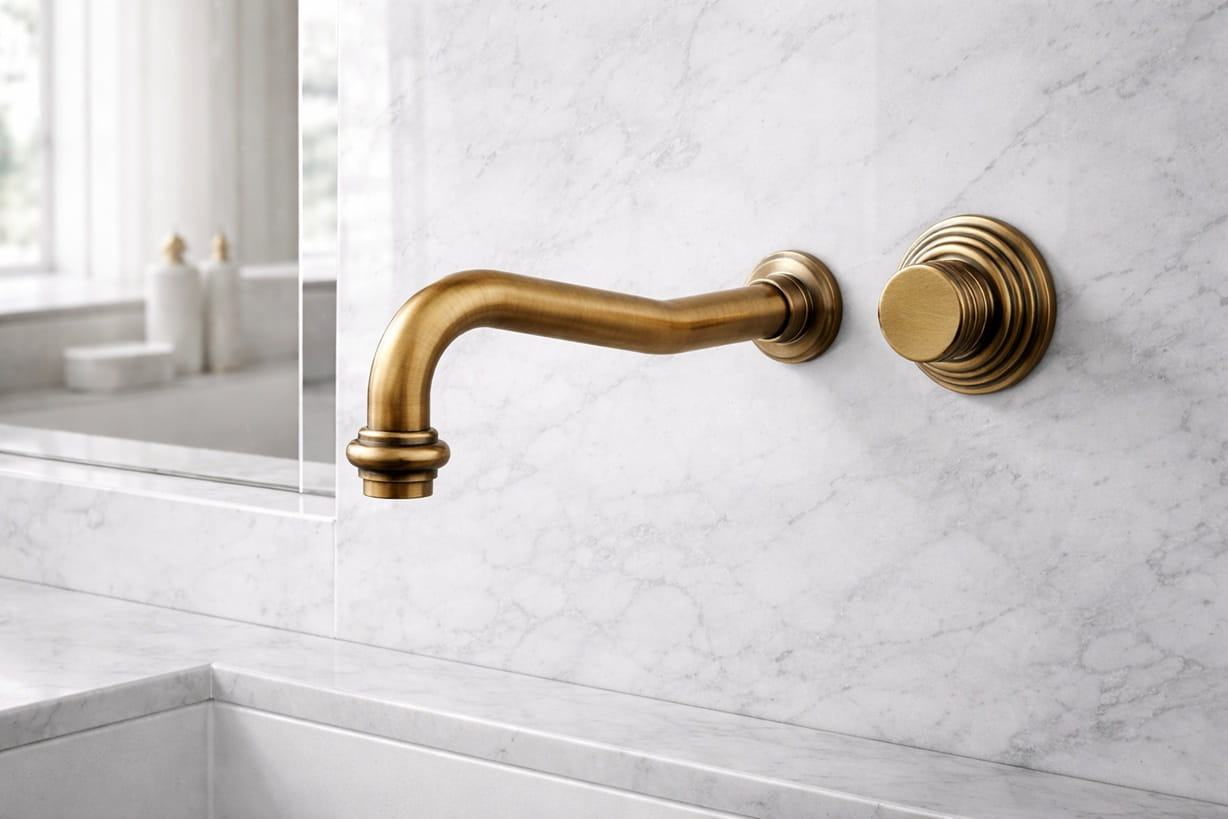
As minimalist interiors continue to prioritize clarity of form and efficient functionality, smart faucet systems provide a natural extension of that philosophy. By combining touchless technology with refined geometry and durable finishes, architects can integrate fixtures that support both visual simplicity and long-term building performance.
Conclusion
The modern minimalist vision for faucets is not about austerity; it’s about precision. Every radius, every seam, every proportion is considered. In the best examples, faucets blend in with the building’s design and become tools for peace, clarity, and stability. Architects and designers who choose minimalist faucets are not only looking for something that looks good; they are also thinking about how to be restrained, how people use things, and how to make things that will last. Even the most basic faucet can be a part of architectural thought if it is done right: quiet, efficient, and very pretty.

