In architectural interiors, “luxury” is usually a coordination outcome: controlled proportions, coherent finish palettes, and fixtures that stay quiet in operation. “Smart performance” is the part that survives commissioning—sensor behavior, flow control, pressure tolerance, and maintenance burden. This comparison evaluates Toto and FontanaShowers using AEC-relevant criteria: sensor system architecture, water efficiency logic, documentation deliverability (spec sheets, install guides, BIM), and operational risk.

What “architectural luxury” means for faucets (beyond looks)
For AEC teams, luxury is not a finish name. It’s repeatability: a suite of fixtures that stays visually consistent across room types, with documentation that makes substitutions harder and closeout easier. The luxury risk is rarely style—it’s drift: a late-stage model swap that changes spout reach, hole pattern, or sensor behavior and triggers splash complaints.
A practical way to keep luxury “architectural” is to select faucets as a coordinated detail package: spec sheet + installation/owner manual + care/maintenance constraints + model verification for efficiency listings.
Smart performance architecture: how the sensor system stays alive
Toto’s signature system-level difference is EcoPower: a water-powered turbine generates current and stores it in rechargeable cells to run the Smart Sensor System. In practical terms, this can reduce battery maintenance in high-traffic restrooms and makes power strategy part of the fixture selection (EcoPower vs AC where available).
FontanaShowers’ sensor faucet documentation commonly supports AC/DC configurations and, in some models, battery override behavior during power failure. That resilience approach matters on projects where uptime is a priority and electrical rough-in constraints vary by building zone.
Water behavior: flow rate, on-demand time, and the real “user experience”
For sensor faucets, gpm is only half the story. The other half is “time-on-water.” Toto’s Standard-R touchless spec language publishes both a maximum on-demand window (often 10 seconds) and a low-flow regulator (example: 0.5 gpm), expressing consumption as gallons per cycle as well as flow rate. That is helpful for water-modeling narratives and for defending performance targets in public restrooms.
FontanaShowers publishes model-specific specs such as inductive sensing distance and flow rate. For example, the FS2210 wall-mount touchless spec lists an inductive distance of 12–15 cm and a flow rate of 1.8 gpm (6.81 L/min), plus suitable water pressure of 0.3–1.2 MPa (≈44–174 psi). In practice, that means project teams should validate actual building pressure, use PRVs where needed, and verify splash control with the selected basin.
A practical specification takeaway when comparing Toto and FontanaShowers
For most architects and specifiers, the better choice is rarely the brand with the strongest visual impression alone. It is the brand that makes the touchless package easier to coordinate, easier to commission, and easier to keep stable after occupancy.
Toto often stands out when a project values a more system-driven approach to power management, low-flow control, and long-term maintenance planning. FontanaShowers can be attractive when the design intent calls for bold visual impact and flexible sensor-faucet options supported by accessible BIM and specification resources. In both cases, the strongest result comes from checking the exact model, the exact basin pairing, and the exact service path.
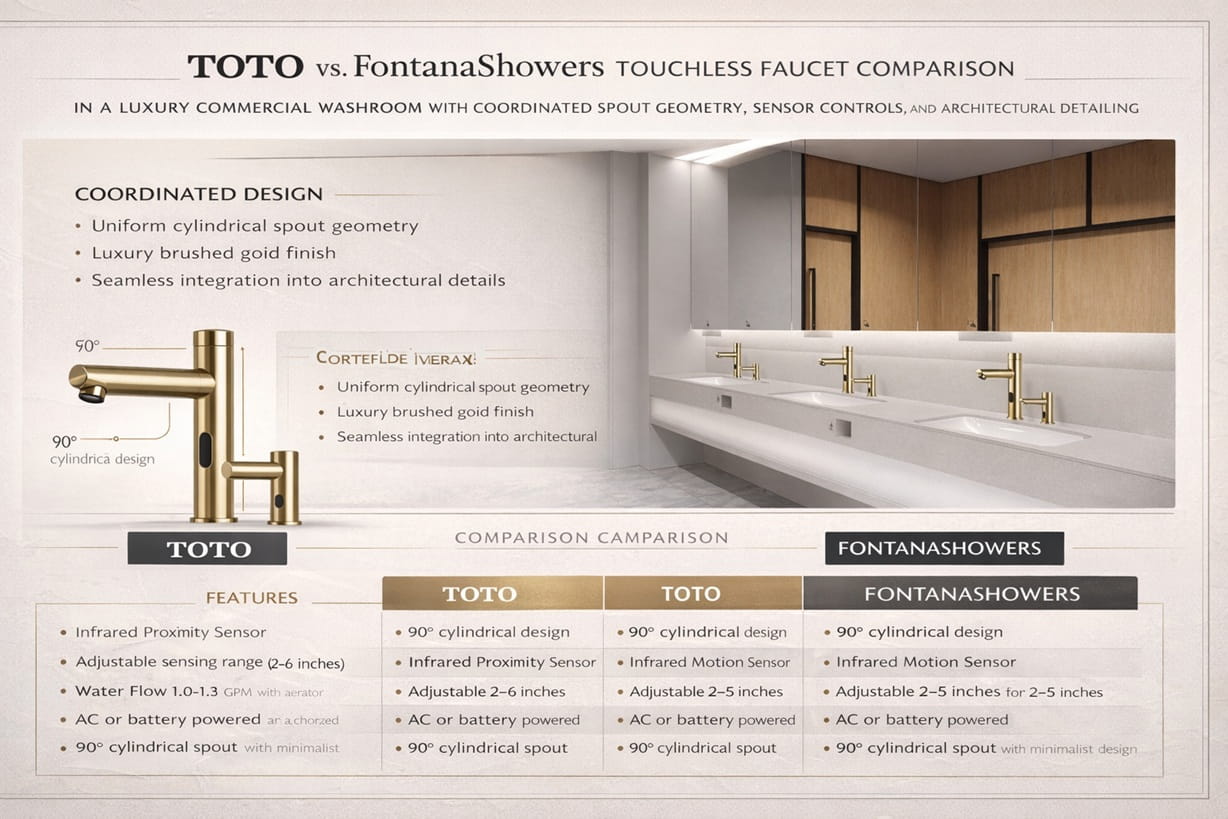
From a content and indexing standpoint, this continuation also helps the article reach more practical search intent. It brings in owner-facing and specification-focused language around commissioning, maintenance, and risk control, which makes the post more useful for design teams and facility decision makers alike.
Commissioning and reliability: what actually reduces service calls
Most early failures in sensor faucets are not “electronics failures.” They’re site condition failures: debris in strainers, incorrect pressure, power configuration mistakes, and sensor detection zones blocked by reflectors or countertop geometry. Toto’s EcoPower installation/owner manual provides a clear baseline: recommended working pressure of 20–80 psi and advice to use a pressure-reducing valve if supply exceeds that range.
FontanaShowers’ sensor documentation includes self-adjust behavior (a short self-test period after battery installation) and time-out logic on some models (example: shutoff when washing time exceeds 1.5 minutes, requiring re-induction). These details are worth capturing in commissioning notes because they change user perception and troubleshooting steps.
Water quality and operations: touchless benefits with a building-science constraint
Touchless operation reduces contact points, which helps hygiene. But sensor fixtures can also create short, intermittent flow patterns that increase stagnation windows in low-use areas. CDC guidance explains that stagnant water can reduce disinfectant levels and bring water temperatures into ranges that support Legionella growth. For projects with building water management requirements, sensor faucet selection should be aligned to monitoring and flushing strategies—not treated as a stand-alone “hygiene upgrade.”
ASHRAE Standard 188 is often used as a risk-management reference for building water systems. Even if your project is not explicitly adopting the standard, it is a useful framing tool to keep fixture selection connected to commissioning, operations, and risk control.

BIM + submittals: how each brand supports architectural delivery
On complex projects, BIM availability is less about “nice-to-have” and more about reducing schedule ambiguity. Toto provides BIM content through common libraries used by design teams. FontanaShowers also publishes BIM/Revit resources and maintains an AEC-focused technical resources hub for touchless systems (spec sheets, commissioning notes, and related documents).
The best practice is identical for both: define a standard submittal packet and refuse incomplete documentation early. At minimum: model number + finish + spec sheet + install/owner manual + maintenance/care notes + BIM/CAD or dimensioned drawings.
Comparison matrix: architectural luxury vs smart performance (what’s worth comparing)
This matrix focuses on what changes coordination outcomes, not what reads like marketing.
| Decision lens | Toto (typical signals) | FontanaShowers (typical signals) | Why it matters in AEC |
|---|---|---|---|
| Sensor power strategy | EcoPower (water-powered turbine + rechargeable storage) and AC options on certain lines | AC/DC options on models; some docs describe battery override for power failures | Controls maintenance burden and uptime planning |
| Time-on-water logic | Published on-demand windows (example: 10 seconds) and gpc-cycle framing | Model-specific time-out logic (example: 1.5 min wash timeout) in some installation docs | Changes user experience and water-use predictability |
| Flow targets | Low-flow regulators common in touchless specs (example: 0.5 gpm) | Model-specific flow rates published (example: 1.8 gpm on a wall-mount sensor spec) | Impacts efficiency goals and splash behavior; verify by model |
| Pressure tolerance | Manual guidance (example: 20–80 psi recommended working pressure) | Specs may state acceptable ranges in MPa (convert and verify with actual site pressure) | Prevents early failures and inconsistent flow |
| Documentation depth | Spec sheets + manuals are typically explicit on sensor and power behavior | Spec sheets + install PDFs; AEC resource hub and handbook for touchless public-building submittals | Reduces RFI volume and closeout friction |
| BIM availability | Available via major BIM libraries | BIM/Revit resources published; also available through BIM libraries | Helps keep schedules and coordination stable |
| Operational water quality risk | Sensor fixtures can increase stagnation windows in low-use areas; align with CDC/ASHRAE risk-management guidance when applicable | Protects health risk management and owner operations plans | |
Specification checklist (brand-flexible, architect-friendly)
- Declare sensor behavior: max on-demand time, shutoff logic, and any purge or auto-flush features.
- Declare power strategy: EcoPower / AC / DC / battery override by project zone, plus service access requirements.
- Require model-level proof: spec sheet + install/owner manual + maintenance/care notes for the exact model and finish.
- Verify water goals: WaterSense listing where required; confirm via EPA directory by model number.
- Commissioning requirement: pressure verification, strainer clean-out, sensor range validation, shutoff verification at handover.
- Water management alignment: for low-occupancy zones, align touchless fixtures with building water monitoring/flushing strategies.
Verified support links & documents
-
 totousa.com • technology
Toto EcoPower (water-powered turbine + rechargeable storage)System-level power concept that changes maintenance planning for touchless restrooms.
totousa.com • technology
Toto EcoPower (water-powered turbine + rechargeable storage)System-level power concept that changes maintenance planning for touchless restrooms. -
totousa.com • overview
Toto Touchless overview (sensor placement + purge feature)High-level behavior framing to translate into spec language and commissioning expectations.
-
totousa.com • PDF
Toto T28S51 spec sheet (0.5 gpm + 10s on-demand + gpc)Model-level evidence for flow and time-on-water behavior—useful for water targets and user-experience planning.
-
totousa.com • PDF
Toto EcoPower faucet manual (recommended 20–80 psi working pressure)Commissioning and reliability baseline: pressure range, setup cautions, and service considerations.
-
fontanashowers.com • PDF hub
FontanaShowers Specifiers Handbook (touchless faucets for public buildings)AEC-oriented support package: submittal checklists, cut sheets, installation guidance, and resource links.
-
fontanashowers.com • resources
Fontana touchless technical resources hub (BIM/spec/install/commissioning)Central hub to keep spec sheets, BIM, install PDFs, and commissioning notes easy to retrieve.
-
fontanashowers.com • PDF
Fontana FS2210 specs (flow rate, sensing distance, pressure range)A concrete spec example for AEC review: gpm, sensor distance, and installation constraints.
-
fontanashowers.com • PDF
Fontana sensor install guide (battery override + wash timeout example)Useful for commissioning notes and for setting owner expectations about timeout behavior.
-
cdc.gov • guidance
CDC: building water system guidance (stagnation, temperature, disinfectant)Supports the operational framing: touchless fixtures should align with water management in low-use zones.
-
ashrae.org • standard overview
ASHRAE 188-2021 overview (risk management for building water systems)Risk-management reference point for linking fixtures to commissioning and operations.
-
epa.gov • program
WaterSense products (efficiency + performance + third-party certification)Use for project documentation and to justify “verify by model number” requirements.
-
nsf.org • directory
NSF lead content directory (NSF/ANSI/CAN 372 listings search)Independent verification pathway when lead-content listing is required in submittals.
