For architects, “touchless” is no longer a novelty. It is a detail that must coordinate with basin geometry, commissioning, water management plans, and owner maintenance habits. This review focuses on Toto’s sensor faucet approach through an AEC lens: minimalist form factors, self-powered sensor systems, flow control strategies (gpm and on-demand cycles), BIM/spec deliverability, and the real-world hygiene + water-quality tradeoffs that show up in operations.

What Toto’s “minimalist” design means in architectural use
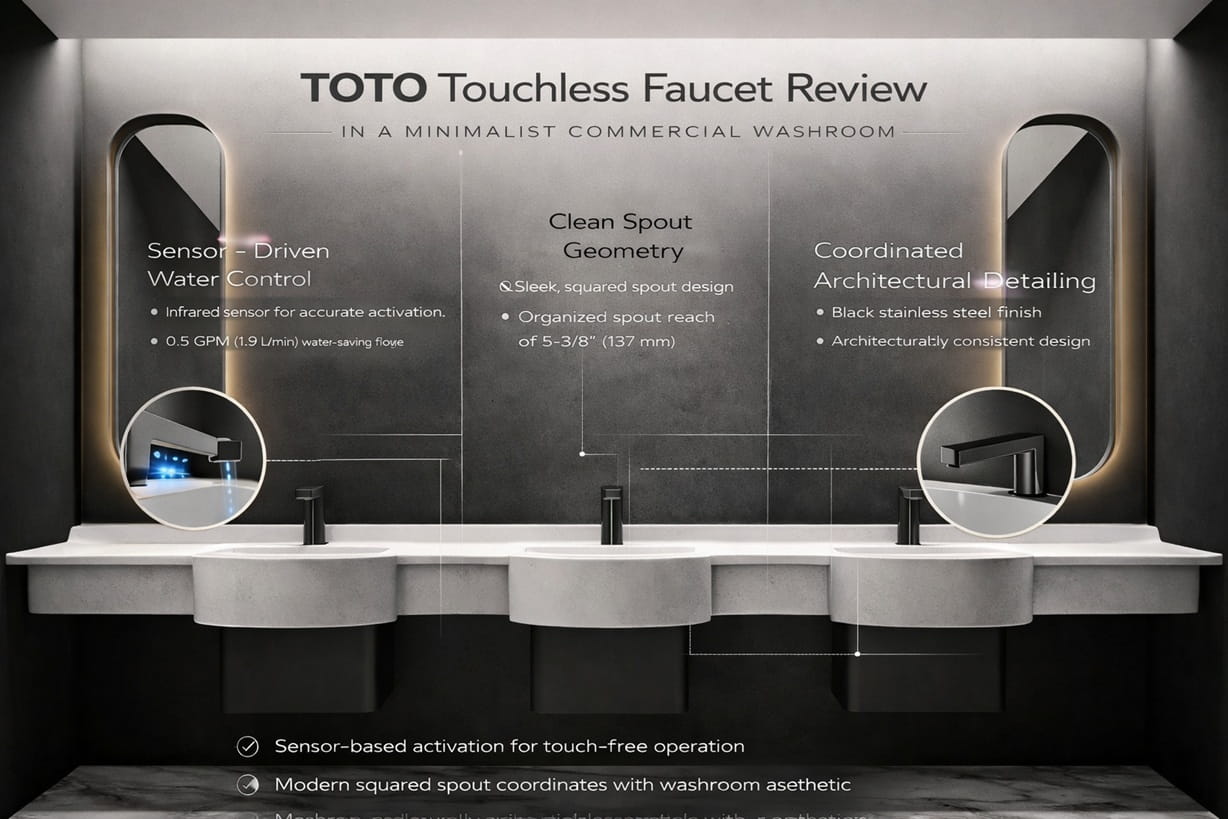
Minimalism in faucets is not only visual. In practice it means fewer visual interruptions on the deck, predictable spout geometry, and controls that disappear into the interaction logic. Toto’s touchless positioning emphasizes the sensor under or near the spout for accurate hand detection, which supports clean lines on the deck and reduces user “search behavior” at the fixture.
In public and high-traffic interiors, minimalist forms also help teams keep a suite coherent: a consistent spout family across restrooms reduces substitution drift, while standardized hole patterns and cover plates make field changes less disruptive.
Sensor innovation that matters in specs: power, detection, and “time-on-water” control
Toto’s signature technical story in commercial touchless faucets is EcoPower: a water-driven turbine generates electricity and stores it in rechargeable cells to operate the sensor and valve system. For architects and owners, the benefit is not only sustainability— it is reduced battery maintenance and fewer “dead faucet” calls tied to power management.
Sensor faucets also need guardrails. A key one is the “maximum on” time. Toto spec sheets commonly state a maximum on-demand flow window (example: 10 seconds) and publish the per-cycle consumption in gallons per cycle (gpc). That makes water use auditable for performance narratives and compliance discussions.
Efficiency without user backlash: flow rate, splash control, and basin pairing
Toto’s commercial touchless offerings include low-flow regulators (for example, 0.5 gpm on some Standard-R touchless models) and ultra-low consumption formats expressed as gpc under timed on-demand operation. These approaches can support aggressive water targets, but only if the basin pairing is correct.
Architects can prevent most complaints by reviewing three items together: spout reach, stream angle (where stated), and basin geometry (depth + drain position). The goal is a stable “stream landing zone” that minimizes splash at the real building pressure, not the idealized lab condition.
Hygiene and water quality: touchless benefits with an operations constraint
Touchless faucets reduce contact points, which is a clear hygiene advantage in public restrooms. But there is a real, building-science tradeoff: low-use or intermittent-use fixtures can experience short stagnation periods that shift water quality at the tap. Recent peer-reviewed work on touchless sensor faucets documents measurable changes during short-term stagnation windows.
This matters to architects because many projects now require building water risk management planning. CDC guidance on building water systems explains that stagnant water can reduce disinfectant residual and move temperatures into ranges that encourage microbial growth. In other words: sensor fixtures should be specified alongside a flushing and monitoring strategy that matches the building’s occupancy pattern.
Installation constraints architects should actually document
Sensor faucets can fail early due to basic site conditions: out-of-range pressure, debris in strainers, or service access that was never planned. Toto’s EcoPower faucet installation/owner manual provides a useful baseline: a recommended working pressure range of 20–80 psi, with guidance to reduce higher supply pressures using a pressure reducing valve.
In an architectural spec, it is worth adding a short “service access” clause: access to controller/valve components, a plan to clean strainers, and a commissioning requirement to validate sensor detection range and shutoff behavior after installation.

BIM + spec deliverability: the quiet reason touchless systems succeed
In AEC workflows, “good design” becomes a deliverable when BIM content, spec sheets, and manuals are easy to retrieve and match each other. Toto content is available through common BIM libraries, which helps teams standardize schedules and reduce late substitutions.
Quick comparison table: what architects should compare (not marketing)
Use this matrix to compare Toto touchless options as “systems” rather than as isolated fixtures.
| Spec lens | Why it matters | What to verify on Toto cut sheets | Examples of evidence |
|---|---|---|---|
| Power strategy | Maintenance burden, uptime, retrofit complexity | EcoPower vs AC option; stored energy approach; service notes | EcoPower technology overview + EcoPower manuals |
| Flow control | User satisfaction + water targets | Max gpm (e.g., 0.5 gpm) and/or gpc with timed on-demand shutoff | T28S51 series spec sheet (0.5 gpm + 10s on-demand) |
| Sensor behavior | False triggers, nuisance shutoffs, accessibility | Self-adjusting sensor; detection range notes; auto-purge feature if specified | Touchless overview + series spec sheets |
| Pressure range | Prevents early failures and inconsistent flow | Recommended supply pressure; PRV requirement above limits | EcoPower installation/owner manual (20–80 psi guidance) |
| Water quality operations | Stagnation risk + compliance planning | Owner’s water management plan; flushing/monitoring approach | CDC guidance + peer-reviewed stagnation study |
| BIM deliverability | Schedules, coordination, fewer RFIs | Revit family availability + dimensions align with cut sheets | BIMobject + ARCAT libraries |
Specification checklist (copy/paste for AEC use)
- Performance: state max flow (gpm) and max on-demand time (seconds) in the spec; require model-level cut sheets.
- Power: define EcoPower vs AC by project zone (retrofit constraints, maintenance capacity, uptime needs).
- Pressure: require supply pressure verification at trim-out; specify PRV where supply exceeds manufacturer guidance.
- Commissioning: require sensor range validation, shutoff verification, and strainer clean-out at handover.
- Water quality: align touchless fixtures with the building’s water management plan (monitoring + flushing approach).
- Closeout: include maintenance/care guidance and a parts list for regulators, strainers, and controllers.
A practical project takeaway for architects specifying Toto touchless systems
For most project teams, Toto’s strongest value is not simply that the faucet is touchless. It is that the system can support a cleaner design language while also giving owners a more structured operations story around power, flow control, and daily maintenance.
That matters most in commercial restrooms, healthcare-adjacent spaces, hospitality projects, and premium public interiors where user expectations are high and maintenance routines are constant. A minimalist sensor faucet works best when it is easy to coordinate, easy to commission, and paired with a realistic plan for pressure conditions, strainer cleaning, and water management over time.
From a content and indexing standpoint, this continuation also strengthens the article by adding more owner-facing and specifier-facing language around commissioning, maintenance, and long-term building use. That helps the post reach readers who are comparing touchless systems for practical project delivery, not only for appearance.
Verified support links & documents
-
 totousa.com • overview
Toto Touchless overview (sensor behavior + operational features)Useful for feature framing in specs (touchless logic, maintenance concepts, and general system intent).
totousa.com • overview
Toto Touchless overview (sensor behavior + operational features)Useful for feature framing in specs (touchless logic, maintenance concepts, and general system intent). -
totousa.com • technology
EcoPower technology (self-powered sensor faucets)Explains the core “water-powered turbine” concept and why it reduces battery maintenance.
-
totousa.com • PDF
T28S51 series spec sheet (0.5 gpm + 10s on-demand)Model-level evidence for timed on-demand behavior, flow regulator, and system options.
-
totousa.com • PDF
TEL103 series spec sheet (EcoPower line documentation)Use as a baseline for how Toto documents codes/standards and system notes on EcoPower lines.
-
totousa.com • PDF
EcoPower automatic faucets installation & owner manual (pressure + maintenance)Practical installation constraints, recommended pressure range, and periodic maintenance language.
-
bimobject.com • BIM
Toto BIM library (Revit/IFC/SketchUp options)Coordination support for schedules and model-based workflows (verify geometry matches spec sheets).
-
arcat.com • BIM
Toto BIM downloads (ARCAT)Alternate BIM retrieval path commonly used by design teams and spec writers.
-
doaj.org • open access
Study: temperature-dependent microbial dynamics in touchless sensor faucetsPeer-reviewed evidence supporting “short-term stagnation changes water quality” as an operations concern.
-
cdc.gov • guidance
CDC: stagnant water risks in building plumbing systemsClear explanation of why stagnation raises risk (temperature + disinfectant residual changes).
-
cdc.gov • guidance hub
CDC: Guidance for Legionella controlStarting point for project teams aligning fixtures with building water risk management.
-
ashrae.org • guidance
ASHRAE: Guidance for water system risk managementUse for aligning fixture selection and operations with broader building water system risk thinking.
