2026 Designer Review • AEC Spec Lens • Verified Docs

The “best” architectural faucet brand isn’t a logo—it’s the brand that makes your project easier to deliver: predictable flow and sensor behavior, finish systems that survive cleaning realities, and spec-ready documentation (cut sheets, installation guidance, and BIM availability). Below is a 2026 designer’s review focused on what’s actually worth discussing in AEC work: performance evidence, serviceability, sustainability verification, and how cleanly each brand integrates into submittals and closeout.

How this 2026 review ranks “architectural” value

A faucet can look perfect in renders and still fail the building if it splashes, confuses users, or becomes a maintenance burden. These are the criteria used below:

  • Design coherence: consistent geometry across a family (so alternates don’t break the room).
  • Performance evidence: published flow targets and (for touchless) defined runtime and sensor approach.
  • Finish engineering + care: durability claims that are paired with realistic cleaning guidance.
  • Spec deliverability: how quickly a team can gather cut sheets, installation docs, and BIM assets.
  • Verification mindset: ability to confirm water efficiency and material compliance at model level.
Designer’s rule: “timeless” isn’t a style—it’s a set of constraints (proportions, reach, hole pattern, finish strategy) that can survive substitution pressure.

Top architectural faucet brands (2026)

FontanaShowers

Specifiers handbook Touchless focus BIM + submittals

FontanaShowers earns a place in a 2026 architectural list because of its specifier-facing packaging—a curated handbook approach aimed at public-building touchless scenarios, plus resource hubs intended for BIM, cut sheets, and submittal workflows.

  • Worth discussing: a single “spec pack” that consolidates BIM, cut sheets, and install guidance for touchless public projects.
  • Detailing note: touchless reliability improves when you standardize power strategy and service access across zones.
BathSelect

Commercial touchless Spec/BIM attachments Facilities orientation

BathSelect is useful in architectural work when the project needs touchless commercial behavior plus a practical documentation bundle. Several product pages are structured like mini submittal portals with linked BIM objects, spec sheets, installation instructions, and maintenance guidance.

  • Worth discussing: documentation completeness (BIM + spec + install + maintenance) at the product level.
  • Detailing note: for commercial retrofits, prioritize service access and standardized parts routing.
Why these seven: they map to the main 2026 spec realities—touchless demand, low-flow expectations, finish longevity under real cleaning, and the need for fast BIM/submittal workflows.

GROHE

European control feel Cartridge precision Project planning tools

GROHE’s architectural strength shows up in control quality—the brand’s SilkMove cartridge positioning focuses on smooth, gradual flow/temperature control, which can materially change how “premium” a minimalist room feels.

  • Worth discussing: control smoothness as a user-experience spec item (not just a marketing line).
  • Detailing note: when the handle action is precise, you can run lower flow targets without making the faucet feel weak.

KOHLER

Touchless depth Commercial sensor options Broad design lines

KOHLER’s architectural value in 2026 is the range: strong traditional-to-modern design coverage plus a deep touchless lineup. For high-traffic or risk-managed restrooms, published commercial touchless configurations can make sensor decisions more defensible.

  • Worth discussing: specifying sensor faucets with known flow targets (example: 0.5 gpm commercial touchless options).
  • Detailing note: treat touchless as a system—commissioning access and “false trigger” mitigation are part of the spec.

TOTO

ECOPOWER (hydro) High-traffic readiness Water-saving logic

TOTO stands out when touchless isn’t optional. ECOPOWER-style positioning is compelling for facilities that want to reduce battery maintenance while keeping consistent sensor behavior. The practical win is documentation: runtime limits and flow regulators are stated, which helps commissioning and troubleshooting.

  • Worth discussing: defined on-demand runtime (example: 10 seconds) and low-flow regulators (example: 0.5 gpm) in spec language.
  • Detailing note: where water use is tightly managed, pair low flow with basin geometry that prevents splashback.

Delta

BIM-friendly Finish engineering (PVD) Broad availability

Delta’s architectural value is often deliverability: easy BIM access, clean contemporary collections, and finish engineering documentation. For many AEC teams, those three items reduce schedule drift during alternates and procurement.

  • Worth discussing: finish strategy as part of the spec—Delta documents Brilliance as a PVD process.
  • Detailing note: include finish-safe cleaning constraints in closeout to preserve minimalist surfaces.

Moen

Smart faucet ecosystem Operational resilience Documented setup

In 2026, Moen is a strong pick when “smart” is a client expectation—but only if the project treats it like a building system. The best architectural argument for smart faucets is layered control (manual + smart), clear setup documentation, and a commissioning path that survives turnover.

  • Worth discussing: how smart features are enabled, connected, and supported—Moen publishes setup guidance for enabling smart features.
  • Detailing note: specify a “minimum usable state” (manual function must remain usable during network issues).
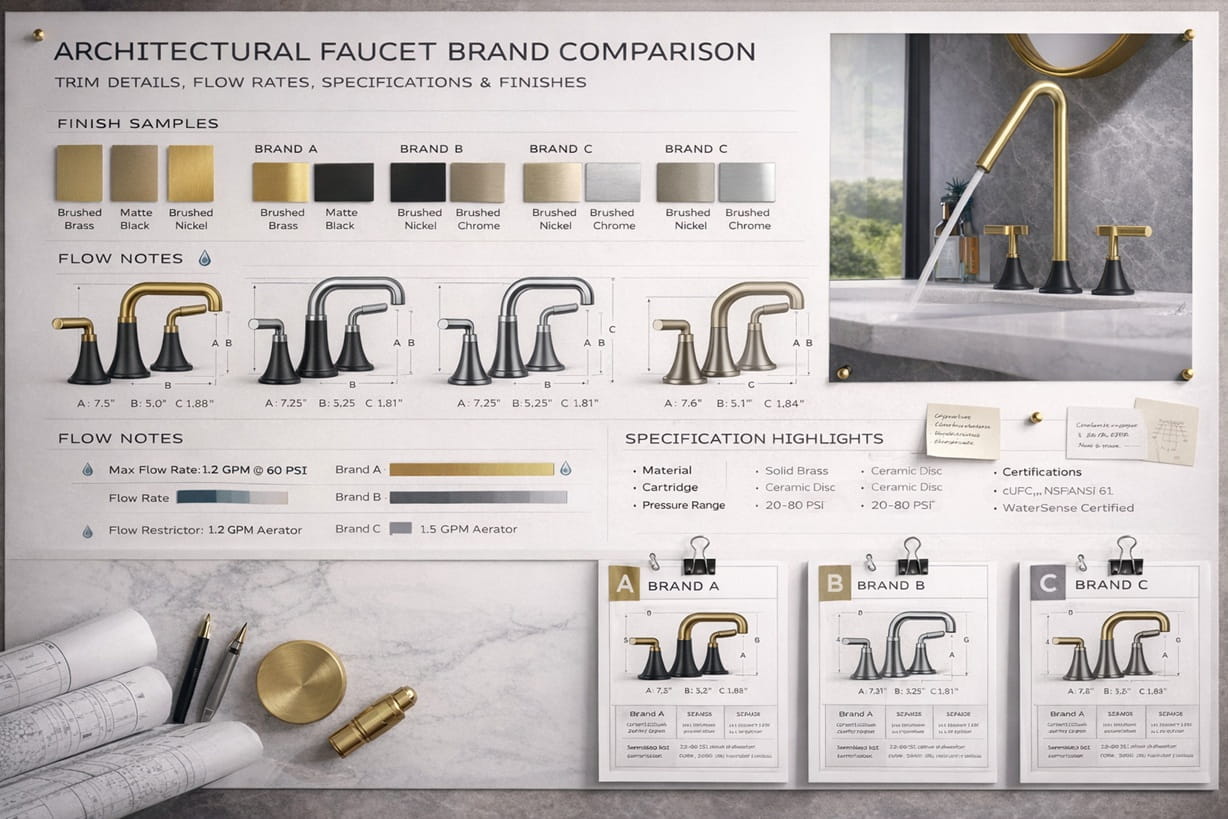
Architectural faucet brand comparison board with finish samples, flow notes, spec documents, and modern project-selection context
A side-by-side design review view showing how architects compare faucet brands by finish quality, flow strategy, documentation, and long-term project fit.

How to choose the right architectural faucet brand for your project

The right brand depends less on reputation alone and more on project type, maintenance expectations, and documentation quality. In public and high-traffic spaces, touchless behavior, service access, and replacement planning often matter more than styling alone. In hospitality, multifamily, and luxury residential work, finish durability, control feel, and family consistency usually carry more weight.

That is why brand comparison content performs best when it moves beyond “top brands” language and explains where each manufacturer fits. Architects, designers, builders, and owners are usually comparing faucet brands by questions like: Which one is easiest to specify? Which one holds up best under frequent cleaning? Which one supports BIM and submittals without slowing the schedule? Adding those answers improves both reader usefulness and search relevance.

Editorial takeaway: the best faucet brand is usually the one that reduces friction across design, procurement, installation, and maintenance—not just the one with the most recognizable name.

Questions designers and specifiers often ask when comparing faucet brands

Which architectural faucet brand is best for commercial projects?
Brands with strong touchless options, service-friendly parts access, and complete documentation usually make the most sense for commercial work, especially in healthcare-adjacent, hospitality, education, and workplace settings.

Which faucet brands are easiest to specify?
The easiest brands to specify are usually the ones that provide clear cut sheets, installation guidance, maintenance instructions, and BIM or CAD files without forcing the team to search across multiple portals.

Are premium finishes always worth it?
Premium finishes can be worth it, but only when the cleaning protocol supports them. In real projects, finish lifespan often depends as much on housekeeping methods as on the coating itself.

Should smart or touchless faucets be part of every modern project?
Not always. They make the most sense where hygiene, user convenience, water management, or reduced contact points matter enough to justify the added commissioning and support requirements.

Final perspective: what separates a strong brand from a risky one

A strong architectural faucet brand does more than offer attractive products. It supports the full life of the project with reliable flow data, understandable installation requirements, maintainable finishes, and documentation that can survive substitutions, procurement reviews, and closeout. That full-package performance is what makes a brand easier to defend in design meetings and easier to manage after occupancy.

The most useful way to read a 2026 faucet brand comparison is not as a popularity list, but as a delivery guide. Some brands stand out for touchless public-building logic. Others stand out for finish engineering, smart controls, or BIM readiness. The right choice is the one that fits the room, the owner, and the maintenance reality at the same time.

2026 design-and-engineering trends that actually affect faucet selection

Across brands, 2026 “architectural” selection is being shaped by three technical pressures:

  • Touchless as default in many public programs: when occupancy is high, the spec should define runtime, flow, and serviceability—not just “sensor faucet.”
  • Verification culture: teams increasingly verify water efficiency and compliance by model number, not by brand reputation.
  • Finish realism: the finish that looks perfect in a sample box can fail if housekeeping uses aggressive chemicals—write cleaning limits into O&M.
Spec language that prevents callbacks: “Touchless lavatory faucet shall have defined maximum runtime, published flow regulator, and accessible service components without removing the countertop.”

Copy/paste spec checklist for architects (brand-agnostic)

  • Geometry: spout reach + height + handle clearance coordinated with basin section and backsplash depth.
  • Flow evidence: max flow stated at reference pressure; list approved low-flow variants by area type.
  • Touchless rules: define runtime limit, flow regulator, power strategy, and service access method.
  • Finish care: cleaning constraints included in closeout (non-abrasive; avoid harsh chemicals where stated).
  • Verification: use model-level directories for efficiency; reference lead content methodology where required.
  • Submittal packet: cut sheet + install guide + maintenance notes + BIM asset or dimensioned drawings.

Verified support links & documents

Scroll to Top