Sloan and TOTO both show up in modern architectural bathrooms, but they “fit” for different reasons. Sloan typically reads as industrial—service-forward components, fleet consistency, and above-deck access that supports uptime. TOTO often reads as modern minimalism—quiet forms paired with a technology story that reduces the visible maintenance layer. This comparison stays practical: sensor behavior, power strategy, water use logic, standards references, and how to spec them so the design intent survives handover.

1) Start with the program constraint (not the silhouette)
When architects say “industrial” or “minimal,” they’re often describing two different project constraints: uptime in high traffic versus quiet experience in refined interiors. A faucet that looks perfect can still fail a project if it causes service calls, inconsistent run time, or unclear closeout documentation.
- Public/institutional restrooms: uptime, service time, parts strategy, and predictable sensor behavior matter most.
- Modern offices/hospitality: “quiet” interaction (stream, splash, cycle behavior) and reduced maintenance friction matter more.
2) Sensor logic and runtime: what users feel is “quality”
Touchless faucets don’t win on “touchless.” They win on predictable behavior: consistent detection, no false triggers, and a runtime that supports real handwashing without wasting water.
Sloan (industrial behavior control): Sloan’s Optima EAF-150 spec sheet describes activation by dual infrared sensors and microprocessor-based logic with self-adapting technology. It also consolidates operating components above the deck within the spout—important when the maintenance goal is to avoid crawling under counters.
TOTO (minimalism with quantified cycles): TOTO’s Standard-R T28S51 series spec sheet frames performance using “gallons per cycle (gpc)” and on-demand flow, and includes a clear equation tying 0.5 gpm to a 10-second maximum (0.08 gpc). This quantified approach helps AEC teams set expectations early and prevent “why is it doing that?” complaints.
3) Power strategy: choose a maintenance model
Power strategy is where industrial design and modern minimalism diverge in a way owners actually feel. You are choosing a maintenance model: batteries and access, hardwired infrastructure, or self-powered technology that reduces routine battery work orders.
TOTO ECOPOWER (minimal service layer): TOTO’s ECOPOWER description explains that water flow spins a high-efficiency turbine to create and store power in capacitors, which then operate the sensor and solenoid. The architectural value is not just “innovative”—it’s fewer routine interventions and a cleaner closeout story.
Sloan (service-first architecture): Sloan’s product messaging and spec language emphasize above-deck serviceability and modular carriers (solenoid/strainers) designed to simplify maintenance. In high-traffic buildings, that “industrial” priority can be the most architectural decision you make—because it protects uptime.
4) Water performance: flow rate vs gallons-per-cycle (why both matter)
Architects usually see “gpm” in schedules, but touchless faucets behave in cycles. That’s why TOTO’s “gpc” framing is useful: it ties water use to actual user events, not just peak flow.
TOTO example: the T28S51 spec sheet states a 0.08 gpc, max 10-second on-demand cycle, and shows the math (0.5 gpm × 10/60). Sloan example: a Sloan BASYS cutsheet shows a factory default timeout of 10 seconds and a default 0.083 gallons per cycle at 0.5 gpm.
For broader efficiency context, EPA WaterSense explains that WaterSense-labeled lavatory faucets and accessories use a maximum of 1.5 gpm, reducing flow compared with the 2.2 gpm federal standard—useful when you’re balancing user experience and water targets.
5) Water quality reality: automation can help—or hurt—without a flushing plan
Touchless doesn’t automatically equal healthier water. In low-use zones, any faucet can become part of a stagnation problem. CDC guidance for building water systems emphasizes preventing water stagnation and maintaining water quality, especially after shutdowns or reduced occupancy.
In healthcare literature, outcomes vary by design and maintenance. One peer-reviewed analysis found differing contamination rates between electronic faucet brands and manual faucets, suggesting the “type” alone is not the determinant—design, water management, and operating conditions matter.
Practical takeaway for AEC teams: if a project includes low-use restrooms or seasonal occupancy, include a water management note in closeout, and consider programming/strategy that supports periodic flushing where appropriate.

Architect-facing comparison table (what’s worth debating)
| Decision factor | Sloan (industrial design strength) | TOTO (modern minimalism strength) | What to lock in the spec |
|---|---|---|---|
| Best-fit programs | High-traffic public/institutional restrooms prioritizing uptime and service access | Modern offices/hospitality/premium public interiors prioritizing quiet UX + cleaner maintenance story | Traffic assumptions, cleaning protocol, uptime expectations |
| Sensor behavior | Dual IR + self-adapting logic framing; above-deck consolidation supports service | Self-adjusting sensor + explicit 10-second on-demand framing in certain series | Runtime (max seconds), range expectations, commissioning steps |
| Power strategy | Service-first access and modular component framing; verify model power type early | ECOPOWER (water-powered) or AC options reduce routine battery replacement | Power source, access to adapters/transformers, spares plan |
| Water use framing | Documented cycle defaults (e.g., 10s and 0.083 gpc on a cutsheet example) | Explicit gpc math tied to on-demand behavior (0.08 gpc = 0.5 gpm x 10/60) | Gpm/gpc target, cycle time, on-demand definition |
| Water quality risk management | Works best with an owner flushing/water management plan in low-use zones | Same—automation is not a substitute for water management | Closeout water management note + low-use outlet strategy |
| Material verification | Use standardized lead-content methodology references as needed | Same | Reference NSF/ANSI/CAN 372 methodology when lead-content verification language is required |
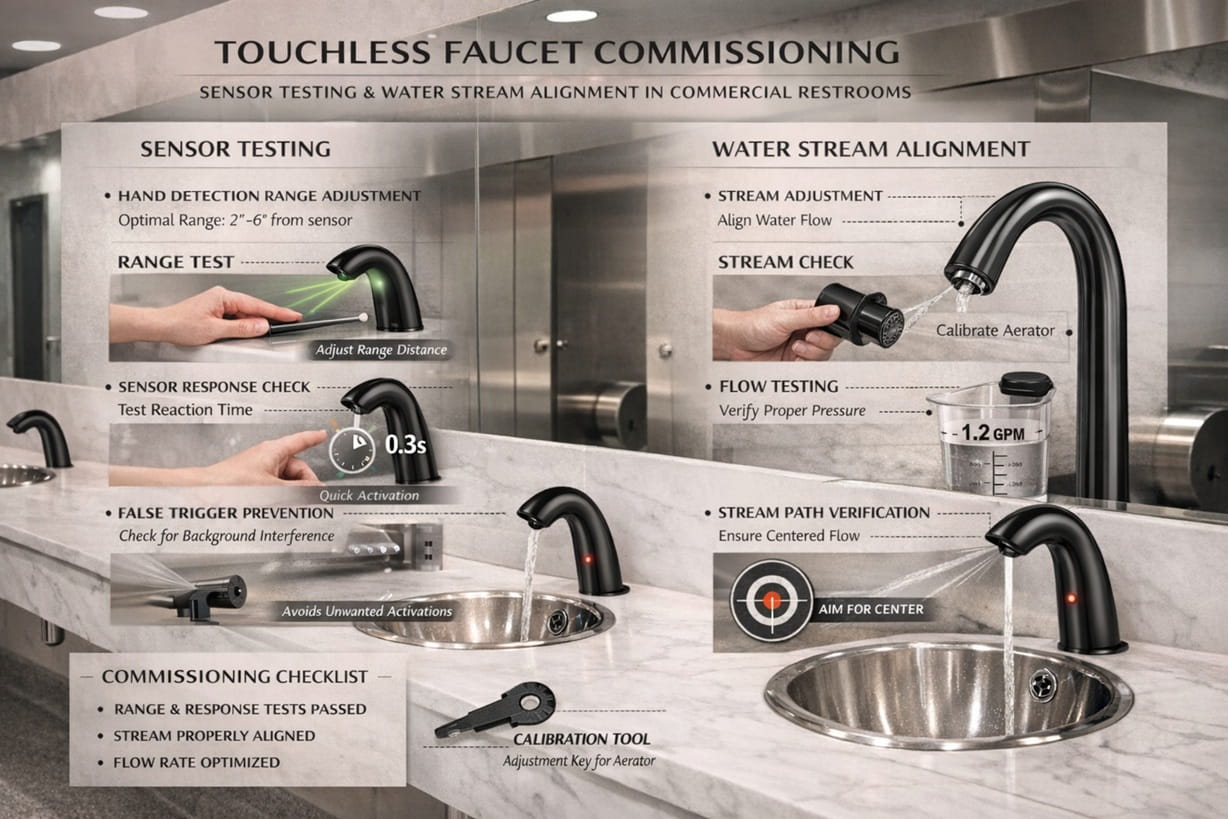
Commissioning matters more than most faucet comparisons admit
Many touchless faucet decisions look settled once the model is chosen, but the project result is usually decided at commissioning. A well-specified product can still feel frustrating if the sensor range is not checked, the runtime feels too short, or the stream lands poorly in the basin. In premium interiors, these issues become visible immediately because the room is designed to feel calm, clean, and intentional.
Sloan and TOTO can both perform well when the commissioning steps are written clearly into the closeout process. That means confirming detection behavior, verifying the intended cycle length, checking splash against the selected sink, and making sure facility teams understand service access and replacement parts. Without that step, the faucet may still work, but it may not deliver the user experience the design team expected.
This is also where architects can protect the original design intent. A faucet in a high-traffic public restroom should feel reliable and predictable every time. A faucet in a hospitality or executive setting should feel quiet, controlled, and easy to use without drawing attention to itself. Those outcomes depend as much on setup and handover as on the brand name.
A smarter way to decide between Sloan and TOTO
The better comparison is not simply Sloan versus TOTO. It is service-first planning versus experience-first planning. Sloan often aligns best when the restroom is part of a large operational system where uptime, standardization, and fast maintenance access matter most. TOTO often aligns best when the project is trying to reduce the visible maintenance layer while keeping the restroom experience more refined and minimal.
For specifiers, that makes the final choice easier. Start with traffic level, maintenance model, and power strategy. Then confirm the desired water behavior and commissioning steps. When those items are resolved early, the selected faucet is far more likely to support both building performance and the design language shown in presentations and submittals.
Verified support links & documents
-
 cloudfront.net • PDF
Sloan Optima EAF-150 specification sheet (PDF)Dual IR + microprocessor/self-adapting framing; above-deck component consolidation and operating details.
cloudfront.net • PDF
Sloan Optima EAF-150 specification sheet (PDF)Dual IR + microprocessor/self-adapting framing; above-deck component consolidation and operating details. -
specifications.sloan.com • cutsheet
Sloan BASYS cutsheet example (timeout + gallons-per-cycle)Shows a 10s default and 0.083 gallons-per-cycle at 0.5 gpm (example cut sheet) for defensible scheduling.
-
sloanplumbingparts.com • PDF
Sloan BASYS EFX-200 series spec sheet (PDF)Spec language focusing on serviceability (removable carriers/strain ers) and standards references.
-
totousa.com • PDF
TOTO T28S51 series Standard-R touchless faucet spec sheet (PDF)Gpc/on-demand framing, 10-second max cycle, and 0.5 gpm flow control with clear math for water-per-cycle.
-
totousa.com • technology
TOTO ECOPOWER technology overviewExplains turbine generation and capacitor storage that powers sensors/solenoids—useful for lifecycle planning.
-
epa.gov • guidance
EPA WaterSense: bathroom faucets (efficiency context)Independent context for 1.5 gpm WaterSense maximum and performance framing.
-
nsf.org • standard
NSF/ANSI/CAN 372 technical requirements (lead-content methodology)Standardized methodology for determining/verifying lead-content compliance language in specifications.
-
cdc.gov • building water
CDC: building water system guidance (stagnation + quality)Supports closeout notes and water management language when occupancy is low or variable.
-
epa.gov • PDF
EPA: maintaining/restoring building water quality (PDF)Building water quality considerations that inform flushing strategies and reopening plans.
-
cambridge.org • peer-reviewed
Peer-reviewed: electronic vs manual faucet contamination outcomesUseful for nuanced discussions: outcomes vary by design/conditions—add water management thinking to touchless specs.

