“Smart” only becomes architectural when it’s dependable: predictable behavior at turnover, clear service access, and documentation that survives the submittal-to-closeout path. This review evaluates Moen through an AEC lens—how the brand’s clean-lined collections support timeless design, how its smart faucet ecosystem reduces touch points and adds precision, and what spec-ready evidence exists for flow, finishes, and commissioning.

Timeless aesthetic: why Moen’s simple geometry is useful in real projects
“Timeless” in architecture often means a controlled silhouette: clean cylinders, restrained handle language, and proportions that don’t look dated when the tile or lighting package changes. Moen’s Align collection is a practical example of this approach. The product family is intentionally minimal, which helps AEC teams standardize across multiple restroom typologies without introducing visual noise.
The architectural advantage is coordination stability. When one collection covers multiple mounting conditions (single-hole, optional escutcheons, consistent handle language), you reduce late-stage substitutions that unintentionally change the room’s character.
Smart integration (the AEC way): control layers, not gimmicks
Moen’s smart faucet ecosystem is most defensible when it’s framed as layered control. The Smart Faucet (U by Moen) is designed to be operated in multiple ways—voice, app, motion/gesture, and manual control—so the room still functions when Wi-Fi is down, a battery is depleted, or a user simply prefers a traditional handle.
From a specification standpoint, the key is to treat smart features like any other building system: define power strategy, write a commissioning step, and include a “minimum usable state” requirement (manual function must remain).
Touchless behavior: where MotionSense earns its place
In kitchens, staff pantries, and amenity spaces, touchless activation can reduce surface contact and keep workflows moving. Moen’s MotionSense Wave documentation is clear about startup behavior, indicator feedback, and power-up steps—details that matter during commissioning and troubleshooting.
For AEC teams, the insight is simple: specify touchless where the program benefits (food handling, shared amenities, healthcare-adjacent zones), and avoid it where false triggers or unusual basin geometry create nuisance. Sensor behavior is a room-detail issue, not just a fixture choice.
Finish performance: protecting “timeless” surfaces with explicit maintenance rules
Minimal forms shift attention to surface quality. Moen’s Spot Resist finish care guidance is unusually actionable: mild soap, rinse thoroughly, dry with a soft cloth, and avoid abrasives, bleach, ammonia, and harsh chemicals. In architectural interiors, that clarity is valuable—because finish failure is often a cleaning-protocol problem, not a product problem.
If you want the timeless aesthetic to stay timeless, put the cleaning limits into closeout documentation and housekeeping training. A single line in Division 22 closeout notes can prevent months of “finish looks worn” complaints.
Water performance and sustainable specs: flow clarity beats marketing
AEC teams don’t need broad sustainability claims—they need numbers. Moen’s Align lavatory specification sheet states a maximum flow rate of 1.2 gpm at 60 psi, which aligns with common efficiency targets for bathrooms while still supporting acceptable user experience when basin geometry is coordinated.
When a project requires verified efficiency, use third-party listing tools rather than assumptions. For U.S. projects, EPA WaterSense verification helps confirm model-level compliance, which is particularly helpful when alternates are proposed during procurement.
Smart + resilient buildings: where “faucet thinking” connects to water-risk engineering
In multifamily, hospitality, and high-value residential, the most meaningful “smart water” benefit is damage prevention. Moen’s Flo Smart Water Monitor & Shutoff is positioned as an always-on system that runs daily plumbing health tests and can automatically shut off water in emergencies. That’s a building-risk conversation, not a gadget conversation.
For decision-makers who need measurable evidence, a LexisNexis Risk Solutions press release describes a loss correlation study comparing homes with the Flo by Moen device to a control group, measuring changes in the number and severity of water-related insurance claims. Treat this as a starting point for owner discussions about risk reduction.

BIM + deliverability: reducing submittal friction
For architecture teams, the best brands are the ones that are easy to document. Moen content is broadly available via common BIM distribution channels, which helps keep Revit families, cut sheets, and schedules aligned—especially on larger projects where a “close enough” family can cascade into repeated coordination errors.
Recommended submittal packet minimum: model + finish + spec sheet + care/cleaning + installation/commissioning notes (smart and/or touchless) + a BIM/CAD reference (or dimensioned drawing) used for coordination only.
AEC evaluation table: what to check for “smart + timeless” success
This table translates design intent into verifiable checks for architects, specifiers, and owners.
| Decision lens | What to verify | Why it matters | Moen evidence examples |
|---|---|---|---|
| Timeless geometry | Family consistency across mounting types, handle language, proportions | Prevents “style drift” when alternates are proposed | Align collection reference page |
| Flow + user experience | Max flow at reference pressure (e.g., 1.2 gpm @ 60 psi) + basin coordination | Controls splash + supports comfort while meeting efficiency targets | Align 6191 spec sheet (FLOW section) |
| Smart control layers | Voice/app/motion/manual controls + “manual fallback” requirement | Ensures the room works during outages and for all users | Moen Solutions smart faucet overview + quick start PDF |
| Commissioning clarity | Network/app onboarding steps + reset/troubleshooting path | Reduces service calls and turnover confusion | Connect Smart Faucet to app (Moen Solutions) |
| Finish longevity | Cleaning limits written into O&M (no abrasives/bleach/ammonia) | Minimal forms make finish wear obvious | Spot Resist care card (PDF) |
| Resilience value | Leak monitoring/shutoff strategy in risk-sensitive buildings | Reduces water-damage exposure in multifamily/hospitality | Flo product page + loss correlation study summary |
| BIM deliverability | Revit/CAD availability + consistent identification in schedules | Reduces RFIs and keeps procurement aligned | BIMobject + BIMsmith content |
Closeout checklist (copy/paste for project manuals)
- Document flow: list max gpm at reference pressure and confirm basin/stream landing to control splash.
- Define smart minimum state: manual operation must remain functional during network/power interruptions.
- Commission smart features: verify onboarding, control modes, and reset procedure at turnover.
- Specify finish care: include “no abrasives/bleach/ammonia” cleaning limits in O&M and housekeeping training.
- Verify certifications: use third-party directories (e.g., WaterSense where required) by model number.
- Deliver submittal packet: spec sheet + care/cleaning + install/commissioning notes + BIM/CAD reference.
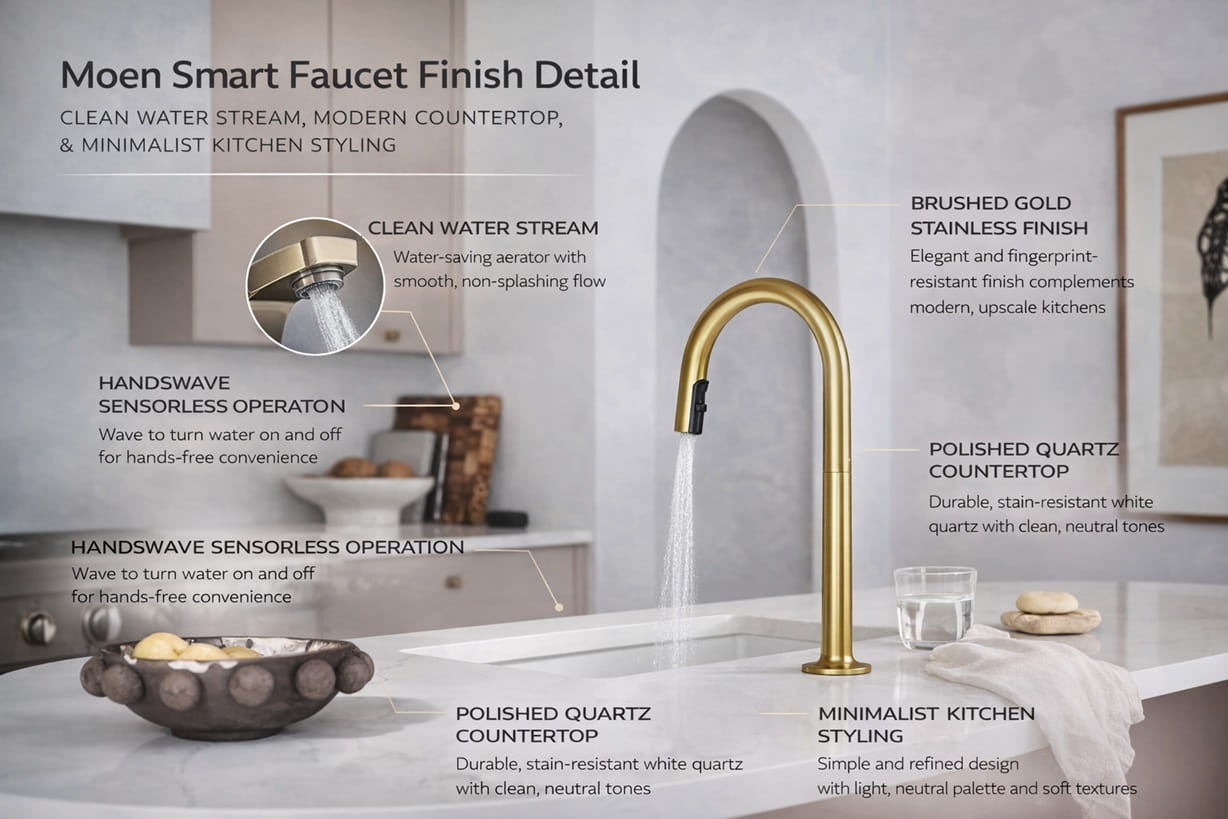
Where Moen makes the most sense in today’s projects
Moen is usually the strongest fit in projects that want modern styling with a clear operational story behind it. In upscale residential kitchens, multifamily amenity spaces, hospitality upgrades, and selected workplace pantries, the brand works well because it combines familiar design language with smart-control options that feel useful instead of experimental.
That balance is also what makes the brand relevant in search-driven buying decisions. People comparing faucets today are not only asking how a fixture looks. They are also asking whether it is easy to live with, easy to clean, simple to commission, and flexible enough to keep working when smart features are not the priority. Adding that practical layer gives this article more value for both readers and search visibility.
Questions buyers and specifiers often ask before choosing Moen
Is Moen a good choice for modern kitchens and bathrooms?
Yes, especially for projects that want clean lines, recognizable product support, and a mix of traditional and smart-use options within the same brand ecosystem.
Is Moen better for smart faucet applications than a standard decorative spec?
It can be, particularly when the project benefits from layered control, touchless convenience, or leak-prevention features that connect the faucet discussion to wider building operations.
Are Moen finishes easy to maintain?
They can perform well when the finish is matched with the right cleaning routine. Like most minimalist fixtures, they look best long term when harsh chemicals and abrasive cleaning habits are avoided.
Who should compare Moen seriously?
Architects, interior designers, builders, remodelers, and homeowners should compare Moen when they want a brand that can bridge timeless styling, practical documentation,
and smart-water features without forcing the project into a highly technical look.
Final perspective: why Moen stays relevant in faucet comparisons
Moen remains relevant because it serves two needs at once. It gives designers a clean, adaptable aesthetic that fits contemporary and transitional interiors, while also giving owners and installers a clearer path for setup, maintenance, and product support. That is a stronger long-term position than a faucet that is only impressive on first look.
For project teams, the real value is not just that Moen offers smart features. It is that the brand can be specified as a practical system: documented flow rates, defined cleaning rules, usable control options, and support resources that help the product stay understandable after handover. That is what turns a stylish fixture into a durable project decision.
Verified support links & documents (no tracking parameters)
-
 assets.moen.com • PDF
Moen Align 6191 spec sheet: flow (1.2 gpm @ 60 psi) + construction + installation notesSpec-ready evidence for sustainable targets and predictable performance documentation.
assets.moen.com • PDF
Moen Align 6191 spec sheet: flow (1.2 gpm @ 60 psi) + construction + installation notesSpec-ready evidence for sustainable targets and predictable performance documentation. -
shop.moen.com • collection
Align collection overview (timeless geometry + family consistency)Useful for keeping design intent consistent across multiple restroom typologies.
-
solutions.moen.com • guidance
Smart Faucet (voice activated): overview, FAQs, and commissioning-friendly contextA practical source for control modes and support pathways that matter during turnover.
-
assets.moen.com • PDF
Enable Smart Features (Moen Smart Faucet quick start)Owner-facing steps: app setup + voice control enablement basics (useful for closeout binders).
-
solutions.moen.com • setup
Connect Smart Faucet to the Moen Smart Water app (step-by-step)Commissioning support: requirements, Wi-Fi steps, and smart home connection workflow.
-
assets.moen.com • PDF
MotionSense Wave quick start (touchless activation + power-up behavior)Helpful for commissioning behavior, indicator cues, and troubleshooting basics.
-
assets.moen.com • PDF
Spot Resist finish care guidance (cleaning limits for long-term appearance)Convert this into a one-line housekeeping rule to protect minimalist interiors.
-
solutions.moen.com • resilience
Flo Smart Water Monitor & Shutoff: daily health tests + automatic shutoff framingA building-risk reference for multifamily/hospitality owners thinking beyond the fixture.
-
risk.lexisnexis.com • study summary
Loss correlation study summary: water-claim frequency/severity comparison (Flo by Moen)Evidence-oriented talking point for owners evaluating smart water shutoff ROI.
-
bimobject.com • BIM
Moen BIM objects (Revit/SketchUp/ArchiCAD access)Supports coordinated documentation and reduces late-stage model substitutions.
-
bimsmith.com • BIM
Moen Revit families & BIM content (BIMsmith Market)A second channel for BIM retrieval—useful when teams standardize libraries by platform.
-
epa.gov • efficiency
EPA WaterSense: bathroom faucets (program guidance)Use for defensible efficiency framing and procurement-time verification workflows.
-
epa.gov • directory
WaterSense product search (verify exact model numbers)Prevents “brand assumption” errors during alternates and substitutions.
-
ashrae.org • PDF
ASHRAE: building water management best practices during low/variable occupancyUseful context when designing systems that include low-use fixtures or intermittently occupied spaces.

