Sustainable faucet selection is often framed as “low flow versus comfort.” Lifecycle Cost Analysis (LCCA) reframes it as a building-performance decision: upfront cost, water + sewer, hot-water energy, maintenance labor, downtime risk, and replacement cycles—evaluated in present-value terms. The result is a selection process that can be both greener and easier to defend to owners.

1) Why LCCA belongs in faucet selection (and not only in energy models)
Faucets are small, repeated components. In most building types, you buy them once—but you pay for them every day through utilities, maintenance, and service calls. LCCA helps teams compare options that satisfy the same functional requirements (user experience, accessibility, hygiene approach, code compliance) while revealing cost drivers that are easy to miss.
A sustainable choice is rarely one single attribute. It’s usually a combination: efficient flow that still performs at realistic pressures, maintainable components, and a system layout that avoids hidden waste like excessive hot-water wait time.
2) Set the boundaries: define “equal performance” before comparing costs
LCCA works best when alternatives meet the same functional intent. For faucets, define that intent in a way that architects, MEP, and owners all agree on:
- User experience: perceived flow quality, splash control, intuitive operation.
- Performance at realistic pressure: not just ideal conditions.
- Maintainability: access, spare parts strategy, frequency of cleaning/adjustment.
- Risk posture: hygiene approach, stagnation/low-use considerations, commissioning plan.
Water-efficiency specifications that include both a maximum flow rate at a reference pressure and a minimum flow at lower pressure help keep comparisons honest. For example, EPA’s WaterSense framing references a maximum of 1.5 gpm at 60 psi and a minimum performance requirement at lower pressure for lavatory applications.
3) The faucet LCCA cost stack: what to include (and what teams forget)
LCCA is not just a utility payback spreadsheet. For faucets, cost drivers often come from labor and service frequency rather than the fixture itself. A practical faucet LCCA includes these buckets:
- First cost: fixture + trim, controls (if any), stops, connectors, rough-in implications.
- Installation: labor, coordination time, mock-up/approval effort, commissioning time.
- Utilities: water + sewer, plus hot-water energy (and any recirculation/temperature maintenance impacts).
- Operations & maintenance: cartridge/aerator service, sensor calibration, battery replacement, cleaning labor.
- Downtime and service calls: disruptions, repeated complaints, and rework risk.
- End-of-life: replacement cycle, disposal/renovation costs, access constraints.

4) The “math” without the pain: a field-ready LCCA workflow
You don’t need a PhD to run a defensible LCCA. You do need consistency and transparency. This workflow mirrors established building LCCA practice and can scale from a single restroom to a multi-building portfolio.
- Step 1 — Define the study period: align with owner planning (often 10–25 years for interior components).
- Step 2 — Choose a discount rate approach: use the owner’s standard approach or a published framework for consistency.
- Step 3 — Model scenarios: baseline versus alternatives that meet equal performance intent.
- Step 4 — Convert recurring costs to present value: utilities, maintenance, service calls, replacements.
- Step 5 — Run sensitivity checks: usage frequency, water/sewer price, hot-water fraction, labor rates.
- Step 6 — Document assumptions: so the result can be reviewed, updated, and reused.
For teams that want standardized inputs (especially on public projects), the DOE/NIST BLCC ecosystem provides tools and references, including an Energy Escalation Rate Calculator and annual discount factors used in federal life-cycle costing practice.
5) Translating water savings into dollars (and why hot-water energy is project-specific)
Water cost is usually straightforward: annual gallons saved × (water + sewer unit cost). The harder part is avoiding overly optimistic assumptions about how fixtures are used. A good LCCA uses a conservative, documented use pattern—or validates with a quick audit where possible.
Hot-water energy is where teams can overstate (or understate) savings. Reduced faucet flow can reduce hot-water energy, but the magnitude depends on:
- Mixed water fraction: what share of draw is hot versus cold at that fixture type.
- Temperature maintenance strategy: recirculation, heat trace, point-of-use, or none.
- Wait-time waste: water run-off while waiting for hot water at remote fixtures.
- Energy source and rate: electric vs gas vs central plant, and escalation assumptions.
6) Maintenance realism: designing for fewer service calls is sustainability
“Sustainable” selection is often treated as materials disclosure. In operations, sustainability is also how long the system stays stable. If a building ends up with frequent adjustments, inconsistent outlet components, or hard-to-access controls, the lifecycle cost climbs quickly—and efficiency can erode through “field modifications.”
LCCA forces a useful question: what maintenance model will the building actually have? A university with in-house trades can tolerate different service needs than a small clinic relying on outside calls. Your faucet strategy should match that reality.
| LCCA input | What to collect | Good data sources | Common pitfall | Why it matters |
|---|---|---|---|---|
| Use frequency | Uses/day by space type | Owner counts, audits, conservative assumptions | Using “average building” numbers without context | Drives utility + wear rates |
| Flow performance | Expected flow at pressure band | WaterSense performance framing (where applicable) | Assuming test pressure equals field pressure | Affects user behavior and runtime |
| Water & sewer rates | Current rates + expected changes | Local utility tariff, owner billing history | Ignoring sewer charge or tiered pricing | Often larger than fixture delta cost |
| Hot-water energy | Fuel type, $/kWh or $/therm, hot-water fraction | Owner bills, energy model outputs, NIST escalation tools | Assuming all draws are hot | Can dominate savings in some buildings |
| Maintenance labor | Minutes/event, labor rate, frequency | FM team input, service logs | Counting parts but not labor | Service calls often exceed parts cost |
| Replacement cycle | Expected life of cartridges/outlets/controls | Owner standards, documented service-life assumptions | Assuming “lifetime” components | Replacement timing affects present value |
| Sensitivity checks | Low/medium/high scenarios | LCCA best practice guidance | Single-point estimates only | Builds confidence and reduces disputes |
7) “Sustainable” also means transparent: pairing LCC with LCA and EPDs
Lifecycle cost focuses on dollars. Lifecycle assessment (LCA) focuses on environmental impacts. In architecture, these two perspectives increasingly travel together—especially as teams track embodied impacts and use Environmental Product Declarations (EPDs) as disclosure documents.
EPDs are commonly discussed as “carbon documents,” but their value for faucet selection can be simpler: they provide a structured way to talk about system boundaries and service life. If you select a component that lasts longer, the environmental and economic pictures often improve together.
- Use EPDs as disclosure, not as a marketing scorecard.
- Compare like-with-like: same function, similar assumptions, transparent boundaries.
- Reward durability: longer replacement intervals reduce embodied and operational burdens.

8) Why faucet retrofits often produce faster lifecycle wins than teams expect
One reason LCCA works so well for faucet decisions is scale. A small per-fixture improvement can turn into a meaningful portfolio result when the same restroom standard is repeated across dozens or hundreds of locations.
That makes retrofit planning especially valuable for schools, offices, healthcare campuses, airports, and hospitality properties. In these settings, owners are not only comparing fixture cost. They are comparing recurring water charges, hot-water energy, labor time, complaint frequency, and the disruption that comes with repeated maintenance.
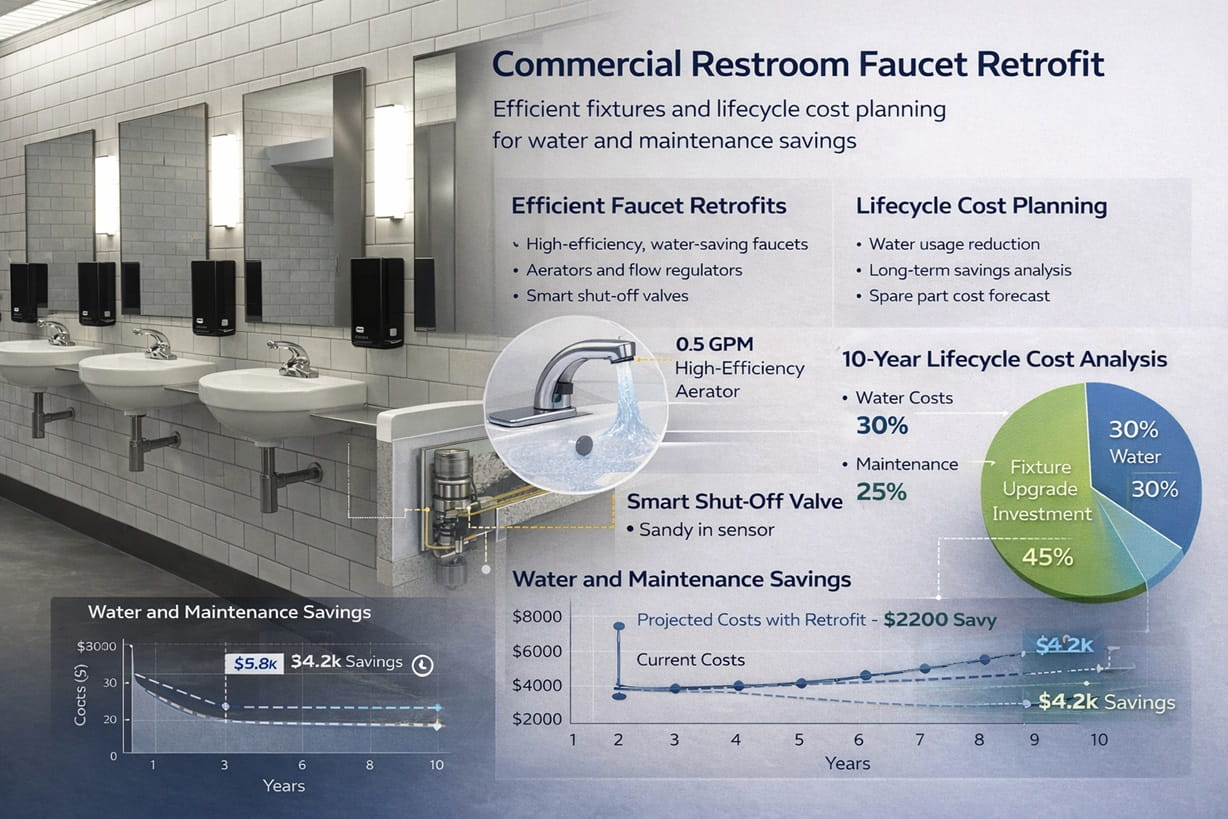
The strongest retrofit business cases usually come from a simple pattern: select fixtures that perform consistently, reduce wasted water, and stay easy to maintain over time. When those three factors align, the sustainability story becomes easier to defend because it is tied directly to operating results.
Conclusion: LCCA turns faucet selection into a defensible, repeatable performance decision
If your goal is a sustainable, high-quality building, the faucet is not a “small” decision—it’s a repeated interface with real utility and maintenance consequences. LCCA doesn’t push you toward any single product type; it pushes you toward clear assumptions, real-world performance, and documented outcomes.
- Define equal performance before comparing options.
- Count labor as carefully as you count gallons.
- Model hot-water energy using the building’s actual temperature maintenance strategy.
- Run sensitivity checks so owners trust the result.
- Document and reuse the method for the next project.
Verified research links & support documents
-
 energy.gov
DOE FEMP: Building Life-Cycle Cost ProgramsFederal LCCA tool ecosystem (BLCC, escalation tools, Handbook 135 references).
energy.gov
DOE FEMP: Building Life-Cycle Cost ProgramsFederal LCCA tool ecosystem (BLCC, escalation tools, Handbook 135 references). -
nist.gov
NIST: BLCC (Building Life-Cycle Cost) programsWhat BLCC is, when to use it, and how it supports water/energy projects.
-
blcc.nist.gov
BLCC portalCentral landing page for BLCC resources and related tools.
-
nvlpubs.nist.gov • PDF
BLCC User Guide (NIST Technical Note 2346) (PDF)How-to guidance for running LCCA consistent with FEMP methodology.
-
pages.nist.gov
NIST Energy Escalation Rate Calculator (EERC)Helps estimate escalation rates used in life-cycle cost computations.
-
nvlpubs.nist.gov • PDF
Energy price indices & discount factors (Annual Supplement) (PDF)Discount factors and indices used in federal life-cycle costing practice.
-
wbdg.org
WBDG: Principles and process for conducting an LCCAHigh-level LCCA logic and decision framing for buildings and systems.
-
astm.org
ASTM E917: Measuring life-cycle costs of buildings (scope page)Standard practice reference for LCC procedure and comparison logic.
-
iso.org
ISO 15686-5: Life-cycle costing of buildings and constructed assetsGlobal guidance on LCC scope, classification, and analysis boundaries.
-
epa.gov • PDF
WaterSense at Work: Faucets (PDF)Efficiency and performance framing for commercial/institutional faucet strategies.
-
epa.gov • PDF
EPA: High-efficiency lavatory faucet specification (PDF)Performance-based efficiency criteria that can inform LCCA assumptions.
-
epa.gov
EPA WaterSense: Case studies (commercial & institutional)Real-world water management projects to support business-case narratives.
-
allianceforwaterefficiency.org • PDF
Restroom faucet retrofit potential: university case study (PDF)Audit-style evidence useful for retrofit LCCA assumptions and validation.
-
academic PDF
Restroom water reduction potential at an urban university (PDF)Study examining fixture-focused retrofit savings potential in real facilities.
-
gsa.gov • PDF
Hot-water temperature maintenance efficiency opportunities (PDF)Helps evaluate energy/water/maintenance tradeoffs tied to DHW systems.
-
nist.gov
NIST BIRDSIntegrated building sustainability framing that connects life-cycle cost and environmental metrics.
-
iso.org
ISO 14025: Type III environmental declarationsFoundational standard behind EPD program rules and third-party verified declarations.
-
constructionproducts.org.uk • PDF
EPD comparability: technical review (PDF)Practical caution on comparing EPDs and aligning functional/declared units and scenarios.
-
environdec.com
What an EPD is (EPD International)Clear explanation of Type III EPDs and third-party verification expectations.
