In architectural work, “premium” isn’t a price tag—it’s a predictable outcome. This guide compares Kohler and Moen through AEC-relevant lenses: design-line discipline, finish systems, model-level performance evidence, BIM/spec deliverability, and sustainability that includes water use and leak-risk reduction.

What “premium design” means in AEC deliverables
Premium faucets in architecture behave like systems. That means consistent geometry across a suite (lavatory, kitchen, tub/shower where applicable), stable finishes under realistic cleaning regimens, and documentation that stays coherent from SD through closeout.
A useful rule: if a faucet selection cannot be supported by a coordinated set of files (spec sheet + installation requirements + care guidance, ideally BIM/CAD), it becomes a coordination risk—regardless of how good it looks on a render.
Design language: Kohler’s “architectural restraint” vs Moen’s “practical modernism”
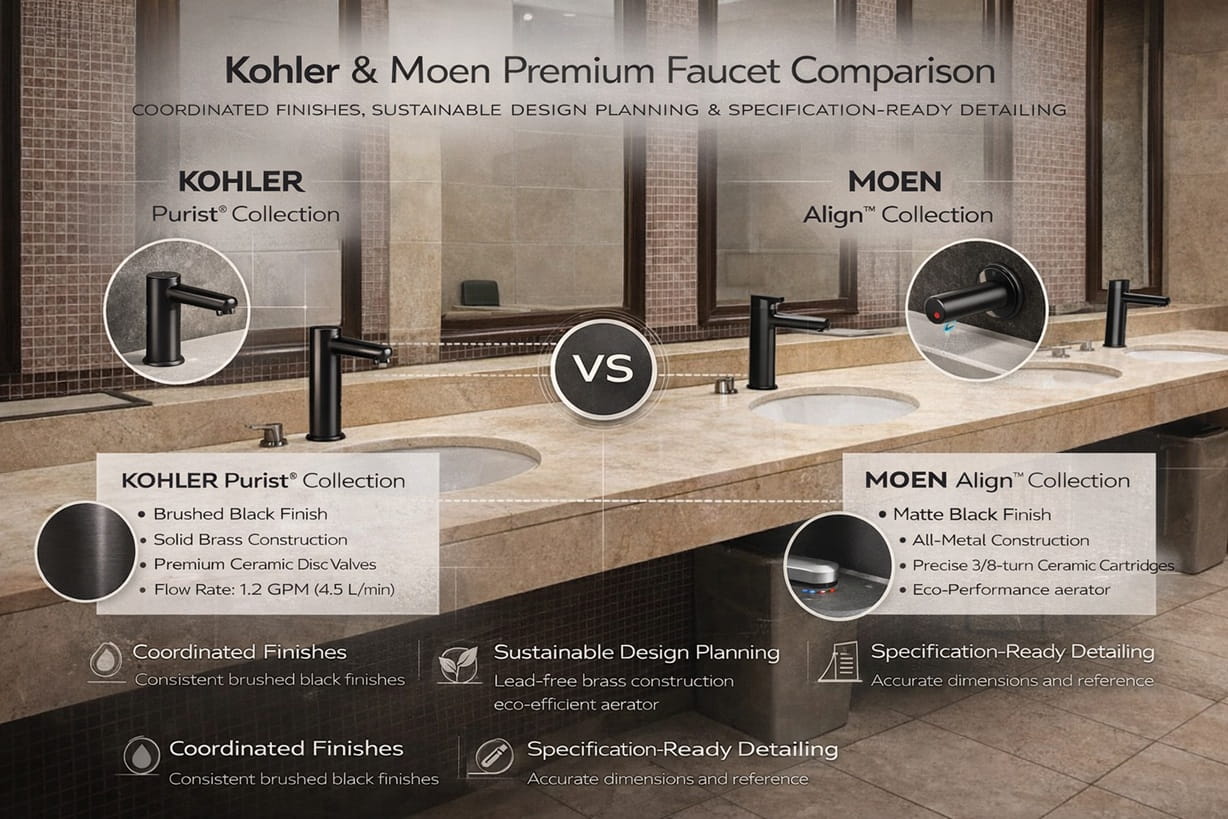
Kohler’s premium positioning often reads as architectural restraint: clean forms that hold up in quiet luxury, hospitality, and workplace interiors. Purist is a good reference point because it is explicitly framed as a go-to design for modern interiors, with “architectural forms” and refined lines.
Moen’s premium strength tends to show up as practical modernism—collections and finish programs designed to look consistent across a project, while supporting operational realities (maintenance, reliability, and in some categories, touchless/connected features). In AEC terms, that can be valuable when the owner’s priorities include straightforward maintenance and broad availability of model variants.

Sustainable innovation: water efficiency is necessary, but it’s not the whole story
In 2025-era sustainability conversations, faucets sit in two related buckets: water efficiency (flow control with acceptable performance) and risk-driven water stewardship (preventing avoidable losses from leaks and failures).
WaterSense provides the most common efficiency verification pathway for lavatory faucets and accessories, with third-party certification. For project teams, that means “verify by model number” rather than relying on brand-level assumptions.
Model-level performance evidence: compare like-for-like, not brand-to-brand slogans
A credible technical comparison uses at least one representative spec sheet from each brand. For Kohler, the Purist widespread lavatory faucet spec sheet states 1.2 gpm (4.5 lpm) max at 60 psi, and provides dimensional data such as spout reach—useful for splash control and basin pairing.
For Moen, many lavatory faucet specs also publish 1.2 gpm max at 60 psi and list third-party certification (commonly WaterSense) plus referenced standards (ASME A112.18.1/CSA B125.1, and NSF 61/9 and NSF 372). That combination is useful in submittals because it ties performance and compliance to a single, auditable document.
Finish systems and maintenance: durability is a specification issue
A premium finish is not just a color—it’s a maintenance agreement between designers, owners, and cleaning staff. Kohler provides finish-selection literature and positions its Vibrant finishes as PVD-based in many regions, while also publishing a general maintenance guide focused on mild soap, thorough rinsing, and soft-cloth drying.
Moen’s finish-care documentation for Spot Resist finishes similarly emphasizes mild soap, rinse, and dry—and explicitly warns against abrasives and harsh chemicals. For AEC teams, the technical implication is straightforward: if your facility uses aggressive chemicals or abrasive tools, write the allowable cleaning regimen into closeout documentation, or expect finish degradation and warranty friction.
Beyond efficiency: leak prevention as sustainability (and operational resilience)
The most overlooked sustainability lever in buildings is preventing water damage and avoidable loss. Moen’s ecosystem includes whole-home monitoring and shutoff (Flo by Moen), and public announcements around insurer partnerships frame the value in measurable terms—reducing catastrophic loss frequency and preventing wasted water from leaks.
Kohler’s sustainability framing emphasizes water stewardship as a core ambition (“Water Stewardship Through Uncompromising Design”), which can be useful for owner narratives and ESG-aligned project goals, especially when paired with model-level WaterSense verification.
A practical project takeaway when choosing between Kohler and Moen
For most architects and specifiers, this comparison becomes most useful when it moves beyond brand reputation and into project fit. The stronger selection is usually the one that keeps design intent consistent while also making submittals, maintenance, and owner expectations easier to manage after installation.
Kohler often fits projects where the design story depends on restrained form, finish coordination, and a more architecture-led material language. Moen can be especially compelling where practical sustainability, broad model availability, and operational resilience are part of the owner’s priorities. In both cases, the smartest decision comes from checking the exact model, the exact finish, and the exact documentation package rather than relying on brand-level assumptions.
From a content and indexing standpoint, this continuation also strengthens the article by adding owner-focused and specifier-focused language around resilience, documentation quality, and long-term value. That helps the post speak to both design-led readers and teams making practical buying decisions.
BIM and specification integration: where schedules live or die
In AEC workflows, integration is mostly retrieval and consistency: can the project team quickly obtain BIM/CAD and technical documents, and are those documents stable enough for submittals and closeout?
Kohler provides a professional portal for technical specifications and a file hub for Revit/CAD/3D downloads. Moen content is available through common BIM libraries as well. The practical approach is the same for both: standardize your internal “submittal packet” requirements and reject incomplete documentation early.
Comparison matrix: premium design + sustainable innovation (what’s worth comparing)
This table is intentionally “spec-first.” It’s less about taste, and more about what you can defend in a submittal meeting.
| Decision lens | Kohler (signals to look for) | Moen (signals to look for) | Why it matters in architecture |
|---|---|---|---|
| Design-line discipline | Architectural restraint; classic-modern lines positioned for designers (e.g., Purist) | Practical modernism across broad model families and finish programs | Coherence across suites reduces visual drift and VE pressure |
| Model-level evidence | Spec sheets with flow at reference pressure + dimensions for basin pairing | Spec sheets with flow at reference pressure + listed standards/certifications | Submittals become auditable and consistent |
| Water efficiency | Verify by WaterSense where applicable; align with owner requirements | Verify by WaterSense where applicable; align with jurisdictional rules | Efficiency targets are now baseline requirements in many projects |
| Finish durability + care | Finish portfolios + care guidance; PVD framing in Vibrant finishes | Clear care guidance for Spot Resist finishes; avoid harsh cleaners/abrasives | Finish degradation is a high-visibility failure mode |
| Resilience / leak prevention | Water stewardship ambition supports owner narratives and ESG alignment | Whole-home leak monitoring/shutoff ecosystem and insurer partnership framing | Leak losses can dominate lifecycle impact and cost |
| BIM/spec deliverability | Professional portals for technical specs + Revit/CAD/3D downloads | BIM content available via common libraries; verify document completeness | Documentation quality reduces RFIs and late substitutions |
Specification checklist: writing a sustainable, premium faucet package (brand-flexible)
- Performance: state max flow at reference pressure (e.g., 1.2 gpm @ 60 psi) and require model-level spec sheets.
- Verification: require WaterSense listing where applicable; verify by model number using EPA’s directory.
- Materials/compliance: require referenced standards (ASME A112.18.1/CSA B125.1, NSF 61/9, NSF 372 where applicable) on the submittal.
- Geometry: coordinate spout reach with basin geometry to control splash and user comfort.
- Finish care: include cleaning constraints in O&M; prohibit abrasives and harsh chemicals unless the finish system explicitly supports them.
- Documentation: require BIM/CAD + spec + installation + care guide as one coordinated packet.
- Resilience: for high-value projects, evaluate leak detection/shutoff strategies as part of sustainability and risk control.
Verified support links & documents
-
 resources.kohler.com • PDF
Kohler Purist K-14406-4 spec sheet (1.2 gpm @ 60 psi)Model-level flow, dimensions, and submittal-ready evidence for lavatory specification.
resources.kohler.com • PDF
Kohler Purist K-14406-4 spec sheet (1.2 gpm @ 60 psi)Model-level flow, dimensions, and submittal-ready evidence for lavatory specification. -
assets.moen.com • PDF
Moen 6150 series spec sheet (1.2 gpm @ 60 psi + certifications)Useful for showing flow, referenced standards, and certification language in one document.
-
epa.gov • program
WaterSense products (how verification works)Explains third-party certification and why model verification matters for specs.
-
epa.gov • directory
WaterSense product search (model verification)Use to confirm a specific model is labeled—avoid brand-level assumptions.
-
resources.kohler.com • PDF
Kohler maintenance guide (finish care)Non-abrasive care guidance—critical for finish longevity and warranty alignment.
-
assets.moen.com • PDF
Moen Spot Resist finish care (PDF)Cleaning constraints that should be reflected in O&M and owner training.
-
kohlercompany.com • impact
Kohler Water Ambition (stewardship through design)Owner-facing framing that can support ESG narratives when paired with model verification.
-
resources.kohler.com • PDF
Kohler 2024 Global Impact ReportCorporate-level sustainability context; use as narrative support, not as model proof.
-
fbin.com • PDF
Fortune Brands Innovations 2024 ESG Report (Moen/Flo references)Useful for understanding how leak prevention is positioned as sustainability and safety.
-
businesswire.com • announcement
Moen insurer partnership announcement (leak-risk framing)Supports the “resilience as sustainability” argument with measurable claims language.
-
kohler.com • pro portal
Kohler technical specs portalSpec sheets and documentation retrieval to keep submittals coherent.
-
studiokohler.com • files
Kohler Revit/CAD/3D download hubDesign-file access for coordination workflows and consistent schedules.
-
bimobject.com • BIM
Moen BIM objects libraryBIM availability reference—still verify that geometry matches the exact spec sheet.