“Classic” in architecture is not nostalgia. It’s proportional control, durable finishes, and details that stay calm in busy spaces. This 2025 review focuses on what actually matters to AEC teams: design-line discipline across a suite, documentation quality (BIM/CAD/specs), water-performance constraints, finish durability signals, and maintenance realities.

2025 lens: what changed (and why “classic” still wins)
In 2025, the most common faucet failures on projects are still not “style failures.” They are coordination failures: mismatched hole patterns, unclear service access, finish inconsistency across trades, and performance expectations that do not match real pressure conditions and water chemistry.
At the same time, the efficiency bar keeps tightening. The U.S. EPA’s WaterSense program has been actively reviewing and discussing revisions to faucet specifications, reflecting a market that increasingly treats 1.2 gpm class performance as a mainstream target for many private lavatory applications.
Design discipline: classic profiles that still read modern
Kohler’s architectural strength is the way certain collections hold a restrained, classic profile while still fitting modern interiors. The Purist line is framed as “simplicity at work,” combining architectural forms with refined lines—exactly the kind of quiet geometry that works across hospitality, workplace, and contemporary residential.
When a design language needs more flexibility than a single “hero faucet,” Kohler’s Components collection is positioned as modular: spouts, handles, and accessories are treated as composable elements. For architects, modularity is not a trend—it is a risk reducer when mounting types, reach, or handle ergonomics must change across room types.
Performance proof: start with one spec sheet, then scale
A credible architectural faucet review should include at least one concrete technical example—because this is where assumptions fail. On Kohler’s Purist widespread lavatory faucet (K-14406-4), the spec sheet states a maximum flow rate of 1.2 gpm (4.5 lpm) at 60 psi, and notes ceramic disc valves intended to exceed longevity standards.
That single data point tells you how to spec the rest of the package: verify flow rates model-by-model, and coordinate performance with basin geometry to reduce splash. The spec sheet also lists common compliance anchors that frequently appear in submittals and jurisdictional requirements.
A practical 2025 takeaway for architects specifying Kohler in classic-modern spaces
For many project teams, Kohler’s value is strongest when a faucet needs to look restrained on day one and still feel appropriate after years of use. That is what makes a classic-modern line useful in architecture: it does not depend on trend-driven shapes to stay relevant. It depends on proportion, finish consistency, and documentation that helps the design survive coordination, installation, and maintenance.
This is especially important in hospitality, premium residential, workplace, and shared amenity spaces where the faucet becomes part of the larger material story. When the line stays visually calm, the finish holds up under cleaning, and the technical files are easy to retrieve, the specification becomes easier to defend from concept through closeout.
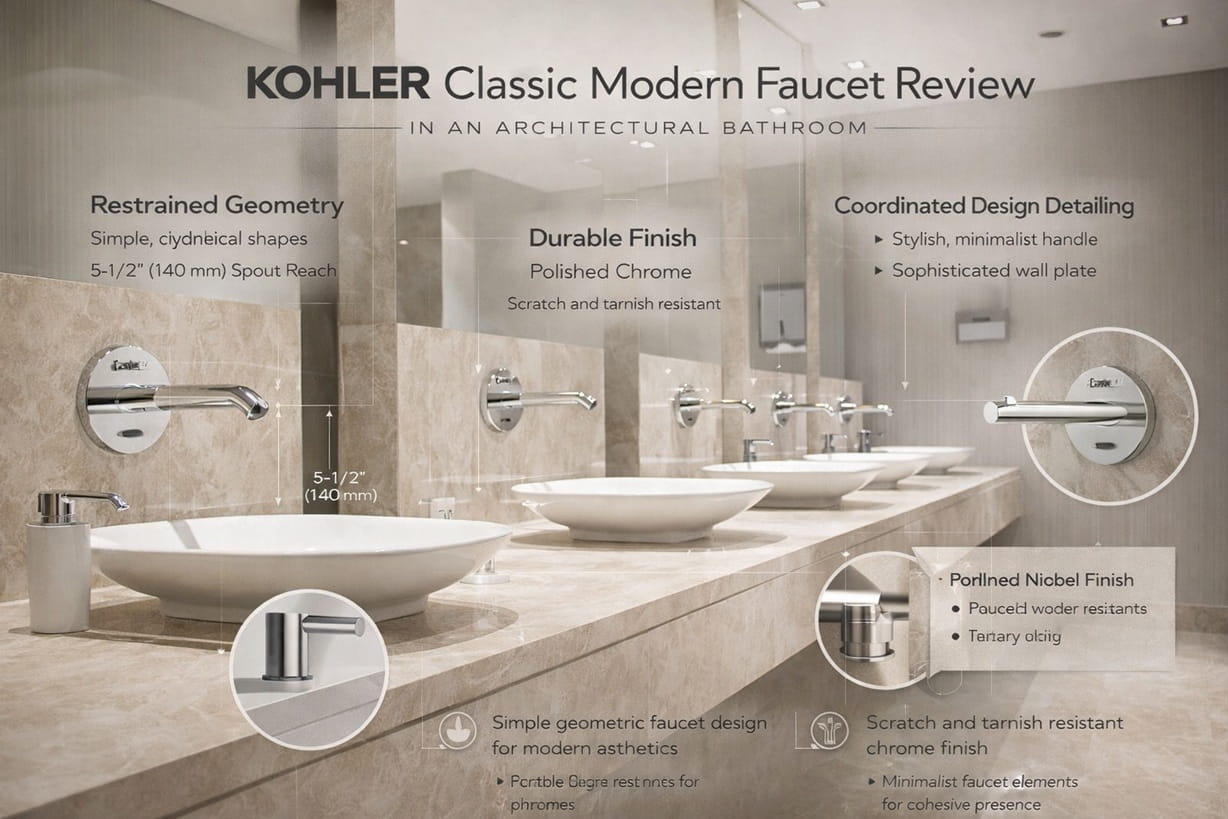
For search visibility and content depth, this kind of continuation also broadens the article in a useful way. It adds owner-facing and specifier-facing language around long-term suitability, design consistency, and deliverability without repeating the earlier technical sections.
Architectural integration: BIM, CAD, and spec deliverability
In practice, architectural faucets are “integrated” when the team can coordinate them quickly and consistently: accurate BIM families, CAD/2D details when needed, and a technical portal that keeps documents easy to retrieve. Kohler supports this workflow through its downloadable Revit/CAD/3D resource hub and professional technical specifications portal.
A useful internal standard is to require a coordinated submittal set for every faucet selection: BIM or dimensioned CAD, spec sheet, installation requirements, and a finish care document—all tied to the exact model number and finish code.
Finishes in 2025: selection is easy; durability is the hard part
“Classic design” succeeds only if the finish stays calm under cleaning and use. Kohler’s literature pushes finish selection as the start of the design story, and its Vibrant finish messaging ties durability to PVD (physical vapor deposition) processes. In architectural practice, the finish conversation becomes actionable when it is paired with test language and realistic care guidance.
Two standards commonly used as reference points in finish durability discussions are ISO salt spray testing and ASTM salt spray apparatus practice. These do not replace product-specific evidence, but they help teams align on what “corrosion resistance” claims actually mean.
Maintenance: the most “classic” projects are the ones that age well
A faucet that looks correct on day one but degrades by month six is not an architectural win. Kohler’s maintenance guide emphasizes mild soap, thorough rinse, and soft-cloth drying, and explicitly warns against abrasive cleaners and certain chemical agents that can damage finishes.
For architects and owners, the key step is to align cleaning protocols with the specified finishes during handover. If a project has aggressive cleaning regimens (hospitality, healthcare, high-traffic public areas), this should be documented at the same level as any other performance requirement.
AEC spec matrix: how Kohler’s “classic modern” holds up
Use this matrix to translate “design intent” into deliverable requirements you can defend in submittals.
| Lens (AEC) | What to look for (Kohler signals) | What to verify | Why it matters |
|---|---|---|---|
| Classic design discipline | Collections framed around restrained geometry (e.g., Purist) and suite-level cohesion | Consistency across room types: single-hole vs widespread vs wall-mount (as applicable) | Reduces “visual drift” and substitution pressure |
| Modularity | Components positioned as modular spouts/handles/accessories | Ability to change reach/handle without changing the whole language | Protects intent when constraints shift late in design |
| Water performance | Model-level flow stated at a reference pressure (example: 1.2 gpm @ 60 psi) | Comfort + splash behavior with the chosen basin at expected building pressures | Stops performance complaints before they start |
| Materials + compliance | Standards and listings referenced (ASME scope; NSF lead-content methodology) | Verify by directory and submittal set for the exact model/finish code | Reduces inspection risk and owner compliance surprises |
| Finish durability | Finish portfolio + PVD documentation (Vibrant) + care guidance | Cleaning compatibility, abrasion risk, and owner maintenance capacity | Finish failures are expensive and highly visible |
| Documentation & BIM | Revit/CAD/3D hub + professional tech specs portal | BIM dimensions match the spec sheet and field conditions | Improves coordination speed and reduces RFIs |

Verified support links & documents
-
 resources.kohler.com • PDF
Purist K-14406-4 spec sheet (1.2 gpm @ 60 psi + compliance anchors)Use as a model for how to validate flow, standards, and submittal language—then repeat for each selected model.
resources.kohler.com • PDF
Purist K-14406-4 spec sheet (1.2 gpm @ 60 psi + compliance anchors)Use as a model for how to validate flow, standards, and submittal language—then repeat for each selected model. -
studiokohler.com • resources
KOHLER Revit/CAD/3D download hubCentral pathway for design files and technical documents to keep coordination tight.
-
kohler.com • pro resources
Product technical specs & instructions (professional portal)Useful for retrieving spec sheets and documentation required in submittals and closeout.
-
resources.kohler.com • PDF
Kohler finishes portfolio insertFinish selection framework—pair with maintenance guidance to avoid premature finish degradation.
-
resources.kohler.com • PDF
Kohler Vibrant PVD finishes leafletPVD-focused finish documentation for durability discussions and owner expectations.
-
resources.kohler.com • PDF
Kohler maintenance guide (finish care)Operational reality: mild soap, rinse, soft-cloth dry; avoid abrasives and harsh chemicals.
-
epa.gov • PDF
EPA WaterSense NOI (spec revision discussion)Shows the direction of travel on efficiency/performance criteria for lavatory faucets and accessories.
-
epa.gov • directory
EPA WaterSense product searchVerify water-efficiency status model-by-model (critical for specifications and owner requirements).
-
nsf.org • directory
NSF lead content directory (NSF/ANSI/CAN 372)Independent listing search to support lead-content verification when required.
-
asme.org • standard
ASME A112.18.1/CSA B125.1 scope overviewBaseline scope context for plumbing supply fittings frequently referenced in faucet spec sheets.
-
iso.org • standard
ISO 9227 reference (salt spray tests)Common corrosion-test reference point used in finish durability conversations.
-
astm.org • standard
ASTM B117 reference (salt spray apparatus practice)Widely used practice for creating and maintaining salt spray test environments.