In architecture, “integration” is the difference between a clean concept and a messy closeout. This comparison looks at what actually changes outcomes: design-line coherence across a suite, finish systems, BIM/CAD deliverability, and water-performance behavior under real pressure conditions.

What “design lines” mean for architects (beyond style names)
A design line is useful only if it behaves like a system. For AEC teams, that means the line offers a consistent geometry across common typologies (single-hole, widespread, wall-mount, vessel), and it coordinates with the rest of the bathroom language (accessories, shower controls, sometimes ceramics).
The practical test is simple: can you keep one design intent across different room conditions without forcing substitutions, odd hole patterns, or “close enough” finishes?
Grohe design lines: a clear geometric strategy (soft, cube, circle)
Grohe’s portfolio reads like a geometry toolkit—helpful when your interior concept is driven by form discipline. Essence is positioned as “clean, simple” and understated; Eurocube pushes an orthogonal, sculptural language; Atrio is framed around the circle as the elemental form.
For architects, that variety matters because it maps cleanly to common design narratives: soft-minimal hospitality, crisp rectilinear commercial, or timeless “quiet luxury” without visual noise.
A practical conclusion for teams choosing between Grohe and Kohler design systems
For most project teams, this comparison becomes clearest when the focus shifts from brand preference to coordination value. The better choice is usually the one that keeps design intent consistent across room types, moves cleanly through BIM and submittals, and stays easier to verify when finishes, flow rates, and compliance requirements are reviewed in detail.
Grohe often stands out when a project benefits from highly legible geometric families and a strong sense of formal consistency across contemporary spaces. Kohler can be especially useful when modular flexibility, broader suite-level coordination, or finish selection tools matter more during documentation and owner review. In both cases, the real win comes from choosing the line that reduces downstream substitutions and keeps the specification easier to defend.
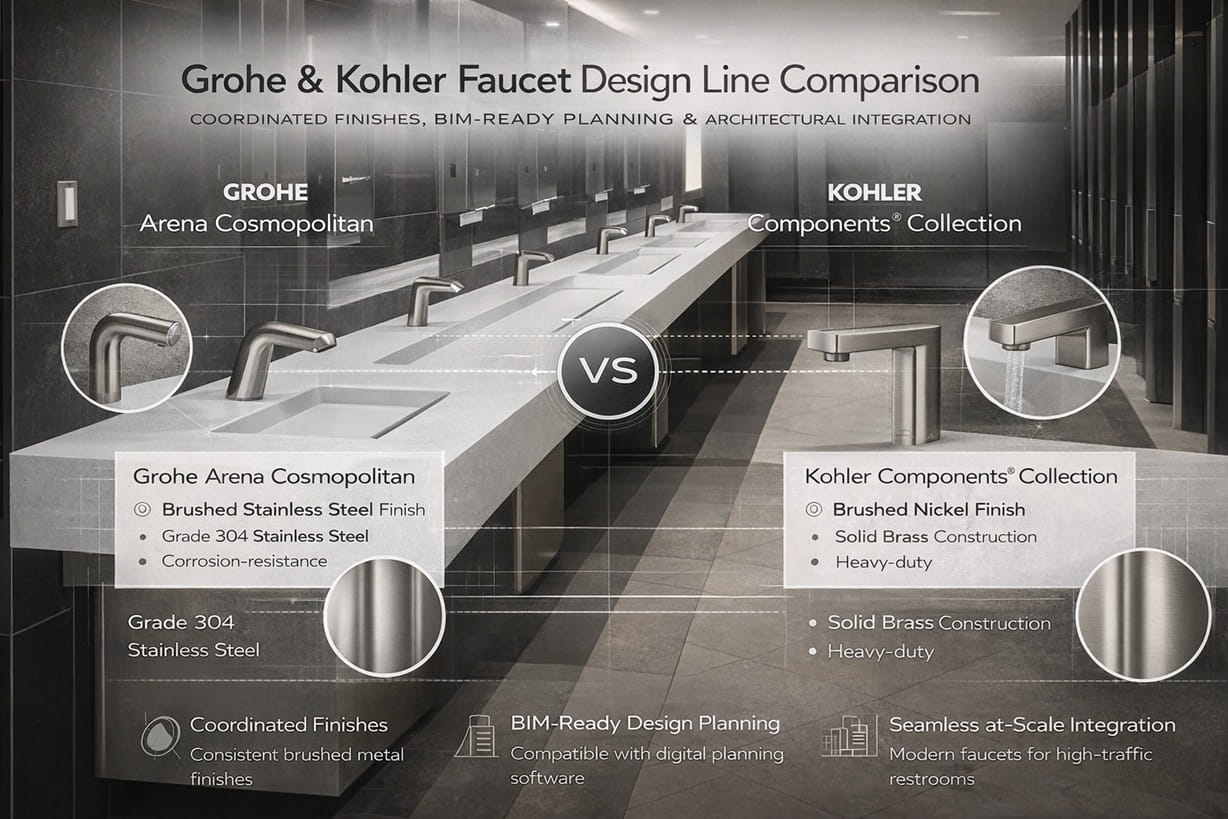
From an SEO and content-expansion angle, this continuation also helps the article connect with readers looking for more than style comparisons. It adds practical language around BIM coordination, suite consistency, and specification workflow, which makes the post more useful for architects, designers, contractors, and owner-side decision makers.
Kohler design lines: architectural minimalism, modularity, and heritage
Kohler’s strength is the breadth of “architect-friendly” lines that still behave like systems. Purist is explicitly framed as architectural form with restrained lines; Components is described as a modular set where spouts and handles are treated as composable elements; Artifacts leans into crafted heritage cues.
The difference is not taste—it’s spec strategy. A modular line can protect design intent when you need to vary spout reach, handle type, or mounting without changing the overall language.
Architectural integration: BIM/CAD, specs, and submittal survivability
Integration is mostly documentation. The best-looking faucet loses value if the project team cannot coordinate it, or if submittals drift into unreviewed substitutions.
- Grohe: publishes BIM access pathways for designers and offers CAD data tools that support coordination workflows.
- Kohler: provides Revit/CAD/3D resources through its technical portal and also maintains a large BIM library presence on BIMobject.
Water performance: compare behavior, not marketing terms
Two faucets can both be “efficient” and still feel completely different. The AEC-relevant difference is how they behave under real pressure ranges and how service steps preserve that behavior over time.
Example signals from manufacturer documentation: Grohe’s Eurocube manual publishes max flow (1.5 gpm at 60 psi) plus a minimum and recommended pressure band, and it explicitly requires flushing the piping before and after installation. Kohler’s Purist spec sheet publishes 1.2 gpm at 60 psi for the widespread faucet configuration and lists common compliance anchors (WaterSense, NSF/ANSI 61, NSF/ANSI 372, and ASME A112.18.1/CSA B125.1).
Finish integration: durability signals and suite-level coordination
Finish integration is where many projects quietly fail. Architects need two things: a finish system that coordinates across visible metals, and care guidance that matches the reality of cleaning regimens.
Grohe publishes PVD-focused finish literature (including claims about increased hardness and scratch resistance), while Kohler publishes a finishes portfolio and PVD (“Vibrant”) documentation aimed at suite-level selection. Kohler also provides a general maintenance guide that emphasizes non-abrasive cleaning and drying to reduce deposits.
Comparison table: design lines + integration, the parts that matter
This table is tuned for architectural decision-making: what survives from concept through commissioning.
| Decision lens | Grohe (what stands out) | Kohler (what stands out) | Why it matters in AEC |
|---|---|---|---|
| Design-line clarity | Strong geometric families (Essence, Eurocube, Atrio) that map cleanly to interior narratives | Architectural minimalism + heritage + modularity (Purist, Artifacts, Components) | Reduces “visual drift” when typologies vary across a project |
| System thinking | Collections often extend across bathroom elements for cohesive schemes | Components supports composable, modular specification strategies | Modularity protects intent when reach, mounting, or handle type must change |
| BIM/CAD workflow | Published BIM data access + CAD download tools | Technical portal for Revit/CAD/3D + large BIMobject library footprint | Improves coordination speed; reduces late substitutions |
| Performance evidence | Some manuals publish pressure bands and commissioning steps (flush piping, etc.) | Spec sheets clearly publish flow at reference pressure; code anchors listed | Clear evidence reduces disputes during inspections and closeout |
| Finish coordination + care | PVD-focused literature; durability framing for surfaces | Finish portfolio + PVD (Vibrant) documentation; general care guidance | Finish mismatch and cleaning damage are common “silent failures” |

How to write an “integration-first” faucet spec (usable for both brands)
If you want to stay brand-flexible without getting vague, write requirements that force deliverability:
- Deliverables: BIM family + spec sheet + installation guide as one coordinated submittal set.
- Commissioning: flush and validate supply conditions; confirm regulator/aerator serviceability.
- Efficiency verification: require third-party certification where applicable (verify by model, not by brand).
- Material verification: use independent directories for lead-content listings when required by owners/jurisdictions.
- Finish care: include non-abrasive cleaning constraints in O&M and closeout training.
Verified support links & documents
-
 grohe.ie • collection
Grohe Essence collection positioningUseful for explaining the “soft minimal” design line in architectural terms.
grohe.ie • collection
Grohe Essence collection positioningUseful for explaining the “soft minimal” design line in architectural terms. -
grohe.co.uk • collection
Grohe Eurocube collection overviewShows collection breadth and the intent to keep a cohesive scheme.
-
grohe.us • collection
Grohe Atrio collection positioning (circle geometry)Good for describing “elemental form” strategies in high-end interiors.
-
cdn.cloud.grohe.com • PDF
Grohe Eurocube manual (flow + pressure band + commissioning steps)Practical integration evidence: pressure ranges, flushing instructions, and baseline specs.
-
grohe.ie • BIM
Grohe BIM data (designer access)Architect-facing BIM access path for coordination workflows.
-
grohe.is • CAD
Grohe CAD data downloadUseful for documentation completeness when BIM is not required.
-
studiokohler.com • design story
Studio KOHLER: Purist design storyExplains the architectural intent behind one of Kohler’s most specified modern lines.
-
studiokohler.com • design story
Studio KOHLER: Components design story (modular)Modularity is a real integration tool when spout/handle needs change mid-project.
-
studiokohler.com • design story
Studio KOHLER: Artifacts design storyUseful when heritage cues are part of the interior narrative.
-
resources.kohler.com • PDF
Kohler Purist K-14406-4 spec sheet (flow + codes)Model-level evidence: 1.2 gpm @ 60 psi plus listed standards and compliance anchors.
-
studiokohler.com • technical portal
Kohler Revit/CAD/3D files (technical specifications portal)Central hub for documentation needed in submittals and coordination.
-
bimobject.com • BIM library
Kohler BIM library (BIMobject)Broad BIM availability can improve spec survivability across project phases.
-
resources.kohler.com • PDF
Kohler finishes portfolio insertSuite-level finish coordination tool for consistent interiors.
-
resources.kohler.com • PDF
Kohler Vibrant PVD finishes leafletFinish-system support when the project relies on PVD longevity and consistency.
-
resources.kohler.com • PDF
Kohler maintenance guide (finish care)Non-abrasive care guidance that helps finishes stay “spec-true” over time.
-
epa.gov • directory
EPA WaterSense product search (verify models)Verification tool for water-efficiency requirements—model-by-model.
-
nsf.org • directory
NSF lead content directory (NSF/ANSI/CAN 372)Independent directory to confirm lead-content listings when required.
-
asme.org • standard
ASME A112.18.1/CSA B125.1 scope overviewBaseline standard context for plumbing supply fittings referenced in many spec sheets.

