This review is written for architects, interior designers, and specifiers who care about two outcomes: the faucet reads “precise” at arm’s length, and it performs predictably under real pressure conditions, real water chemistry, and real maintenance cycles. No hype—only what affects project risk and user experience.

What “aesthetic precision” means in architecture
Architectural faucets are judged like hardware: edges, alignments, and surface continuity matter as much as silhouette. On high-traffic projects, that “precision” has to survive cleaning and use—otherwise a crisp spec turns into visual noise.
Grohe’s design reputation is supported most clearly by the way it pairs “feel” with geometry. The brand explicitly frames its faucet experience around cartridge behavior and controlled actuation, not only shape. Grohe’s SilkMove cartridge system is described as precision control using ceramic discs and a low-friction approach designed for long-term smooth handling.
Water performance: the three numbers that decide real satisfaction
Architects often see flow rate as a sustainability metric. Users experience it as comfort—and splash. The most reliable performance view uses three numbers: maximum flow at a reference pressure, minimum usable pressure, and the faucet’s aerator/flow regulator behavior over time.
For example, Grohe’s Eurocube installation document states a maximum flow of 5.7 L/min (1.5 gpm) at 60 psi, and provides a practical pressure range (including a minimum and a recommended band). It also calls out a real maintenance issue: periodically cleaning the flow regulator (aerator) to restore performance.

Splash control is part of performance (not a user behavior issue)
Water performance is not only flow rate. It’s where the stream lands and how it breaks up. On modern shallow basins, a small shift in reach or stream angle can change splash outcomes dramatically.
The “architect move” is to treat faucet + basin as one system: confirm the stream impact point in a mock-up, and verify performance at the pressures the building actually sees. The Eurocube guidance even includes a simple but high-impact field step: flush piping thoroughly before and after installation. That step reduces debris that can foul the regulator, valves, or cartridge behavior.
Controls that protect intent: temperature limiter + flow limiter (the quiet heroes)
In multi-user buildings, comfort and safety are strongly affected by limiter strategies. Grohe’s documentation and parts listings commonly include adjustable limiters (temperature and/or flow) at the cartridge level. That is practical for designers because it creates a path to “cap” risk without changing the aesthetic.
The Eurocube document describes a temperature limiter that can be commissioned and adjusted, and a cartridge assembly that must be installed correctly to maintain intended behavior. For specifiers, this becomes enforceable: require commissioning, not just installation.
Finishes: what matters is the system and the evidence
Finish discussions get subjective fast. Keep it technical: what is the finish process, and what durability signals are provided? Grohe frames its StarLight surfaces as made-to-last, and explicitly connects its PVD process to increased hardness and scratch resistance.
For architects, the key move is to map that finish story onto test language used in specifications. ISO salt spray testing (ISO 9227) and ASTM salt spray practice (ASTM B117) are common reference anchors when teams request durability evidence for coatings and plated systems—especially in demanding cleaning environments.
Water efficiency and verification: keep it model-by-model
If your project targets water reduction or certifications, don’t assume a brand equals compliance. WaterSense is a clean reference point because labeled products are backed by independent third-party certification, and the EPA provides a public product search to verify specific models.
EPA materials also show that the market is shifting toward lower maximum flow rates in many regions (with discussion of thresholds like 1.5 gpm and newer interest in 1.2 gpm for some categories). That matters because “water performance” is increasingly shaped by code and owner requirements, not only by design intent.

BIM and spec workflow: where Grohe helps architects move faster
In real projects, “architectural readiness” shows up as downloadable BIM and consistent technical files. Grohe publishes BIM access pathways and also appears in major BIM distribution libraries, which reduces friction from concept through CDs.
AEC-ready review table: aesthetic precision + water performance in one checklist
Use this table as a pre-submittal checklist. It is structured around what actually changes outcomes on site.
| Review lens | What to look for in Grohe docs | What to verify (mock-up / site) | Why it’s worth discussing |
|---|---|---|---|
| Aesthetic precision | Control narrative (cartridge + lever feel), finish system description | Gap consistency, reflection continuity, lever feel “under load” | Precision only counts if it survives use and cleaning |
| Hydraulic performance | Max flow at reference pressure; pressure ranges; regulator notes | Comfort at actual building pressure; stream impact point; splash | Flow rate alone doesn’t predict satisfaction |
| Commissioning | Flush piping steps; limiter commissioning notes | Debris management; regulator cleanliness; stable operation | Most “performance failures” start as commissioning failures |
| Finish durability | PVD/finish claims + cleaning guidance | Cleaning-chemical compatibility and scratch behavior | High-use spaces expose finishes immediately |
| Verification | Model-by-model compliance pathways (WaterSense, lead content) | Directory verification for the exact model number | Prevents late inspection or owner-requirement surprises |
| BIM deliverability | Revit families / BIM objects + matching technical files | Does BIM match the cut sheet/manual dimensions? | Reduces coordination friction across disciplines |
Why Grohe often performs well in projects that demand both visual control and daily reliability
For many architects, the strongest value in Grohe is not only the visual discipline of the faucet body. It is the way that design, flow control, and service logic tend to support each other in real project use. That becomes especially important in hospitality, premium residential, workplace, and mixed-use interiors where a faucet must stay consistent after months of cleaning and repeated handling.
In that context, aesthetic precision should be understood as a long-term performance quality. A faucet that keeps a stable stream, maintains a clean finish appearance, and remains easy to service protects the original design intent far better than a product that looks refined only at installation. This is where control hardware, flow-regulator maintenance, and finish-system evidence become more useful than surface-level style claims.
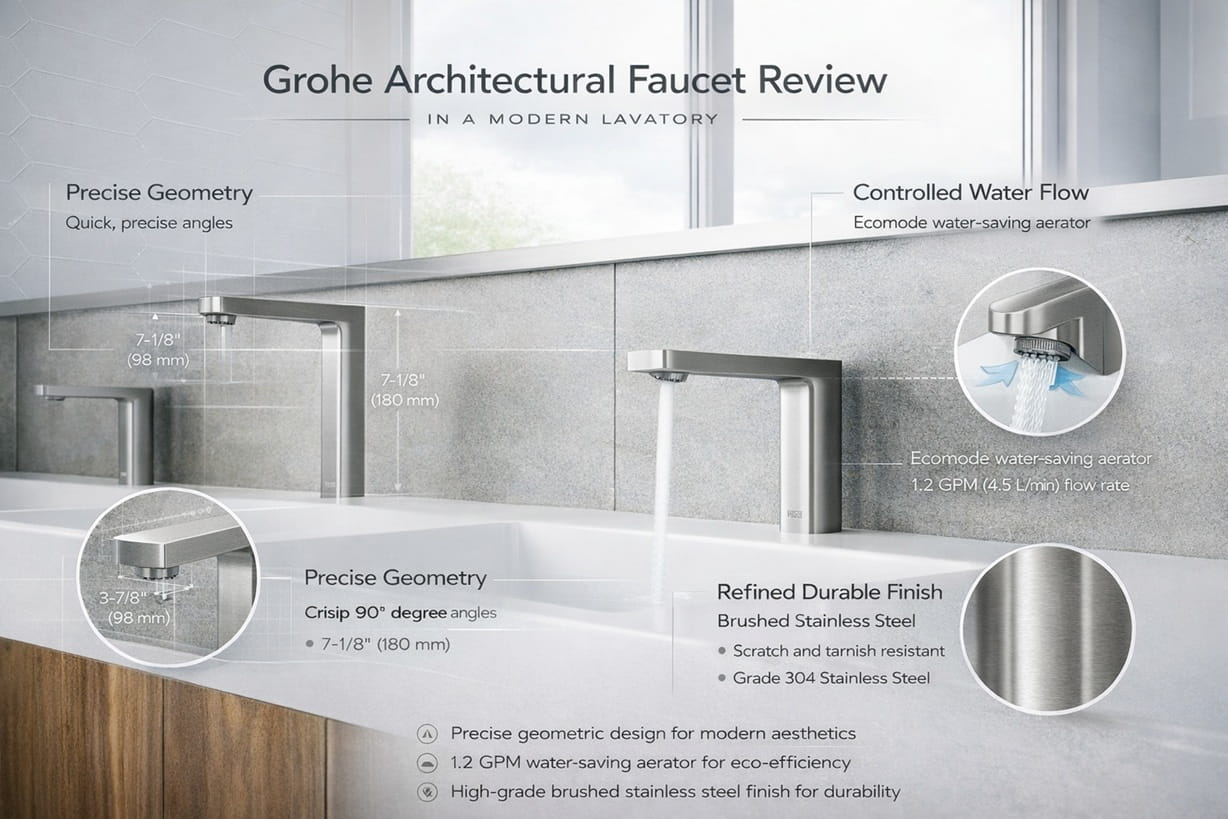
For content expansion and better indexing, this continuation helps connect Grohe’s design reputation with practical project concerns such as finish durability, daily maintenance, and long-term user satisfaction. That makes the article more useful for both design-led readers and specifiers looking for clearer product-evaluation language.
Verified support links & documents
-
 cdn.cloud.grohe.com • PDF
Grohe Eurocube installation document (flow rate, pressure band, flushing, regulator cleaning)A strong example of “water performance” evidence that maps to commissioning and maintenance.
cdn.cloud.grohe.com • PDF
Grohe Eurocube installation document (flow rate, pressure band, flushing, regulator cleaning)A strong example of “water performance” evidence that maps to commissioning and maintenance. -
grohe.us • technology
Grohe EcoJoy faucets (flow-limiting framing)Useful context for how Grohe positions low-flow comfort; pair with per-model technical sheets.
-
grohe.com • technology
Grohe Technology overview (SilkMove described as precision control)Connects aesthetic “precision” to control behavior—useful for performance-driven narratives.
-
grohe-cac.com • technology
Grohe SilkMove explainer (ceramic discs + smooth handling)Helpful for describing “feel” in technical terms instead of style language.
-
grohe.co.uk • parts
Grohe cartridge listing (SilkMove + limiter mentions)A practical reference when writing submittal requirements around limiters and service parts.
-
grohe.sg • finishes
Grohe StarLight surfaces (PVD process described)Finish-system framing for durability discussions; pair with your project’s testing evidence requirements.
-
iso.org • standard
ISO 9227 (salt spray tests) — corrosion testing referenceCommon spec anchor for finish durability evidence (NSS/AASS/CASS variants).
-
astm.org • standard
ASTM B117 (salt spray apparatus practice)Widely referenced practice for salt spray testing environments in coatings discussions.
-
epa.gov • directory
EPA WaterSense product search (verify models)Model-by-model verification tool for water-efficiency requirements.
-
epa.gov • guidance
EPA WaterSense products overview (third-party certification note)Useful for explaining why labeled products are a reliable spec pathway.
-
epa.gov • PDF
EPA (PDF): faucet specification revision discussion (1.5 gpm / 1.2 gpm context)Shows the direction of travel for faucet efficiency thresholds in many markets.
-
asme.org • standard
ASME A112.18.1/CSA B125.1 scope overviewBaseline technical context for plumbing supply fittings requirements and testing references.
-
nsf.org • guidance
NSF/ANSI/CAN 372 technical requirements (lead content)Standardized methodology for determining and verifying lead content compliance.
-
grohe.is • BIM
Grohe BIM data (official planning support)Direct BIM access path for planners; pair with manual/cut sheet verification during submittals.
-
bimobject.com • BIM library
Grohe BIMobject library (Revit/ArchiCAD/SketchUp options)BIM distribution reference that can speed up coordination in multi-discipline workflows.

