Architectural faucets are evolving from “finish items” into building-performance interfaces. The next wave is less about novelty and more about measurable outcomes: user experience with lower water/energy, verified lead-content compliance, longer service life in aggressive water chemistries, and automation that integrates with building operations without creating hygiene or cybersecurity risks.

1) Design trend: performance-first minimalism (where geometry does the work)
The strongest design trend is also the most technical: faucets are being designed as quiet, splash-controlled, low-flow interfaces where the spout, basin, and user behavior are treated as one system. When the discharge pattern and landing zone are right, users don’t compensate by opening the valve wider or running water longer.
In AEC terms, this is a shift away from “select a spout and hope it behaves” toward: defined outlet performance, mock-up verification, and repeatable details that survive value engineering.
- Outlet stability: consistent flow feel across realistic pressures, not just at a test point.
- Splash control: geometry and flow shaping that reduce countertop wetting and slip risk.
- Reduced crevices: simplified forms that are easier to clean and maintain visually.
2) Design trend: universal operability becomes a primary aesthetic constraint
As inclusive design expectations rise, the most durable “trend” is operability: one-hand use, low activation force, and controls that don’t require tight grasping, pinching, or twisting. This influences handle profiles, lever geometry, and how touchless modes are blended with manual override and maintenance access.
For architects, this is not a code-afterthought issue. It becomes a design driver that can guide a consistent language across a project: a lever that reads as refined can still meet operability requirements when the mechanism and force are specified early.

3) Materials science trend: lead-content verification is moving from “claim” to methodology
One of the most consequential trends is invisible: material compliance is becoming more standardized and auditable. In potable applications, lead-content requirements are increasingly framed around standardized methodology—how lead content is calculated, verified, and documented—rather than informal language.
For specifiers, this is good news: it supports clearer submittals and reduces ambiguity during procurement. The technical takeaway is simple: write requirements that point to recognized lead-content verification frameworks so “equivalent” substitutions still meet the same verification logic.
4) Materials science trend: corrosion behavior is driving alloy selection (not only aesthetics)
Water chemistry varies more than many teams expect. That variability is pushing a more scientific approach to alloy selection and microstructure control—especially for brass components in contact with potable water, where dezincification can reduce service life.
Research continues to document how dezincification behaves in different brass alloys and under different water conditions. The architecture-level takeaway is that “brass” is not one material: composition and microstructure choices can meaningfully change durability.
- Durability planning: align service-life expectations with water chemistry risk (especially in large facilities).
- Material transparency: specify the performance intent (dezincification resistance / lead-free approach) and require supporting documentation.
- Commissioning awareness: if a building has long periods of low use, water quality management becomes part of fixture longevity.
5) Materials science trend: coatings engineered for wear and corrosion (PVD and beyond)
Finish is shifting from color selection to surface engineering. Designers want stable appearance, but owners want resistance to scratches, cleaners, and corrosion. That is driving broader adoption of engineered surface treatments—often discussed under Physical Vapor Deposition (PVD) and related coating families.
The key is to treat coatings like performance layers, not decorative films: define what they must resist (cleaning regime, abrasion, chloride exposure), and require realistic maintenance assumptions in O&M.
6) Fabrication trend: additive manufacturing enables internal geometries that conventional machining avoids
Additive manufacturing (AM) is unlikely to replace high-volume faucet production overnight, but it is changing what’s possible in prototypes, limited-run architectural pieces, and internal flow-path design. Complex internal channels can be used to tune pressure loss, reduce noise, and improve mixing stability—if corrosion performance and surface quality are addressed.
AM’s constraint is not creativity; it is surface integrity and corrosion behavior. That’s why AM-related research increasingly focuses on corrosion performance and surface engineering approaches that stabilize the final water-contact surface.
7) Automation trend: touchless evolves into “operationally managed” fixtures
Touchless is maturing. The next step is not more sensors—it’s better control of outcomes: predictable run time, reduced nuisance activations, low-pressure satisfaction, and maintenance visibility. Well-designed automatic faucets can reduce water use in public settings, but real performance depends on tuning and context.
AEC teams are also more openly discussing a hard truth: electronic fixtures can create unintended hygiene risks if they increase stagnation, create warm mixing zones, or complicate cleaning and maintenance. In healthcare, professional guidance emphasizes careful evaluation rather than blanket assumptions.

8) Connected trend: water fixtures meet smart-building protocols and cybersecurity expectations
As fixtures begin to report usage, runtime, fault states, and flush events, they collide with building automation realities: interoperability, commissioning, and secure operations. The trend line is clear: if a device connects, it must connect in a way that building teams can manage—ideally through established building automation communication approaches—and it must support baseline cybersecurity capabilities.
- Interoperability: facilities prefer solutions that integrate into building automation and monitoring practices.
- Cybersecurity baseline: connected devices should support capabilities like secure updates, logging, access control, and data protection.
- Maintainability: device management must be feasible for real operations staff, not only the installer.
9) Health + sustainability trend: automation will be paired with building water management
Low-flow, low-use, and intermittent occupancy can increase stagnation risk in parts of a building. That’s pushing fixture discussions into broader water management planning: flushing, temperature management, and operational control points. In other words, the faucet becomes part of a water management program, not a standalone endpoint.
This is especially relevant where automation can be used responsibly: scheduled flushing routines and operational checks can reduce risk, but only if they are designed as part of the building’s overall risk management approach.
10) Spec trend: lifecycle thinking (LCA + EPD literacy) becomes normal for interior plumbing interfaces
Sustainability trendlines are moving toward lifecycle transparency: embodied impacts, service life, and replacement cycles. For faucet systems, the practical approach is to pair operational performance (water + hot-water energy) with a basic lifecycle lens: expected life, maintainability, and whether environmental disclosures are comparable and meaningful.
The goal is not to turn every project into a research exercise. It’s to avoid short-lived choices that look “green” on paper but create more replacements, more maintenance, and more waste over time.
A practical trend matrix for architects and MEP teams
Use this matrix during schematic design and again during submittals. It keeps “future-ready” language grounded in things you can specify, verify, and operate.
| Trend area | What’s changing | What to ask in design/spec | What to verify (mock-up / commissioning) |
|---|---|---|---|
| Design + UX | Geometry-driven splash + low-flow satisfaction | What is the target discharge pattern + landing zone? | Mock-up: splash, perceived flow at real pressure |
| Accessibility | Operability constraints drive handle/controls | One-hand use? activation force? maintenance override? | Field check: activation force + reach + usability |
| Lead-content verification | Methodology-focused compliance documentation | What verification method/reporting is required? | Submittal review: documentation completeness |
| Corrosion durability | Alloy/microstructure matters with real water chemistries | Water chemistry risk? expected service life? operations plan? | O&M alignment: flushing/low-use plan, maintenance logs |
| Coatings | Surface engineering for wear + cleaner resistance | Cleaner regime? abrasion exposure? warranty assumptions? | Maintenance plan: cleaner list + training + inspection |
| Automation | Touchless as managed performance, not a feature | Runtime tuning? false-trigger mitigation? power strategy? | Commissioning: settings, nuisance events, user feedback |
| Connectivity | Integration + cybersecurity become required | How is device managed, updated, logged, and secured? | Device inventory + config record + update plan |
| Water management | Stagnation risk ties fixtures to WMP strategy | How do flush routines support the building WMP? | WMP documentation + verification checks |
| Lifecycle sustainability | LCA literacy + EPDs support durable decisions | Are disclosures comparable? is service life realistic? | Replacement/maintenance plan consistency |
11) What these trends mean for retrofit projects over the next few years
The most important shift is practical, not futuristic. Owners are starting to expect faucet systems that are easier to document, easier to maintain, and better aligned with wider building goals such as water efficiency, indoor hygiene, accessibility, and digital operations.
That makes retrofit work a major part of the next trend cycle. Many buildings will not replace entire plumbing systems, but they will upgrade fixtures, controls, and maintenance standards in phases. In that setting, the best faucet choices are the ones that deliver measurable performance without adding operational friction.
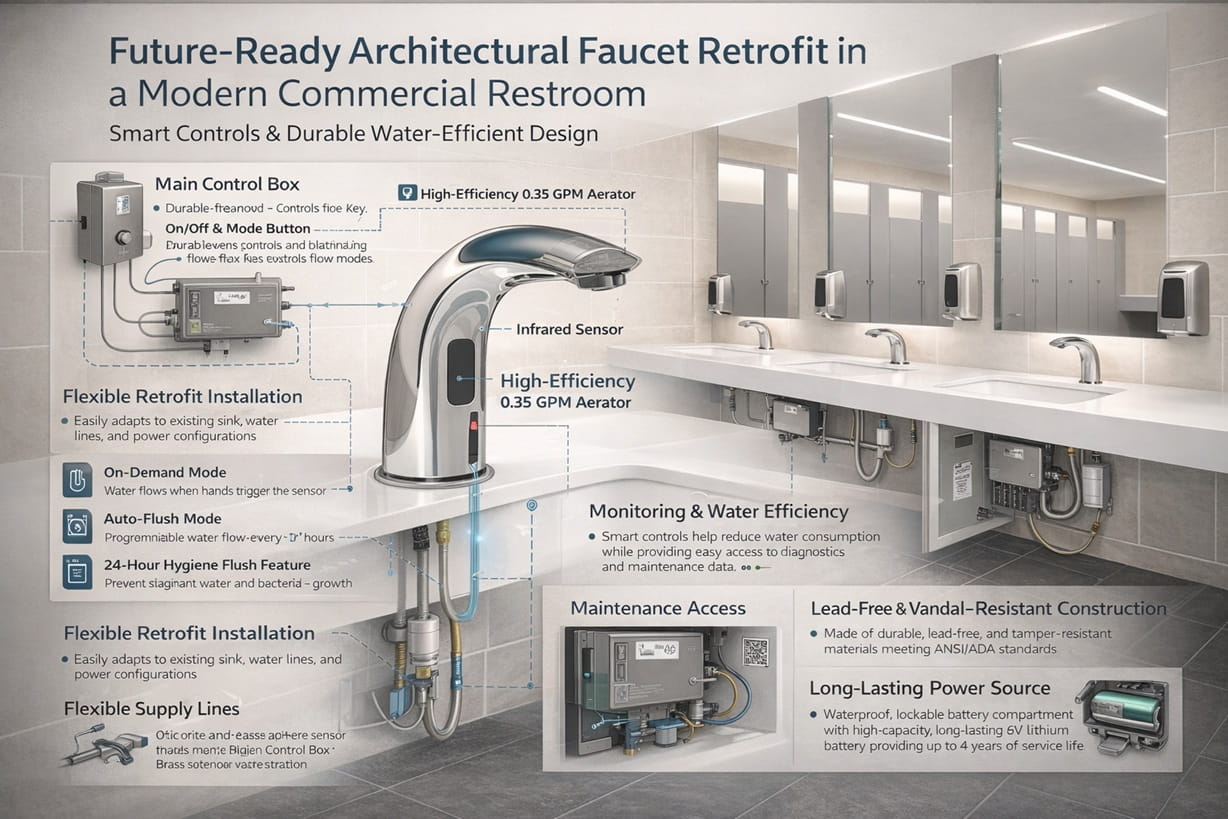
For architects, engineers, and facility teams, the takeaway is straightforward: future-ready faucet design means choosing products that perform well today and remain manageable over time. That includes realistic pressure performance, durable materials, clear compliance documentation, and smart features that support operations instead of complicating them.
Conclusion: the “future faucet” is a building-system citizen
The most credible future trend is convergence: design intent, materials science, and automation are merging into a single requirement— predictable performance across the building lifecycle. For AEC teams, that means writing specifications that define what matters, verifying it in mock-ups, and commissioning it like any other system that affects health, comfort, and operating cost.
- Design: geometry + flow behavior reduce splash and user overuse.
- Materials: verified lead-content methodology and corrosion-aware alloy choices support longevity.
- Automation: tuned controls, safe water management, and secure connectivity reduce unintended consequences.
Verified research links & support documents
-
 epa.gov
EPA WaterSense: bathroom faucetsEfficiency + performance framing for faucets (useful for “low flow without weak experience”).
epa.gov
EPA WaterSense: bathroom faucetsEfficiency + performance framing for faucets (useful for “low flow without weak experience”). -
epa.gov • PDF
WaterSense at Work: faucets (PDF)Commercial/institutional guidance; includes performance considerations at low pressure.
-
nsf.org
NSF/ANSI/CAN 372: technical requirements overviewStandardized methodology for verifying lead content in drinking water system components.
-
ansi.org • PDF
NSF/ANSI 372 preview (PDF)Preview document useful for understanding scope and definitions.
-
sciencedirect.com
Dezincification of faucets with different brass alloysResearch on brass durability mechanisms in faucet components (potable-water contact).
-
diva-portal.org • PDF
Corrosion behavior of lead-free & DZR brass alloys (PDF)Accessible research with practical implications for alloy choice and water chemistry variation.
-
degruyterbrill.com • PDF
Review: brass dezincification corrosion in potable systems (PDF)Context on corrosion modes, why “brass” is not a single durability category.
-
sciencedirect.com
PVD coatings for improving stainless steel surface performanceSurface engineering research relevant to wear/corrosion resistance expectations.
-
sciencedirect.com
Review: corrosion performance of additively manufactured stainless steelHow AM microstructure and defects influence corrosion behavior and reliability.
-
springer.com
Review: surface engineering for corrosion resistance in AM materialsWhy finishing/surface treatment is critical to AM parts used in real environments.
-
csus.edu • PDF
Study (PDF): manual vs automatic faucet water use in a public settingReal-world comparison of water use with different aerator flow rates on automatic faucets.
-
apic.org • PDF
APIC + ASHE statement (PDF): electronic faucets in healthcareBalanced guidance noting both conservation benefits and infection-control considerations.
-
cdc.gov • PDF
CDC toolkit (PDF): developing a Legionella water management programRisk management approach that strongly influences “smart” flushing and low-use strategies.
-
ashrae.org
ANSI/ASHRAE Standard 188 overviewMinimum legionellosis risk management requirements for building water systems.
-
ashrae.org
ASHRAE BACnet overview (Standard 135)Interoperability framing for how connected systems communicate in buildings.
-
nist.gov • PDF
NISTIR 8259A (PDF): IoT device cybersecurity core baselineBaseline device capabilities that matter when fixtures become connected assets.
-
nist.gov • PDF
NISTIR 8259 (PDF): foundational cybersecurity activitiesGuidance for how IoT devices should be designed and supported over time.
-
access-board.gov
ADA operable parts (guide)Practical interpretation of operability constraints that shape handle/control design.
-
iso.org
ISO 14025: Type III environmental declarationsEPD foundation standard; useful for lifecycle transparency conversations.
-
iso.org
ISO 14040: LCA principles and frameworkFramework for lifecycle thinking; supports “durability is sustainability” narratives.
-
iso.org
ISO 14044: LCA requirements and guidelinesImplementation guidance for consistent LCAs and decision-grade comparisons.

Location: Miami, FL
Profile: Hospitality fixture specification expert. Works with designers to match aviation-inspired touchless faucets with finishes, lighting, and architectural details in upscale resorts and boutique hotels.