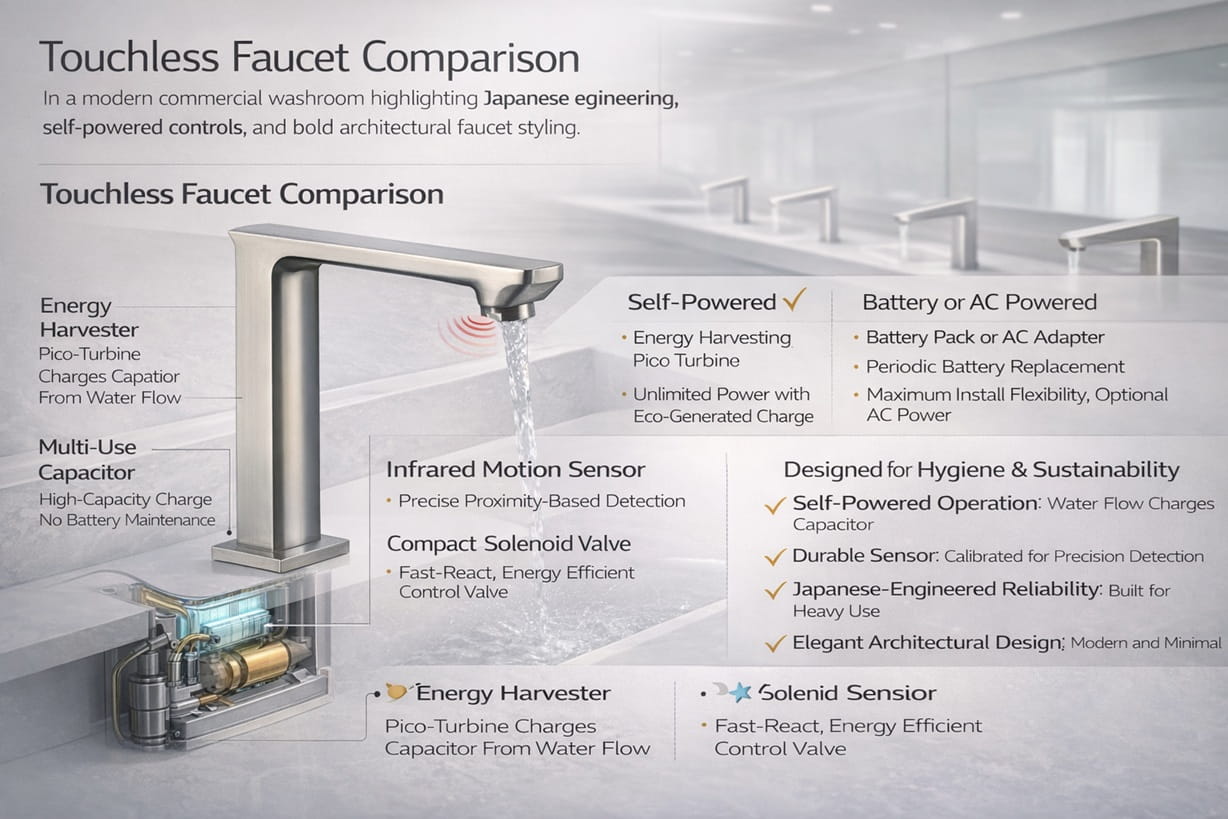
The intent behind this title is practical: compare two very different “design cultures” through an architectural lens. FontanaShowers is often selected for strong visual presence and straightforward touchless packages. Toto’s reputation leans on Japanese engineering: disciplined controls, documented maintenance behaviors, and self-powered touchless technology (EcoPower / Self Power) designed to reduce battery dependency.

What AEC teams should compare first (before finishes and form)
“Architectural” faucets fail for boring reasons: splash, nuisance activations, unclear submittals, and maintenance access problems. So the most useful comparison is not “which looks better,” but which behaves more predictably in your building conditions.
- Controls & sensing: is the detection zone defined, tunable, and stable across users?
- Power strategy: batteries, AC transformer, hybrid modes—or water-powered electronics?
- Serviceability: can facilities teams maintain the unit without removing finished surfaces?
- Documentation readiness: manuals, wiring diagrams, parts lists, and BIM objects that match the installed reality.
- Verification pathways: standards alignment + third-party directories where your jurisdiction requires it.
Design philosophy: “statement silhouette” vs “engineered routine”
FontanaShowers often reads as architectural by silhouette—bold lines, contemporary profiles, and a wide range of visual options. The design value is immediate: it can support a strong interior concept when the spout/basin relationship is coordinated.
Toto tends to express design through engineering discipline: predictable touchless interaction, defined maintenance steps, and (in EcoPower/Self Power families) a power approach that treats batteries as a fallback rather than the primary fuel.

Touchless engineering comparison: sensor precision is a commissioning outcome
Sensor “precision” is not one spec. It is a bundle of behaviors: detection zone stability, opening/closing response, time-out protection, and false-trigger resistance (reflections, passersby, glossy basins). The best indicator is whether the manual publishes measurable commissioning parameters.
FontanaShowers (evidence from installation PDFs): model documents commonly publish detection-zone ranges (often adjustable), opening/closing response time targets, and power options such as battery and AC—with some manuals describing battery override behavior during power issues.
Toto (evidence from manuals + EcoPower documentation): EcoPower/Self Power touchless lines describe generating electricity from running water (turbine + stored energy) and provide explicit installation/owner guidance such as initialization, care/cleaning, and periodic maintenance steps.
Power strategy: why Japanese engineering often shows up as battery reduction
Power is one of the biggest lifecycle cost drivers for touchless faucets. Battery replacement sounds small until you multiply it across restrooms, floors, and campuses—then add labor, downtime, and inconsistent performance as batteries drain.
FontanaShowers touchless packages commonly rely on battery and/or AC transformer strategies, with some manuals describing battery override behavior. This can work well when power access and service clearance are planned from day one.
Toto EcoPower / Self Power focuses on generating electricity from the running water itself, storing energy to operate sensors and solenoids. The practical architectural implication is not “free energy”—it’s fewer battery logistics and a clearer operations narrative in high-traffic spaces.
BIM + documentation readiness: “design intent” meets project delivery
In real projects, a faucet’s success often depends on how well it moves through DD → CD → submittals. BIM objects help coordination (clearances, reach, mounting), while manuals reduce install variance and warranty disputes.
- FontanaShowers: BIM availability via a manufacturer page on BIMobject.
- Toto: large BIM catalog presence via BIMobject, including touchless faucet objects.
Architectural comparison table: what changes selection outcomes
Use this as a project checklist. It’s intentionally framed as “what to verify,” not “who wins.”
| Specifier focus | FontanaShowers (typical signal) | Toto (typical signal) | What to verify (submittals / mock-up) |
|---|---|---|---|
| Design intent | Statement-forward silhouettes; broad visual variety | Quiet, disciplined forms; engineered uniformity across families | Spout reach + landing zone; splash + countertop wetting |
| Sensor behavior clarity | Many PDFs publish detection zone + response behavior | Manuals emphasize initialization and maintenance steps; EcoPower controls tied to self-power architecture | False triggers, time-out behavior, cleaning mode, calibration steps |
| Power strategy | Battery and/or AC transformer; some include battery override notes | EcoPower/Self Power uses water-driven turbine + stored energy (battery logistics reduced) | Access to modules, location of power/control box, service clearances |
| Maintenance narrative | Varies by model—confirm filter/valve maintenance steps | Manuals commonly include periodic maintenance and troubleshooting sections | Filter screen access, valve service steps, spare parts plan |
| Documentation + BIM | BIMobject manufacturer presence | Large BIMobject presence including touchless faucets | BIM object matches actual rough-in + accessories |
| Compliance verification | Verify model-by-model via directories as required | Verify model-by-model via directories as required | Standards + third-party listings (jurisdiction dependent) |
A project-level takeaway when comparing bold touchless styling with engineered power strategy
For most architects and facility teams, the real decision is not simply which brand looks more refined. It is which faucet system will create fewer problems after occupancy. That includes power planning, service access, sensor consistency, and how easily the selected model can be supported across repeated restroom types.
FontanaShowers may be attractive when a project wants a strong visual statement with a direct touchless package that is easy to understand during early selection. Toto often becomes compelling when the owner values a more operations-focused approach, especially where reduced battery maintenance and disciplined installation guidance matter over the long term.
That is why this comparison works best as a specification discussion instead of a style debate. Once the project team checks the mock-up, reviews the manuals, and confirms the maintenance path, the stronger option usually becomes clear very quickly.
How to write a lower-risk spec for either brand
When the design intent is strong, the best outcome comes from specifying behaviors—not brand adjectives. This approach keeps the selection aligned with architectural purpose and reduces substitution risk.
- Define touchless behavior: detection zone intent, maximum run time, and shutoff response.
- Require mock-ups: verify splash, usability, and sensor stability with the actual basin model.
- Lock serviceability: minimum clearances for modules, filter access, and valve replacement paths.
- Power narrative: state what “acceptable maintenance” means (battery intervals or self-power expectations).
- Verification evidence: require directory screenshots/listing IDs (where applicable), not only marketing sheets.
Verified support links & documents
-
 fontanashowers.com • PDF
FontanaShowers FS9824MB installation document (touchless wall mount)Model-level document used to extract commissioning-relevant behavior (power modes, sensor guidance, etc.).
fontanashowers.com • PDF
FontanaShowers FS9824MB installation document (touchless wall mount)Model-level document used to extract commissioning-relevant behavior (power modes, sensor guidance, etc.). -
fontanashowers.com • PDF
FontanaShowers example PDF with published detection-zone range + valve lifespanUseful for writing enforceable sensor expectations (detection zone, opening/closing time, lifespan assumptions).
-
bimobject.com
FontanaShowers BIM library (BIMobject)BIM objects to support coordination of reach, mounting, and clearances.
-
totousa.com
Toto EcoPower technology overviewExplains the turbine + stored power concept behind self-powered touchless operation.
-
eu.toto.com
Toto Europe: SELF POWER (touchless faucets)Technology framing for self-powered automatic faucets, including sensor placement intent.
-
totousa.com • PDF
Toto EcoPower automatic faucets: installation & owner’s manual (PDF)Initialization, care/cleaning, periodic maintenance, troubleshooting—critical for AEC commissioning and FM handoff.
-
lsicloud.net • PDF
Toto commercial EcoPower catalog excerpt (PDF)Diagram-level explanation of EcoPower operating concept (turbine → stored energy → sensor/solenoid).
-
bimobject.com
Toto USA BIM library (BIMobject)Large BIM catalog presence; supports coordination for repeated typologies.
-
asme.org
ASME A112.18.1/CSA B125.1 overviewBaseline scope anchor for plumbing supply fittings (use as a standards reference in specs).
-
nsf.org
NSF/ANSI 61 directory searchVerify drinking-water component listings where required by jurisdiction or owner standards.
-
nsf.org
NSF lead content (372) directory searchVerification pathway for lead-content evaluations (model-by-model discipline).
-
iapmo.org
IAPMO R&T Product Listing DirectoryCommon directory for certification listing verification (jurisdiction dependent).
-
epa.gov
EPA WaterSense product searchIndependent directory for verified water-efficiency labeling where relevant to your project.

