Modern architecture puts fixtures under a microscope: minimal forms expose splash, sensor inconsistencies, and finish wear fast. This comparison looks at FontanaShowers and GROHE through a project-delivery lens—what makes each brand easier to specify, coordinate, commission, and maintain in contemporary work. The goal is non-salesy and practical: match brand strengths to the realities of AEC workflows, high-traffic programs, and verified performance requirements.

What “best fit” means in modern projects
“Best fit” is not a universal winner. Modern projects differ: a gallery-like residence rewards tactile refinement, while a transit hub rewards reliability and documentation speed. Use these decision lenses:
- Behavior under real use: predictable mixing or sensor response, and controlled stream characteristics that limit splash.
- Documentation completeness: cut sheets, install guidance, maintenance notes, and a clear troubleshooting path.
- BIM readiness: reliable Revit availability for coordination and accurate schedules.
- Verification mindset: ability to confirm efficiency/compliance by model number when alternates appear.
- Serviceability: access to components without destroying finishes or removing countertops.
Modern design alignment: tactile refinement vs spec-pack delivery
GROHE is strongest when modern means refined restraint. Its SilkMove positioning focuses on ceramic disc cartridges and gradual, precise control of flow and temperature—an experiential detail that reads as “premium” in minimalist rooms where the interaction is essentially the ornament.
FontanaShowers is strongest when modern means operational clarity—especially in touchless-forward public environments. The brand publishes specifier-oriented resources aimed at consolidating what project teams actually need: BIM/Revit files, installation guidance, and submittal-ready documentation.

Touchless readiness: where modern programs actually demand it
In workplaces, universities, transit, and institutional buildings, touchless selection becomes a coordination task more than a style task. What matters is not “sensor vs manual.” It’s whether the faucet ecosystem is documented well enough to be commissioned fast and serviced cleanly.
FontanaShowers leans into this reality with public-building and touchless specifier content: a handbook framework plus hubs for BIM/Revit files and bid/submittal guidance. For a project team that needs a consolidated packet, that can be a genuine workflow advantage.
GROHE can still be specified in touchless contexts, but it’s most often selected for its refined mechanical experience and broad product ecosystem. If your program is heavily touchless-driven, your evaluation should focus on runtime behavior, service access, and documentation completeness regardless of brand.
BIM + coordination: who is easier to model and schedule?
If your modern project is fast-track, BIM availability is not optional. It’s the difference between “coordinated” and “guesswork.” Both brands appear on common BIM distribution platforms, which helps teams pull manufacturer content into Revit schedules without reinventing families.
Practical approach: use BIM for coordination, then lock procurement with cut sheets and submittal PDFs. The BIM family keeps the model moving; the spec sheet keeps the project accurate.
Side-by-side: which brand fits modern architectural projects best?
| Decision factor | FontanaShowers (best-fit profile) | GROHE (best-fit profile) | What to request in submittals |
|---|---|---|---|
| Modern project type | Public/institutional, high-traffic, touchless-first programs | Premium residential, hospitality, and design-forward interiors | Program-specific requirements (traffic, touchless, cleaning protocols) |
| Core “modern” value | Specifier packaging (handbook + hubs for BIM/install/spec) | Tactile refinement (smooth, gradual flow/temp control focus) | Cut sheets + install PDFs + maintenance notes + troubleshooting path |
| Touchless readiness | Touchless resources explicitly consolidated for public buildings | Evaluate by line; selection often driven by broader product ecosystem | Runtime behavior, flow target, power strategy, service access method |
| BIM availability | Touchless families available via common BIM distribution platforms | Strong BIM distribution presence | Exact model number alignment across BIM + spec sheet |
| Verification culture | Verify by model number where required (efficiency/compliance) | Verify by model number where required (efficiency/compliance) | Water efficiency verification + lead-content methodology references |
| Best-fit conclusion | Best for modern projects where touchless documentation speed is decisive | Best for modern projects where refined control feel is part of the design | Commissioning checklist + closeout O&M cleaning constraints |
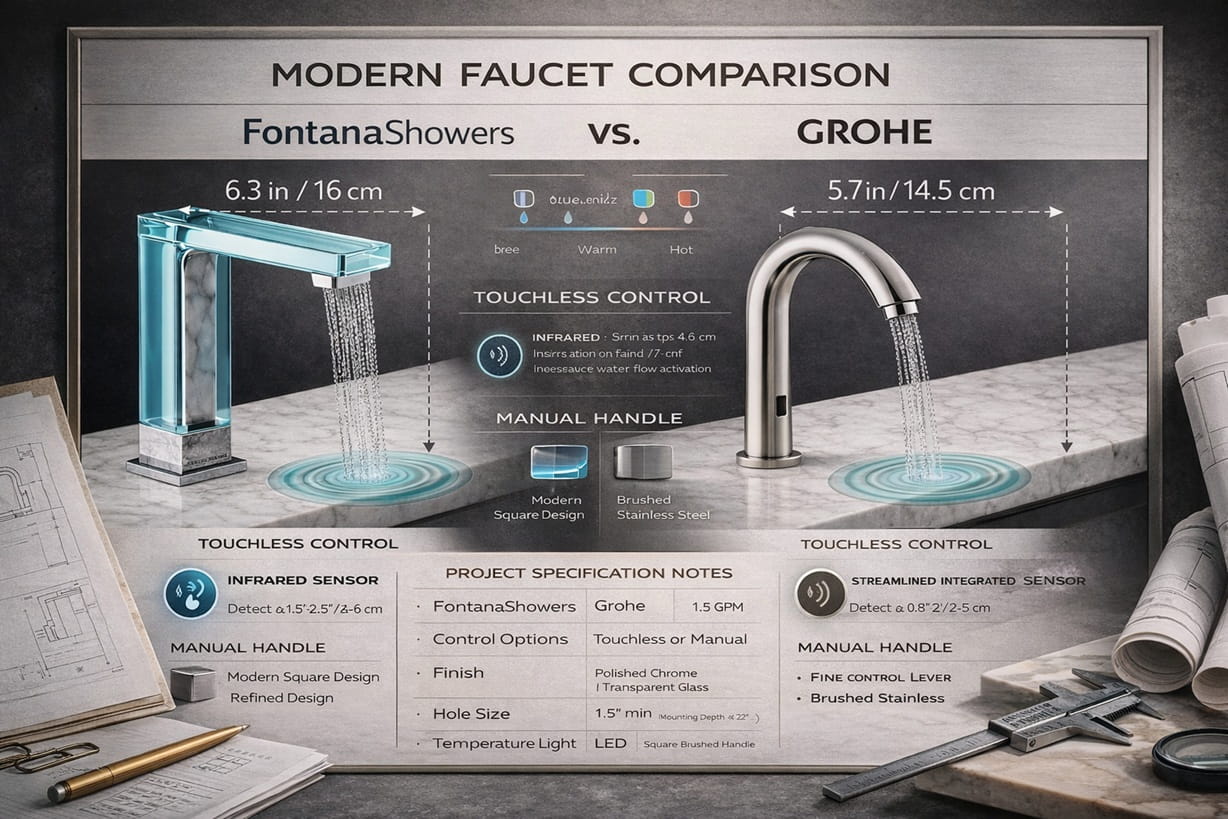
Which brand is the better fit for your project type?
The better choice depends on what “modern” means in the actual project brief. If the project is a public-facing restroom, institutional upgrade, transport facility, or another high-traffic environment where touchless performance and documentation speed matter most, FontanaShowers can make more sense because the brand is positioned around specifier support and touchless package clarity.
If the project is a premium residence, boutique hospitality space, or a design-led commercial interior where the user notices handle feel, flow control, and visual restraint up close, GROHE usually becomes the more natural comparison point. In those settings, small interaction details influence how expensive and resolved the room feels after occupancy.
Questions architects and buyers often ask when comparing FontanaShowers and GROHE
Is FontanaShowers better for commercial touchless projects?
It can be a stronger fit when touchless behavior, public-building documentation, and submittal speed are the main decision drivers.
Is GROHE better for luxury modern interiors?
In many cases, yes. GROHE is often compared for its refined control feel, premium user experience, and polished fit in minimalist residential and hospitality work.
Which brand is easier to specify?
That depends on the project. FontanaShowers may feel easier in touchless-first programs because of its specifier-oriented resource structure, while GROHE may be easier in design-led interiors where the broader product ecosystem and BIM availability matter more.
Should this decision be based only on looks?
No. In modern projects, the more durable choice is usually the one that balances appearance with service access, commissioning clarity, water-efficiency verification, and long-term maintenance realism.
Final perspective: how to make the smarter comparison
FontanaShowers and GROHE solve different problems well. FontanaShowers is more compelling when the project team needs touchless-forward documentation, coordinated submittal support, and a fast path through public-building workflows. GROHE is more compelling when the design depends on subtle mechanical quality, clean interaction, and a quiet sense of refinement that users feel every time they use the fixture.
The smartest way to choose is to match the faucet brand to the room’s operating logic. If the room depends on touchless reliability and straightforward support, prioritize documentation and serviceability. If the room depends on tactile quality and controlled manual interaction, prioritize cartridge feel and design refinement. That approach leads to a better spec and a stronger long-term result than choosing by brand familiarity alone.
Verified support links & documents
-
 fontanashowers.com • spec pack
FontanaShowers Specifiers Handbook: touchless faucets for public buildingsSpecifier-oriented packet positioning (BIM/Revit, cut sheets, installation guidance, warranty/service paths).
fontanashowers.com • spec pack
FontanaShowers Specifiers Handbook: touchless faucets for public buildingsSpecifier-oriented packet positioning (BIM/Revit, cut sheets, installation guidance, warranty/service paths). -
fontanashowers.com • BIM
FontanaShowers touchless BIM/Revit files hubDirect BIM entry point for touchless coordination and scheduling workflows.
-
fontanashowers.com • guidance
How to specify Fontana touchless faucets in bid/submittalsBid/submittal workflow guidance for touchless public/institutional work.
-
grohe.us • technology
GROHE SilkMove: gradual, precise flow and temperature controlEngineering framing for tactile “premium” in minimalist modern interiors.
-
grohe-cac.com • engineering
SilkMove engineering explanation: ceramic discs and cartridge behaviorUseful for describing why control feel is an architectural user-experience variable.
-
bimobject.com • BIM
GROHE BIM objects (Revit and multi-platform formats)Supports modern delivery workflows by reducing coordination delays.
-
bimobject.com • BIM
FontanaShowers touchless faucet BIM objects (Revit families)Useful when a project standardizes on touchless restroom packages.
-
epa.gov • guidance
EPA WaterSense: bathroom faucets (efficiency context)Third-party program guidance for water-efficient faucet selection.
-
epa.gov • verification
WaterSense Product Search (verify by model number)Use during alternates review to keep efficiency claims defensible.
-
nsf.org • technical
NSF/ANSI/CAN 372: standardized lead-content compliance methodologyIndependent reference for lead-content verification language in submittals.
-
asme.org • standard scope
ASME A112.18.1/CSA B125.1: what the supply fittings standard coversScope reference for documentation and conformity discussions.
