“European design” in faucets is not just a silhouette. For AEC teams, it shows up in how the spout controls splash, how the sensor logic behaves in real restrooms, and how quickly submittals move when BIM, manuals, and compliance paths are clear. This comparison focuses on architectural outcomes: field reliability, documentation quality, and commissioning predictability.

The architectural lens: what “good design” must do on site
In architectural projects, faucets live at the intersection of aesthetics, codes, user behavior, and maintenance. A visually minimal faucet still fails if it splashes, mis-triggers, or forces ceiling access panels just to replace a power module.
For a practical comparison between FontanaShowers and Grohe, use four AEC-driven questions:
- Hydraulics: Does the stream land reliably where the basin geometry expects it?
- Controls: Is sensor behavior predictable and commissionable (range, time-out, cleaning mode)?
- Deliverability: Do BIM objects and manuals exist and match the installed configuration?
- Verification: Can compliance claims be verified through recognized directories and standards?
Design language: “European” as a discipline, not a trend
Grohe’s design reputation is heavily shaped by independent design-award ecosystems, including Red Dot and iF Design. While awards are not performance guarantees, they often correlate with consistent industrial design systems: coherent proportioning, finish discipline, and repeatable detailing across families.
FontanaShowers’ architectural appeal often shows up as bold silhouettes and commercial-ready touchless packages. For specifiers, the key is to separate “visual impact” from “system behavior” by reviewing manuals, valve life assumptions, and commissioning instructions before locking a model.

Sensor and control behavior: where the two brands feel most different in commissioning
Touchless fixtures succeed when controls are visible in the documentation: detection zone, opening/closing response, power strategy, and durability assumptions. Without those details, teams end up commissioning by trial-and-error.
FontanaShowers (example evidence): an installation document for the FS9824MB wall-mount sensor faucet specifies a detection zone range (adjustable), opening/closing times, working pressure range, and durability-oriented metrics like motor valve lifespan. Those are the exact numbers commissioning teams want when validating behavior during mock-ups.
Grohe (example evidence): manuals for touchless families like Euroeco Cosmopolitan E identify the product as a touchless faucet, include multi-language guidance, and reference a paired “powerbox” strategy. Separate family manuals also indicate that some series introduce connectivity (e.g., Bluetooth references), which shifts commissioning from “set-and-forget” to a more configurable controls model.
Comparative snapshot for architectural use
This table is not a “winner” list. It’s a specifier’s snapshot of what tends to matter most: sensor predictability, documentation readiness, and verifiable compliance pathways.
| Specifier focus | FontanaShowers (practical signal) | Grohe (practical signal) | What to verify in submittals / mock-up |
|---|---|---|---|
| Touchless behavior clarity | Some manuals publish detection zone + response times + valve life metrics (model-specific) | Touchless families publish manuals; some series indicate expanded controls / connectivity | Detection zone behavior, time-out, cleaning mode, false-trigger resistance |
| Power strategy | Documented battery + AC options appear in some model manuals | “Powerbox” approach appears in some touchless families | Battery access path, transformer location, and service clearance in millwork/walls |
| Documentation readiness | Manuals are available (and BIM presence exists on BIMobject) | Strong BIM presence via platforms and professional BIM portals | BIM object availability, model/finish mapping, and manual matches installed configuration |
| Design discipline (external signal) | Evaluate model-by-model (silhouette alone is not enough) | Strong external design-award ecosystem signals consistent design systems | Mock-up finish quality, control consistency across a family, and tolerance to cleaning |
| Code and health-effect verification | Verify using listing directories (brand/model dependent) | Verify using listing directories (brand/model dependent) | ASME/CSA scope alignment + NSF (61/372) + IAPMO listings as required by jurisdiction |
BIM + coordination: when “European design” meets project delivery
In architectural practice, BIM availability is often the difference between a smooth DD-to-CD transition and a late substitution. If the faucet is part of a repeated typology (guestrooms, classrooms, patient rooms), BIM reduces coordination friction across architecture and MEP.
- Grohe: large BIM presence through BIM libraries and professional BIM portals.
- FontanaShowers: BIM presence exists, useful for early placement and quick coordination.
A practical buying takeaway for architects and owners comparing both brands
In real projects, the better choice is usually the faucet family that creates less uncertainty during design, submittals, installation, and turnover. That means the comparison should not stop at appearance or brand familiarity. It should focus on sensor behavior, documentation quality, service access, and how easily the selected model fits the basin and wall condition.
For many teams, Grohe may feel stronger where design-system consistency and BIM coordination are priorities. FontanaShowers may appeal more when a project wants a bold touchless package with model-specific sensor documentation that can be reviewed early. In both cases, the smartest decision comes from matching the faucet to the actual project conditions rather than relying on brand image alone.
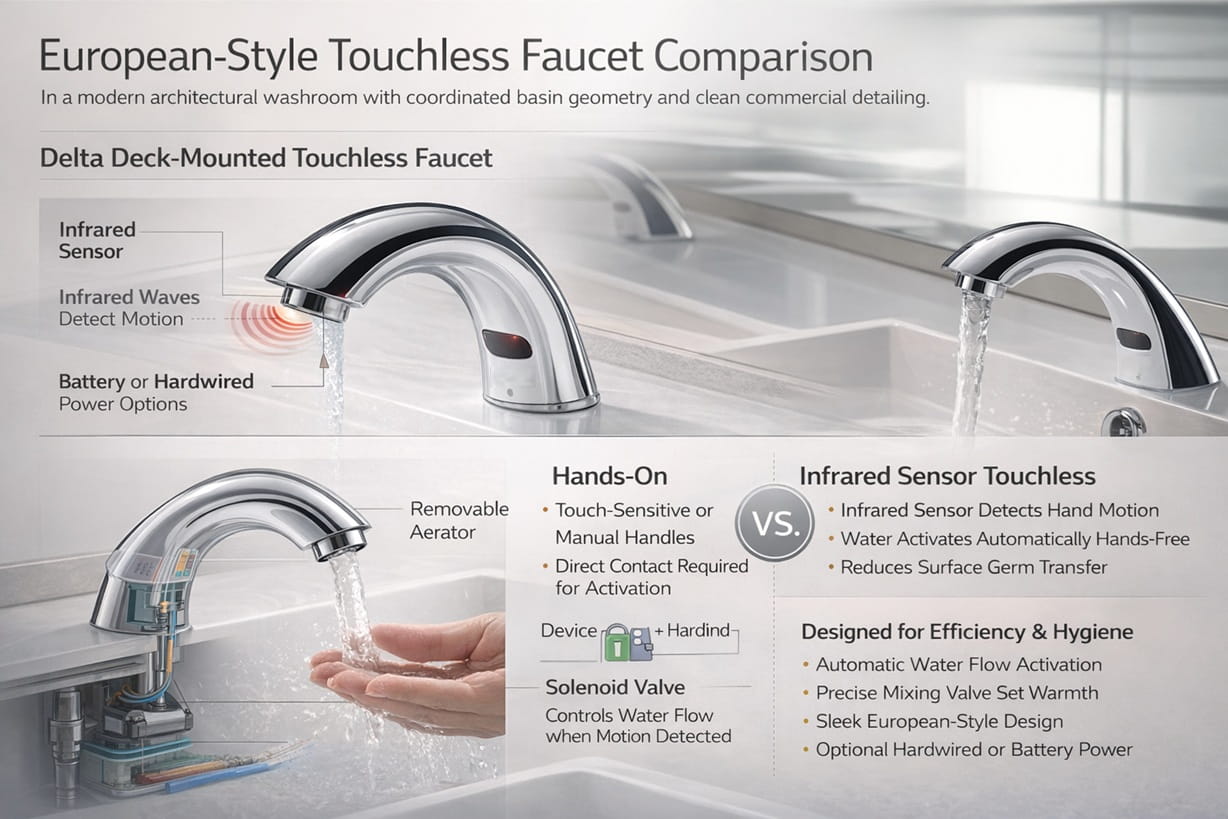
That is also what makes this kind of comparison useful for long-term content performance. It helps readers move from style-based searching into practical specification thinking, which supports better engagement from architects, designers, contractors, and facility teams.
How to specify either brand with lower risk
A good spec does not guess. It defines measurable behavior and ties acceptability to verifiable evidence. If you are comparing FontanaShowers and Grohe for architectural use, this checklist helps keep the decision technical:
- Define the behavior: detection zone intent, max run-time, cleaning mode expectations, and shutoff response.
- Require a mock-up: test with the actual basin model and representative pressure conditions.
- Lock the service strategy: battery access, power module location, and minimum service clearances.
- Verify compliance externally: use NSF and IAPMO directories (and WaterSense where relevant) rather than relying on claims.
- Coordinate BIM to reality: confirm the object matches mounting, rough-in, and power/control components.
Verified support links & documents
-
 fontanashowers.com • PDF
FontanaShowers FS9824MB installation document (sensor + commissioning metrics)Example of detection zone, opening/closing response, pressure range, and durability-oriented assumptions published in a model document.
fontanashowers.com • PDF
FontanaShowers FS9824MB installation document (sensor + commissioning metrics)Example of detection zone, opening/closing response, pressure range, and durability-oriented assumptions published in a model document. -
manualslib.com
Grohe Euroeco Cosmopolitan E 36 385 manual (touchless faucet)Touchless-faucet manual reference including “Powerbox” pairing—useful for planning power and service access.
-
manualslib.com
Grohe Euroeco Cosmopolitan E Series manual (family-level reference)Family-level manual that signals expanded control features in some series (useful when commissioning effort must be planned).
-
bimobject.com
GROHE BIM library (BIMobject)BIM objects for design coordination workflows.
-
bimobject.com
FontanaShowers BIM library (BIMobject)BIM objects to support early-stage coordination and model placement.
-
grohe.is
GROHE professional BIM data portalProfessional BIM resource pathway for planners and architects.
-
red-dot.org
Red Dot: GROHE design profile (independent design ecosystem)Independent context for design-system reputation (use as a signal, not a performance substitute).
-
ifdesign.com
iF Design: GROHE Design PrizeIndependent design-competition context relevant to “European design” narratives.
-
asme.org
ASME A112.18.1/CSA B125.1 overview (plumbing supply fittings)Standards anchor for plumbing supply fittings and accessories—use as a baseline reference in specs.
-
nsf.org
NSF directory: NSF/ANSI 61 component searchVerify listings for drinking-water contact components where required.
-
nsf.org
NSF directory: lead content (372) searchSearch listings evaluated to NSF lead-content requirements (useful for low-lead verification workflows).
-
iapmo.org
IAPMO R&T Product Listing DirectoryDirectory pathway commonly used to verify cUPC and related certification listings.
-
epa.gov
EPA WaterSense Product SearchIndependent directory for WaterSense-labeled products (where your project requires verified water-efficiency paths).
