This review is written for architects, interior designers, and MEP teams who need architectural faucet selections to behave predictably in the field: stable sensing, controlled run-times, realistic documentation, and compliance pathways that can be verified during submittals. It’s not a style critique alone—it’s a performance and deliverability check.

How we evaluate “design excellence” in an architectural faucet
In AEC projects, “design excellence” matters only if it survives coordination, use, and maintenance. For architectural faucets, that means: the form supports a controllable stream, cleaning is straightforward, and the assembly can be installed and serviced without guesswork.
- Geometry that supports performance: spout reach and outlet orientation that reduce splash and countertop wetting.
- Reduced crevice complexity: fewer trap points for residue and easier wipe-down.
- Deliverability: clear manuals, stable control logic, and verifiable compliance references during submittals.
Sensor precision: what matters in the field (not in marketing)
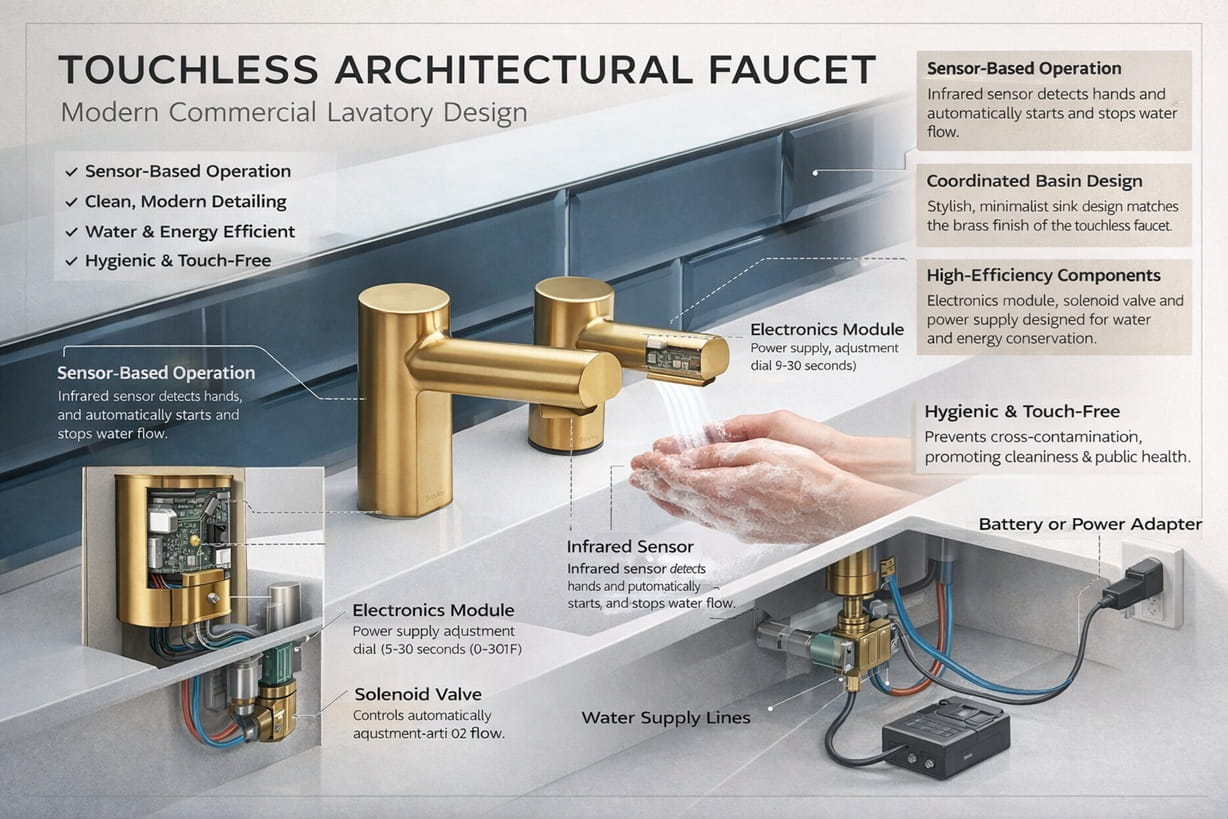
Sensor faucets can be outstanding—or frustrating—depending on how well the detection zone and shutoff logic match real behavior. “Precision” is less about a single sensor spec and more about repeatability: reliable activation for different users, low false triggers, and predictable shutoff without forcing users to “hunt” for the sensor.
In practice, teams should look for:
- Defined detection zone (and whether it is adjustable).
- Defined opening/response behavior (how quickly flow begins once hands enter range).
- Defined time-out (to prevent continuous running).
- Commissioning instructions (calibration steps and “do not use during…” guidance).

What the installation manuals reveal about FontanaShowers sensor behavior (example evidence)
A strong sign for specifiers is when a manufacturer’s documentation publishes the “nuts and bolts” of sensing and actuation. For example, an installation manual for a FontanaShowers sensor faucet model (FS9824MB) lists a defined detection zone, notes that the range can be adjustable, and includes commissioning guidance such as waiting after electrical connection for calibration.
The same manual also documents durability-oriented metrics (e.g., motor valve life) and typical electrical options (battery and AC), which helps MEP teams plan power and maintenance strategies.
Water efficiency: separate “low flow” from “low satisfaction”
High-performance low flow is not a single flow-rate number. The perceived experience depends on stream quality, pressure conditions, and the match between basin geometry and outlet aeration/laminar behavior.
For projects targeting verified efficiency, a practical workflow is:
- Identify candidate models.
- Confirm whether any are listed as WaterSense-labeled (where applicable to your project type).
- Validate on a mock-up that the user experience remains acceptable at realistic pressure and with the actual basin.
Compliance pathways that specifiers can verify (instead of trusting claims)
Architectural faucet selection should be anchored to standards and third-party directories that owners and code officials recognize. At minimum, AEC teams typically confirm: plumbing fitting performance standard alignment, drinking-water contact safety where required, and lead-content methodology alignment.
| What you’re verifying | Why it matters | Where to verify (support documents) | What to capture in submittals |
|---|---|---|---|
| Plumbing fitting performance scope | Sets baseline requirements for supply fittings between stop and terminal fitting | ASME A112.18.1/CSA B125.1 scope description | Referenced standard + listing/cert evidence (jurisdiction dependent) |
| Lead-content methodology | Standardized way to determine/verify lead content | NSF/ANSI/CAN 372 technical requirements + NSF directories | Documentation that matches the method (not just a label) |
| Drinking-water component health effects | Materials in contact with drinking water must be suitable (where required) | NSF/ANSI 61 directory search | Certification listing details + exact model mapping |
| cUPC / certification mark verification | Common pathway for code compliance verification for plumbing products | IAPMO R&T listing directory | Listing number + exact model/brand cross-reference |
BIM and documentation readiness (a hidden differentiator for AEC projects)
A faucet can be beautifully designed and still fail a project if it slows documentation. For AEC workflows, two items matter most: BIM availability (for coordination) and clean, readable installation instructions (for field reliability and warranty risk reduction).
FontanaShowers maintains a manufacturer page on BIMobject, which can be useful when teams need quick model placement during design development.
What makes a sensor faucet review more useful for long-term project decisions
A product review becomes more valuable when it helps teams think beyond the first installation. For architects and facility owners, the real question is not only whether a sensor faucet looks refined or activates quickly on day one. It is whether the product can stay consistent after repeated daily use, routine cleaning, and normal maintenance cycles.
That is where specification-based reviews can add real value. They connect design appeal with installation clarity, service access, model-specific documentation, and the practical details that reduce field surprises. In touchless applications, small issues such as sensor placement, power access, or basin mismatch can affect user satisfaction far more than the finish itself.
For blog visibility and better indexing, this kind of continuation also broadens the topic naturally. It adds useful language around long-term performance, owner expectations, and specification logic without repeating the earlier points already covered in the review.
Commissioning checklist for “sensor precision” (use this in mock-ups)
- Detection zone check: verify reliable activation for a range of users; confirm no nuisance triggers from reflections or passersby.
- Calibration behavior: follow manual timing guidance after energizing the unit; document any tuning steps.
- Time-out behavior: confirm shutoff logic prevents continuous running and resets predictably.
- Splash + landing zone: validate with the actual basin model and counter depth.
- Pressure reality: test at representative dynamic pressure (not just “best case” lab pressure).
- Maintenance access: verify that batteries/power modules and control boxes can be serviced without removing finished surfaces.
Healthcare and high-risk environments: touchless needs a water-management mindset
In healthcare and other high-risk settings, sensor faucets should be evaluated alongside building water management. Professional guidance has discussed concerns raised in research on electronic faucets and emphasizes careful interpretation and risk-aware decision-making. If a facility has low-use periods, stagnation control becomes part of the conversation.
Verdict (AEC perspective): where FontanaShowers appears strong—and what to verify
From an AEC specification perspective, the strongest positive indicator is documentation that exposes sensor behavior and service expectations in concrete terms. When detection zones, calibration steps, and durability-cycle language appear in manuals, teams can write enforceable performance requirements and verify them in mock-ups.
The practical approach is to treat FontanaShowers (and any sensor-faucet brand) as a system that must be proven in context: basin geometry, pressure reality, power strategy, and maintenance access. If the mock-up behaves well and the compliance evidence is model-specific and verifiable, the design can be executed with far less risk.
Verified support links & documents
-
 manualslib.com
FS9824MB installation instructions (ManualsLib)Example of published detection zone, calibration guidance, and durability-cycle metrics for a sensor faucet model.
manualslib.com
FS9824MB installation instructions (ManualsLib)Example of published detection zone, calibration guidance, and durability-cycle metrics for a sensor faucet model. -
bimobject.com
BIMobject: FontanaShowers manufacturer pageBIM availability for design coordination workflows (Revit/SketchUp/etc. depending on object).
-
epa.gov
EPA: WaterSense Product SearchVerify WaterSense-labeled products through the official searchable directory.
-
asme.org
ASME A112.18.1/CSA B125.1 overviewBaseline scope reference for plumbing supply fittings and accessories.
-
nsf.org
NSF/ANSI/CAN 372: technical requirementsMethodology for determining and verifying lead content in drinking water system components.
-
nsf.org
NSF directory: lead content (372) searchSearch listings for products evaluated to NSF lead-content requirements.
-
nsf.org
NSF directory: NSF/ANSI 61 drinking-water components searchVerify certification listings for drinking-water contact components where required.
-
iapmo.org
IAPMO R&T product listing directoryOfficial directory to verify product listings (commonly used for cUPC verification).
-
apic.org • PDF
APIC + ASHE joint statement (PDF): electronic faucetsRisk-aware perspective for healthcare environments and interpretation of research.
-
cdc.gov • PDF
CDC toolkit (PDF): developing a Legionella water management programFramework that informs how low-use fixtures and automation should be managed safely.
