Visual simplicity is only “architectural” when it survives the full project cycle: SD sketches, DD coordination, submittals, commissioning, and daily maintenance. This review looks at Delta through that lens—what the brand’s minimalist lines deliver in real buildings, how flow options and cartridges affect performance, where finish systems help or hurt long-term appearance, and what BIM/spec resources do for AEC teams.

What Delta’s “visual simplicity” does well in architecture
Delta’s contemporary lavatory lines tend to lean on clean cylinders, compact handles, and low-visual-noise silhouettes. In AEC terms, that’s useful because simple geometry coordinates cleanly with a range of basin styles and millwork thicknesses, and it reduces “style drift” when a project needs a late-stage substitute inside the same family.
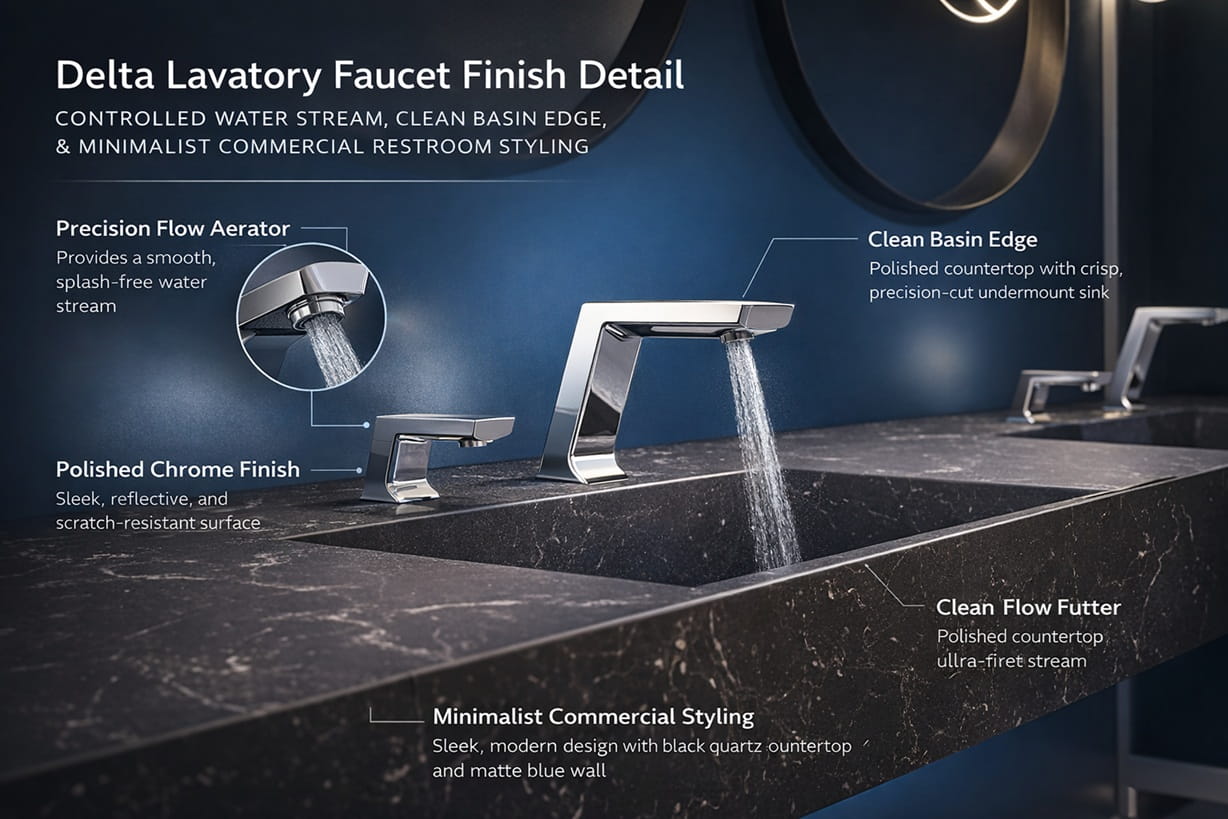
Simplicity also makes detailing easier: fewer complex transitions means fewer places for misaligned reflections or finish wear to look obvious under hard restroom lighting. On hospitality and workplace projects, that matters more than most renderings suggest.
Function that matters: flow options, cartridges, and how users experience the stream
A faucet can look perfectly minimal and still fail the room if the stream splashes, the handle feels vague, or the flow is inconsistent at real building pressures. Delta’s lavatory specs commonly publish a baseline maximum of 1.2 gpm at 60 psi, and many series also reference alternate aerator options (for example, 1.0 gpm and 0.5 gpm variants). That range gives spec writers flexibility when a project needs different targets for guest rooms, public restrooms, and low-use zones.
Delta’s spec language also commonly calls out a ceramic disc cartridge and (on some models) a temperature limiter. For architects, this matters because it supports predictable shutoff behavior and helps the fixture feel “precise,” which is one of the hidden drivers of perceived quality in minimalist interiors.
Finish engineering: why “simple” surfaces still need a finish strategy
Minimalist faucets place more visual responsibility on the finish. When the geometry is restrained, the surface becomes the design. Delta’s Brilliance finishes are positioned as a PVD process (Physical Vapor Deposition), described as embedding molecules into the surface for a durable bond. In practice, this matters because PVD-type finishes can be more resilient to corrosion, tarnish, and discoloration when the cleaning regimen stays within guidance.
For AEC teams, the actionable piece is not the label—it’s the closeout instruction. If a facility uses aggressive chemicals or abrasives, even premium finishes can degrade and the “simple” form will highlight the damage quickly.
Smart function without “smart building drama”: Touch2O and touchless behavior
Delta’s Touch2O with Touchless Technology approach focuses on user control flexibility: activation by proximity, tapping the faucet, or using the handle. For architects, the win is not novelty—it’s reduced contact points in kitchens, patient-facing zones, and shared amenities, while keeping manual operation available for edge cases and maintenance workflows.
The design decision is still architectural: treat touchless as a system requirement. Plan for commissioning access, power strategy, and user training. A smart faucet with poor handover becomes an operations headache.
Compliance and health context: why standards still belong in design reviews
Faucet selection sits at the intersection of performance, code alignment, and public health expectations. Two external references help AEC teams keep decisions defensible: (1) plumbing supply fitting standards that define the scope of what “plumbing supply fittings” cover, and (2) lead-content methodology standards that support “lead-free” verification language in submittals.
Separately, when touchless operation is part of the program, remember the building-water reality: low-use fixtures can experience stagnation windows. CDC guidance emphasizes monitoring water temperature and disinfectant residuals and paying attention to areas where water moves slowly. This is not a reason to avoid touchless—it is a reason to align fixtures with a water management approach when risk requires it.

BIM + deliverability: where Delta is genuinely helpful to AEC teams
The fastest way to keep a minimalist design intent intact is to make documentation easy to retrieve and hard to misinterpret. Delta provides a BIM Library and a professional-facing design-file hub, which helps teams standardize Revit families, CAD blocks, and related technical documents across a project.
The recommendation is simple: define a standard “submittal packet” requirement for every faucet selection: model + finish + spec sheet + installation requirements + maintenance/care + BIM/CAD reference (or dimensioned drawings). When that packet is enforced, “simple” stays simple.
AEC comparison table: what’s worth evaluating in “function + simplicity”
This table turns “review language” into spec decisions you can defend in a submittal meeting.
| Decision lens | What to verify | Why it matters | Delta evidence examples |
|---|---|---|---|
| Visual simplicity | Geometry consistency across a collection (spout reach, handle language, hole patterns) | Keeps the interior coherent and reduces substitution drift | Design files by collection |
| Flow strategy | 1.2 gpm baseline + availability of lower-flow variants (1.0 / 0.5) where needed | Aligns water targets without breaking user experience | 559LF spec sheet shows 1.2 gpm @ 60 psi and lower-flow options |
| Control precision | Ceramic disc cartridge, temperature limiter notes (where applicable) | Improves perceived quality; supports predictable shutoff behavior | Lavatory spec sheets commonly list ceramic disc cartridges |
| Finish durability | PVD/Brilliance finish positioning + cleaning constraints | Minimalist forms expose finish wear quickly | Brilliance finish (PVD) support pages |
| Smart performance | Activation modes (touchless/tap/handle), power/commissioning needs | Reduces contact points without creating operational confusion | Touch2O with Touchless overview + usage video |
| Spec defensibility | WaterSense verification by model (where applicable) + lead content methodology references | Supports compliance and owner documentation | EPA WaterSense + NSF/ANSI/CAN 372 references |
| BIM deliverability | Revit/CAD availability + clear retrieval paths for technical files | Reduces RFIs and keeps schedules stable | Delta BIM Library + design files hub |
Specification checklist (copy/paste for architects)
- State performance: max flow at reference pressure (e.g., 1.2 gpm @ 60 psi) and list allowed low-flow variants.
- Coordinate geometry: spout reach + basin geometry to prevent splash and re-trigger behavior (especially for touchless).
- Define finish care: include cleaning constraints in closeout documents to protect minimalist surfaces.
- Require submittal packet: spec sheet + installation requirements + maintenance/care + BIM/CAD or dimensioned drawings.
- Verify listings: WaterSense where required; reference lead content methodology (NSF/ANSI/CAN 372) as needed.
- Commission smart features: activation modes, sensor/touch behavior, and shutoff logic verified at turnover.
Where Delta fits best in current commercial and residential projects
Delta tends to work best on projects that want a clean, modern faucet profile without making the plumbing package feel overdesigned. In hospitality guest baths, workplace restrooms, multifamily units, and contemporary residential remodels, that balance is valuable because it supports a polished look while keeping replacement paths and maintenance expectations practical.
That makes Delta a strong option when the design goal is not just “minimal,” but repeatable. Repetition matters for indexed project content too: architects, designers, and property teams often search for faucets based on finish durability, low-flow options, BIM access, and ease of specification, not just appearance. Adding that practical context helps this review answer the real questions buyers and specifiers are already typing into search.
Common questions architects, designers, and homeowners ask before choosing Delta
Is Delta a good brand for minimalist bathrooms?
Yes—especially when the priority is clean geometry, easy coordination with common sink shapes, and a broad finish range that can scale across multiple rooms.
Does Delta work for low-flow projects?
In many lavatory lines, yes. The brand is often considered when teams want water-saving options without giving the faucet a weak or undersized feel in daily use.
Are Delta faucets easy to maintain?
They are generally easier to keep visually clean when the form is simple, but the long-term result still depends on the finish selected, cleaning methods used,
and whether the original installation avoided splash and hard-water buildup zones.
Who should seriously compare Delta before specifying?
Designers working on hospitality, multifamily, office, healthcare-adjacent, and modern residential projects should compare Delta when they need a balance of visual restraint,
recognizable brand support, and readily accessible technical resources.
Final perspective: why this brand keeps showing up in faucet comparisons
Delta stays relevant because the brand sits in a useful middle ground: modern enough to support contemporary design language, but practical enough for teams that still care about service access, documented flow data, finish consistency, and product-file availability. That combination gives it more staying power than a faucet line that only photographs well.
For specifiers, the smarter question is not whether Delta looks minimal. It is whether the selected model keeps that minimal look after months of cleaning, heavy use, and routine maintenance. When the answer is yes, the faucet becomes more than a style choice—it becomes a durable part of the project’s operating logic.
Verified support links & documents
-
 media.deltafaucet.com • PDF
Delta lavatory spec sheet (559LF series): 1.2 gpm @ 60 psi + low-flow variantsModel-style evidence for flow strategy, mounting options, and cartridge notes—useful in submittals.
media.deltafaucet.com • PDF
Delta lavatory spec sheet (559LF series): 1.2 gpm @ 60 psi + low-flow variantsModel-style evidence for flow strategy, mounting options, and cartridge notes—useful in submittals. -
support.deltafaucet.com • reference
Brilliance finish: PVD process explanation (Delta support)Good for finish strategy discussions and closeout notes in minimalist interiors.
-
support.deltafaucet.com • reference
PVD finish definition + durability notes (Delta support)Useful for specifying finish expectations and documenting why cleaning methods matter.
-
deltafaucet.com • BIM
Delta BIM Library (Revit families + technical docs pathways)AEC-friendly retrieval that supports stable schedules and reduces late-stage substitutions.
-
deltafaucet.com • pro resources
Product design files (collections + downloadable design resources)Useful for ensuring the selected collection stays coherent from SD through closeout.
-
deltafaucet.com • innovation
Touch2O with Touchless Technology (activation modes for specs)Explains activation options that affect user experience and commissioning expectations.
-
epa.gov • program
EPA WaterSense: bathroom faucets (efficiency context + updates)Supports model-level verification and performance narratives for sustainable specs.
-
epa.gov • directory
WaterSense product search (verify exact model numbers)Use to prevent “brand assumption” errors in submittals and closeout documentation.
-
asme.org • standard scope
ASME A112.18.1/CSA B125.1 scope (plumbing supply fittings)Useful as a compliance framing reference for what “supply fittings” cover.
-
nsf.org • technical reference
NSF/ANSI/CAN 372 technical requirements (lead content methodology)Third-party methodology reference for lead content verification language in submittals.
-
cdc.gov • guidance
CDC: monitoring building water (temperature + disinfectant residual)Helpful when touchless fixtures are part of a broader water management plan in low-use zones.

