- Similar aesthetics to pro lines.
- Lower-cost internal components.
- Shorter lifecycle in high‑use settings.
Introduction
In today’s built environment—from luxury residential to active commercial—faucet selection is much more than an aesthetic decision; the modern faucet has evolved to marry style and performance with water efficiency, durability, code compliance, and user experience.
This specification guide is for architects, designers, and specifiers in both commercial and residential spaces. It outlines key considerations, technical benchmarks, and design strategies necessary to confidently select the right faucet for each environment.
Construction & Durability
Faucets used in businesses like airports, hotels, healthcare, and offices need to be able to handle a lot of use, stay clean, and last a long time.
Brass
Preferred body material for corrosion resistance.
PVD
Hard finish layer to reduce wear & tarnish.
50k+
Cycle life target for commercial cartridges.
Cost & Specification Tier
- Upgraded cartridges and seals.
- More robust finishes and bodies.
- Optimized for maintenance & longevity.
Reference: Aquacubic: Retail vs Contractor‑grade ↗
Key take‑away: Two faucets can look identical yet differ in internal quality and lifespan—verify spec tier before selection.
Key Specification Criteria
Material
Prefer solid brass or corrosion‑resistant alloys.
Prefer solid brass or corrosion‑resistant alloys.
Finish
PVD, brushed nickel, chrome, or matte black for durability.
PVD, brushed nickel, chrome, or matte black for durability.
Operation
Manual, touchless, or metered per use case.
Manual, touchless, or metered per use case.
Maintenance
Modular parts, accessible service paths, spare availability.
Modular parts, accessible service paths, spare availability.
Mounting & Configuration

Mount on deck or wall based on sink type and design. Verify spout reach, thread size, and available mounting holes.
Document brand, model, finish, certifications, and warranty in submittals.
Flow Rate & Code Compliance
Residential lavatory faucets: ≤ 1.5 GPM (5.7 L/min) at 60 psi.
Always check compliance with local plumbing code.
Sensor & Touchless Technology
Use Cases
- Public restrooms
- Healthcare environments
- Hospitality venues
Power & Service
- Battery or hardwired options
- Modular sensor units for easy swap
- Service access without removing faucet
Durability & Maintenance
Cartridges
Choose ceramic cartridges that are rated for commercial use and will last a long time.
Choose ceramic cartridges that are rated for commercial use and will last a long time.
Access
Design for easy cartridge access and shut‑off isolation.
Design for easy cartridge access and shut‑off isolation.
Parts
Confirm spare part availability over the faucet lifecycle.
Confirm spare part availability over the faucet lifecycle.
ADA Accessibility & Sustainability
Lever handles and touchless operation improve accessibility. Ensure reach ranges and operability meet ADA requirements.
ADA
Low Force
Reach Range
To make sure that water is used efficiently without sacrificing the user experience, look for WaterSense® or similar products in your area.
WaterSense
≤1.5 GPM
Lifecycle Impact
Aesthetic Integration


Residential: Coordinate faucet finish with lighting and hardware for cohesive design.
Commercial: Favor clean lines and easy‑to‑clean forms; prioritize hygiene and serviceability over ornament.
Emerging Trends in Architectural Faucet Specification
As building technologies evolve, faucet specification is increasingly influenced by broader trends in smart buildings, sustainability targets, and long-term facility management strategies. Architects and designers are no longer selecting faucets purely for style or initial cost; the focus has shifted toward performance over the entire lifecycle of a building.
One major trend is the integration of faucets into connected building systems. Smart plumbing fixtures can now monitor water usage, detect leaks, and communicate with building management platforms. These technologies help facility managers track water consumption patterns and identify maintenance needs before problems occur.
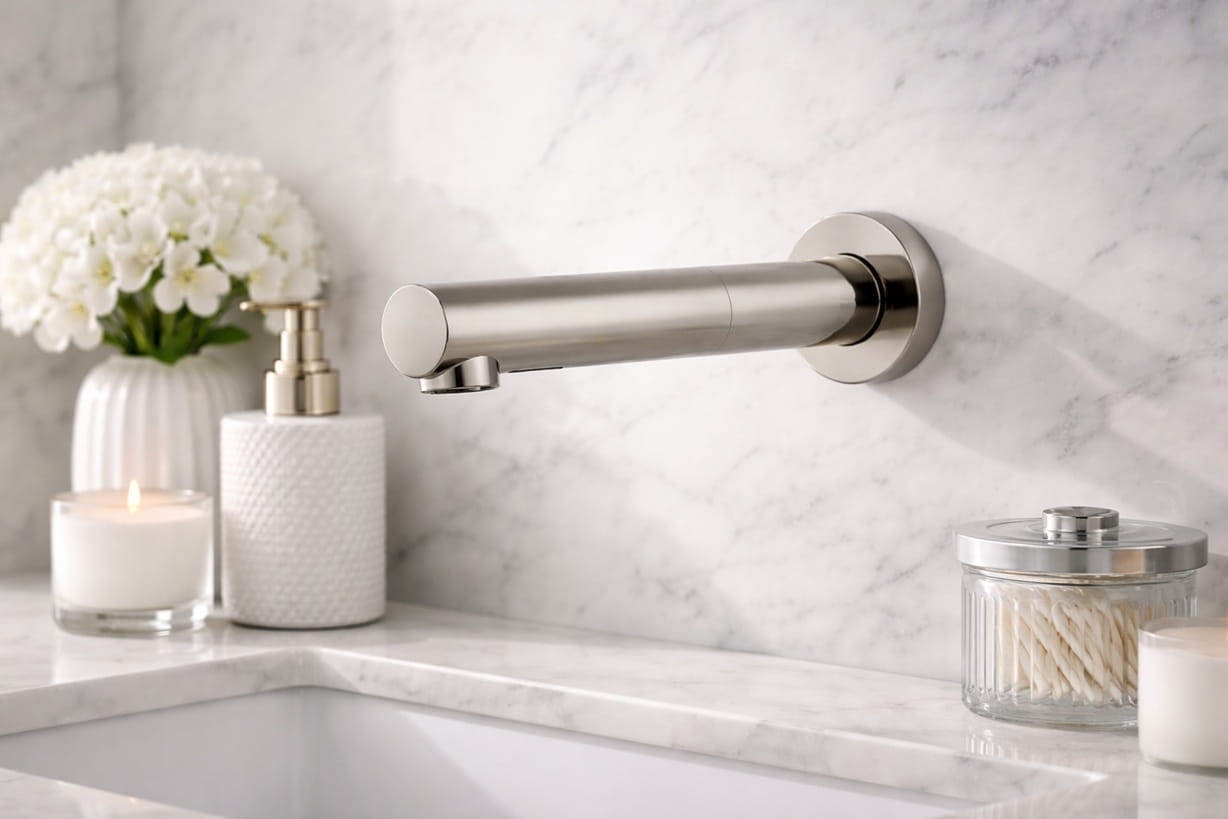
Sustainability standards are also shaping faucet specification decisions. Designers are prioritizing fixtures that combine efficient flow rates with durable materials and long-lasting finishes. Products that support environmental certifications such as LEED or WELL are often favored in commercial and hospitality projects.
Finally, architects are paying closer attention to the adaptability of faucet systems. Modular components, accessible service points, and standardized replacement parts ensure that fixtures remain maintainable throughout a building’s lifespan. This approach reduces downtime, simplifies maintenance, and contributes to more resilient building infrastructure.
When evaluating new faucet technologies, confirm compatibility with plumbing infrastructure, electrical requirements for sensors, and long-term service support from manufacturers.
Structured Specification Process
1
Define use casePublic restroom, luxury home, hotel, etc.
2
Assess plumbing layout3
Match durabilityMaterials for expected usage.
4
Check flow rate5
Choose operation typeManual, touchless, metered.
6
Coordinate finishes7
Confirm maintenance access8
Document detailsBrand, model, finish, certs, warranty.
9
Lifecycle costs10
Review sample/mock‑upCommon Pitfalls & Solutions
| Issue | Solution |
|---|---|
| Specifying non‑commercial components for high‑traffic restrooms. | Specify commercial‑grade materials and cartridges; verify cycle ratings. |
| Mismatch of spout reach/thread with sink and supply. | Verify spout reach, thread size, and mounting holes against fixture schedule. |
| Incomplete documentation and submittals. | Include finish sample, BIM/Revit, cut sheets, certifications, and warranty terms. |
| Service access blocked by millwork or basin design. | Ensure isolation valves and service clearances; choose modular sensor assemblies. |
| Complete degradation in corrosive environments. | Use PVD finishes, marine‑grade alloys, and routine maintenance schedules. |
Scenario‑Based Guidance
Example: Airports, transit hubs, stadiums.
- Brass body
- Easy cartridge access
- Touchless operation
Example: Luxury homes & condominiums
- Design harmony with lighting & hardware
- Flow rate ≤ 1.5 GPM
- Finish coordination
Hotels & serviced apartments blend style with performance. Contractor‑grade faucets provide durability & versatility.
Key Resources
EPA WaterSense® Guide
Official resource with standards for commercial faucets and efficiency metrics.
Commercial Faucet Selection
WebstaurantStore overview of key features and installation advice.
Commercial‑Grade Construction
Pioneer Industries on materials and durability expectations.
Architectural Faucets
Curated design inspiration for residential and commercial projects.
Takeaways
The best faucet choice strikes a balance between design, durability, compliance, and performance. Thorough specifications make sure that a home or business facility, no matter how fancy or busy, will last a long time and look good together.
“Good design doesn’t just meet requirements, it anticipates them—making function and form flow effortlessly together.”