In high-performance buildings, “beautiful” is no longer a finish choice alone—it’s a systems decision. Nowhere is that more visible than at the tap: where user experience, water efficiency, hot-water energy, hygiene, and compliance meet in a few square inches of hardware.

1) The new brief: beauty, performance, and resource budgets
For AEC teams, faucets are often treated as “late-stage selections.” But they directly influence three project budgets that show up in commissioning reports and operations dashboards: potable water, hot-water energy, and risk management.
The water-energy coupling is easy to underestimate. Every gallon saved at a lavatory can also reduce the energy used to heat, circulate, and maintain temperature in domestic hot water loops—especially in larger buildings where wait times and recirculation strategies matter.
Because these interfaces are so visible, they also have outsized influence on how occupants perceive quality: handle feel, acoustics, splash control, perceived flow “strength,” and intuitive temperature control. Good eco-engineering keeps those experiential cues intact—without relying on higher flow.
2) Flow is a design material: aeration, laminar quality, and performance at low pressure
Architects have long used lighting to “shape” space. In a similar way, engineers and specifiers can treat flow quality as a design material—one that influences splash, sound, and perceived power. This matters because the best efficiency strategies don’t depend on making water “feel weaker.”
A key technical nuance: performance at reduced pressure. In many existing buildings, pressure varies by floor, time-of-day demand, and balancing. Water-efficient faucets may also be tested for adequate flow at lower pressures to protect user experience.
Aerators and laminar devices do more than limit flow. They can affect aerosolization, cleaning behavior, and maintenance frequency. In healthcare and other high-sensitivity settings, teams may evaluate laminar devices and aerators through an infection-control lens (alongside the building’s water management plan).
| Design goal | Eco-engineering lever | What to coordinate | What to verify |
|---|---|---|---|
| “Strong” handwashing feel | Flow shaping + pressure-compensation | Pressure at fixture, worst-case floors | Performance at lower pressure; splash behavior |
| Quiet, premium acoustic | Laminar quality; turbulence control | Spout height + basin geometry | Noise + splash testing in a mock-up |
| Lower potable water use | Efficient flow rate + metering/sensors | Occupant patterns; misuse scenarios | Post-occupancy measurement or spot audits |
| Hygiene + risk control | Simpler wetted pathways; maintainability | Water management plan; flushing access | Cleaning + maintenance procedures |
3) Systems thinking: pipe volume, tempering, and the “hidden” water waste between heater and hand
Fixture efficiency is only half the story. Many buildings waste water while occupants wait for hot water to arrive. The amount lost depends on the volume of water sitting in the branch line and how quickly the system restores target temperature.
This is where eco-engineering becomes a coordination exercise: shorten developed lengths, avoid dead legs, place tempering strategies appropriately, and select hot-water temperature maintenance approaches that match the building type and risk profile.
- Reduce branch volume: tighter planning of risers, stacks, and fixture groups.
- Right-size temperature maintenance: demand recirculation, heat trace, or point-of-use approaches based on use patterns.
- Mixing valve strategy: balance scald protection with the need to control bacterial growth through a documented water management plan.

4) Materials, finishes, and potable-water chemistry
“Eco” is also about what lasts. A faucet that holds up for decades—without finish failure, chronic leaks, or premature cartridge replacement—avoids the embodied impacts of repeated manufacturing and service calls.
For potable water, the modern baseline is more than corrosion resistance. Specs often reference lead-content limits and verification pathways so teams can document compliance and reduce the risk of lead contribution from wetted components.
- Lead-content compliance: align submittals with recognized lead-content verification methods.
- Water quality awareness: consider chloramine, hardness, and disinfectant residual impacts on elastomers and plating.
- Cleanability: coordinate finish + cleaning protocol (especially in healthcare, labs, and high-turnover public spaces).
5) Sensors and controls: when “smart” saves water—and when it doesn’t
Touchless and metering faucets can reduce waste, but outcomes vary. Field performance depends on user behavior (hand positioning and dwell time), calibration, and the selected flow device.
For owners, the important question is not “smart or not?” but: Can the control strategy be tuned and maintained with the staff and budget that actually exist?
- Setpoints and timing: default run time, timeout, and re-trigger thresholds.
- Maintainability: access for battery change or power supply service, plus spare parts plan.
- Water management: plan for flushing and stagnation control—especially in low-use restrooms.
6) Proving it in documentation: LEED calculations, commissioning, and post-occupancy checks
“Eco-engineering” becomes real when it’s documented. Many teams already run the numbers for indoor water use reduction pathways, but the highest-performing projects also validate assumptions after occupancy.
A practical workflow that avoids late surprises:
- Design phase: set target flow rates by space type and occupancy patterns.
- Mock-up phase: validate perceived flow, splash control, and accessibility.
- Submittals: confirm the flow device and cartridge are consistent with the specified performance.
- Commissioning & turnover: include tuning guidance and a short maintenance playbook.
- Post-occupancy: spot-check runtime settings, aerator swaps, and hot-water wait times.
Case-study signal: when standards drive design (ASHRAE HQ)
One useful pattern in high-performance renovation is to treat sustainability standards as design constraints rather than a post-design checklist. A public case study of ASHRAE’s headquarters renovation documents a structured approach: set owner project requirements, evaluate strategies, and track performance goals (including water efficiency) alongside budget and schedule.

Conclusion: a specifier’s checklist for design-led eco-engineering
The most successful projects treat faucets as part of an integrated water-and-energy system—while still respecting the architectural intent at the point of use. If you want “non-sacrificial” sustainability, focus on what occupants feel, what operators can maintain, and what the building can document.
- Mock-up the interface: confirm splash, acoustics, reach, and perceived flow.
- Coordinate the hidden system: branch volumes, dead legs, and temperature maintenance.
- Document compliance pathways: water reduction calculations and material requirements.
- Plan for tuning: sensors and run times should be adjustable and maintainable.
- Write the O&M story: cleaning chemistry, spare parts, and flushing practices.
If you’d like, you can adapt this checklist into a one-page “fixture interface” spec appendix for architectural and MEP coordination.
7) Why retrofit decisions matter as much as new-build specs
In existing buildings, faucet upgrades can deliver measurable results faster than major plumbing replacements. A well-chosen retrofit can cut water use, improve user comfort, and reduce hot-water waste without changing the full restroom layout.
This is especially relevant in offices, hotels, schools, and mixed-use properties where fixture counts are high and daily usage patterns are easy to track. When owners pair efficient faucets with the right aerators, cartridge performance, and maintenance planning, the return often shows up in both utility savings and fewer service calls.
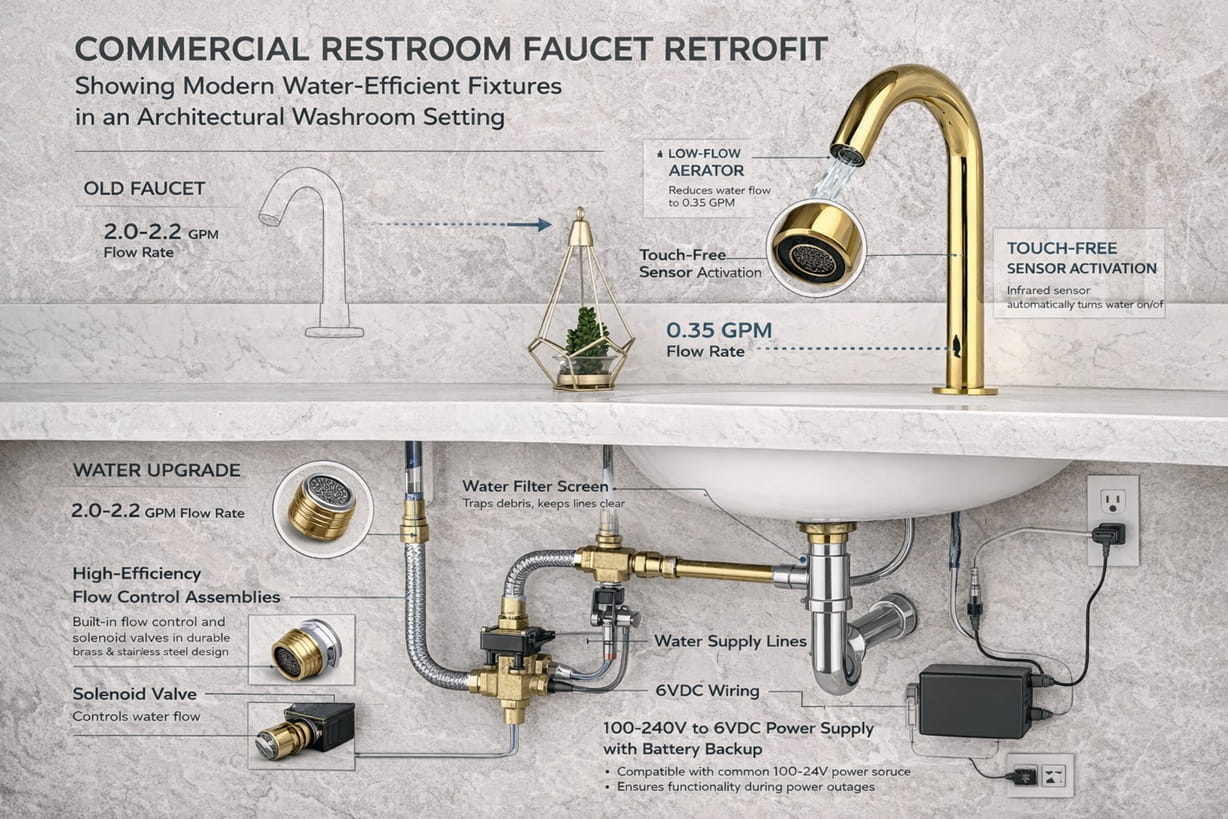
For specifiers, the key is to evaluate the faucet as part of the full use condition: basin geometry, water pressure, cleaning routine, and expected occupant behavior. That approach turns a simple product swap into a practical performance upgrade.
Verified research links & support documents
-
 epa.gov
WaterSense bathroom faucets overviewProgram context plus savings framing for efficient faucets and aerators.
epa.gov
WaterSense bathroom faucets overviewProgram context plus savings framing for efficient faucets and aerators. -
epa.gov • PDF
WaterSense technical sheet: bathroom sink faucets (PDF)Performance + flow testing context useful for specs and submittal review.
-
epa.gov • PDF
WaterSense labeled bathroom sink faucets & accessories (PDF)Quick, shareable summary for owners and project documentation packets.
-
gsa.gov • PDF
Hot water temperature maintenance efficiency opportunities (PDF)Strategies to reduce wait-time waste while balancing energy and risk.
-
cdc.gov
CDC module: potable water systems & Legionella controlDesign and operations considerations for water management planning.
-
cdc.gov • PDF
CDC potable water systems toolkit (PDF)Downloadable guidance supporting water management and design review.
-
nsf.org
NSF/ANSI/CAN 372 technical requirementsLead-content verification overview for potable-water components.
-
asme.org
ASME A112.18.1/CSA B125.1 scope pageBaseline definition for plumbing supply fittings and interfaces.
-
gsa.gov • PDF
ASHRAE HQ renovation case study (PDF)Integrated performance approach useful for AEC precedent and documentation.
-
csus.edu • PDF
Automatic faucets: do they save water? (PDF)Useful field perspective on behavior and real-world savings variability.
-
mdpi.com
Energy & water savings retrofit M&V case studyMeasured outcomes supporting post-occupancy verification workflows.
