“Design flexibility” in architectural faucets is not just how many styles exist. It’s how well a brand lets you hold a design intent across different restroom types, budgets, and procurement realities—while keeping finish behavior, documentation, and maintenance predictable. This comparison focuses on what matters to architects: line breadth, finish systems (and what they imply), documentation quality, and verification pathways.

What architects mean by design flexibility (and how to test it)
On modern projects, the faucet sits at the intersection of interior language and facility performance. Flexibility is strongest when a brand can support:
- Multiple mounting patterns: single-hole, widespread, wall-mount, and commercial deck contexts.
- Multiple program types: private restroom suites, public restrooms, hospitality, and institutional areas.
- Finish continuity: a finish that can be carried through accessories so the room reads intentional.
- Documentation speed: cut sheets, installation guidance, and maintenance clarity without hunting.
Finish options: breadth is good, but finish engineering is the real story
Finish selection affects more than aesthetics. It changes how fingerprints appear, how cleaning chemicals behave, and how quickly wear becomes visible—especially in modern minimalist bathrooms where surfaces are intentionally quiet.
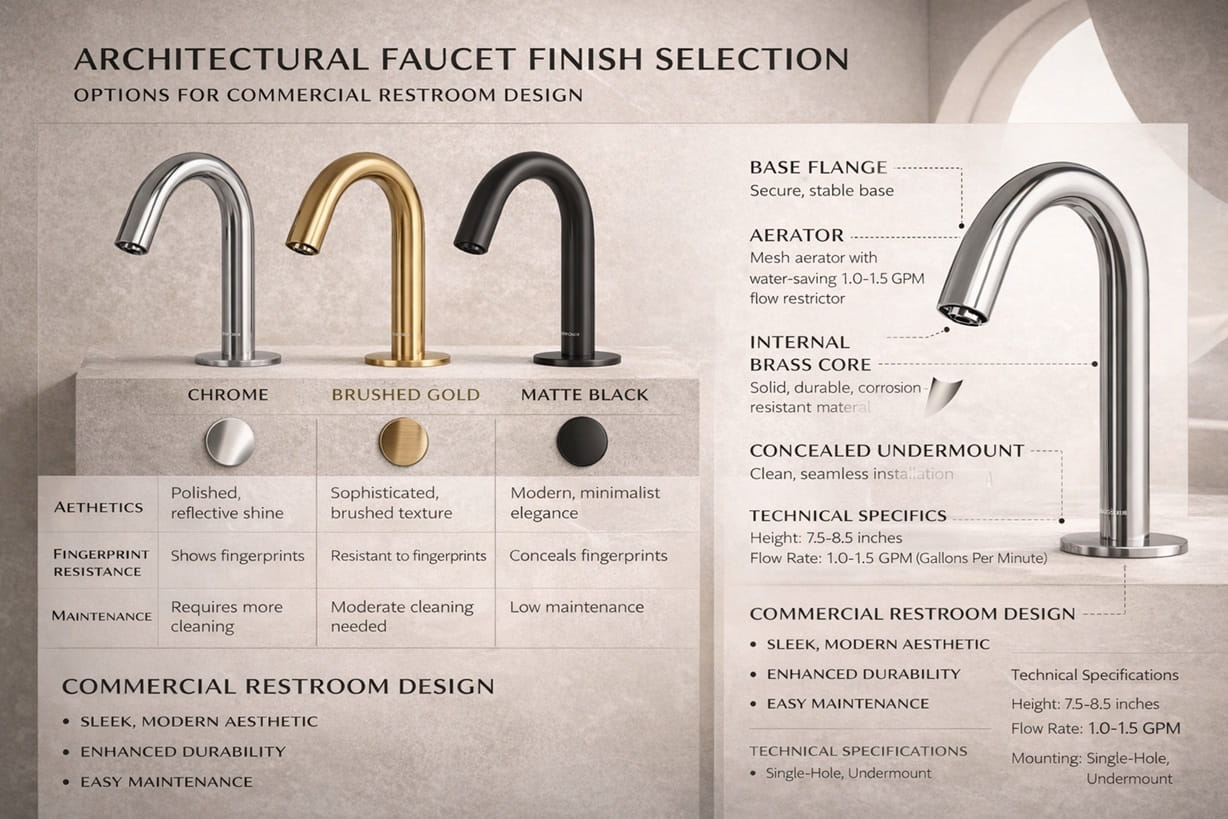
BathSelect (commercial touchless category): BathSelect explicitly lists finish options such as Chrome, Brushed Gold, and Matte Black in its commercial touchless faucet category. That’s a practical palette for modern projects because it covers the three most specified contemporary directions: bright neutral, warm metallic, and deep matte contrast.
Kohler: Kohler’s finish ecosystem is broad and design-led (with curated “featured finishes”), and it also publishes a more engineering-forward explanation of its Vibrant® finishes using PVD (physical vapor deposition), framing durability attributes like scratch/tarnish resistance. For architects, the advantage is the ability to specify warm metallics (including Moderne Brass tones) and still speak about a finish process in technical terms during reviews and closeout.
Design flexibility in real projects: where each brand tends to fit
BathSelect is typically evaluated in contexts where modern flexibility means “solve the program” quickly—especially commercial or hospitality-adjacent scenarios where touchless, standardized plumbing fit, and a clear palette of modern finishes matter. A representative BathSelect commercial sensor faucet page also emphasizes a cast brass body and highlights a Brushed Gold finish option, which is useful when you want warm metal tones without losing the simplicity of a touchless spec.
Kohler is often selected when flexibility means “hold the design language” across multiple faucet silhouettes and coordinate finishes across a broader interior family. Kohler’s finish ecosystem is expansive, and it can support projects that want one finish direction across many room types and fixture styles.
Verification and standards: keep the comparison defensible
AEC teams increasingly verify performance with independent references, especially when alternates appear. For faucets, two common verification tracks are:
- Water efficiency: using WaterSense guidance and model-level search when applicable.
- Lead-content methodology: referencing NSF/ANSI/CAN 372 as a standardized methodology for determining/verifying lead content compliance.
For broader supply fitting scope and conformity discussions, ASME A112.18.1/CSA B125.1 is a common anchor point for what plumbing supply fittings cover between the supply stop and terminal fittings.

Architect-facing comparison table
| Design/finish factor | BathSelect (what to expect) | Kohler (what to expect) | What’s “worth discussing” in reviews |
|---|---|---|---|
| Modern finish palette | Clearly listed modern staples in touchless category (Chrome, Brushed Gold, Matte Black) | Broad curated finish ecosystem (including warm metallic families) | Finish continuity across accessories + how finishes read under project lighting |
| Finish engineering narrative | Category-driven options; verify durability and cleaning guidance per model | Publishes Vibrant finish/PVD explanation as a durability framework | Cleaning protocol in O&M; chemical exposure assumptions |
| Design flexibility | Program-first flexibility (commercial touchless, hospitality/public restroom use cases) | Family-first flexibility (multiple silhouettes + finish continuity across lines) | Ability to maintain design intent across room types (public vs private zones) |
| Specification defensibility | Confirm flow/compliance and include verification steps in submittals | Same; pair finish system narrative with verification steps | WaterSense verification (when applicable), lead-content methodology references |
| Best-fit conclusion | Best when you want modern finishes + touchless category clarity with straightforward program alignment | Best when you need expansive finish/line coordination to hold design language across a project | Match the brand strength to the project constraint (program vs design language) |
How to choose the right finish strategy for long-term project value
In many specifications, the finish decision is treated as a late aesthetic choice. In practice, it should be made earlier. The right finish strategy helps the faucet stay aligned with the design concept after occupancy, especially in busy restrooms where cleaning frequency, lighting, and touch patterns quickly expose weak finish choices.
Chrome usually remains the safest option when durability, cleaning familiarity, and cost control are the main priorities. Matte Black works well when the project needs strong visual contrast, but it should be reviewed carefully in high-use environments where residue and handling marks may become more visible. Brushed Gold and other warm metallic finishes are often chosen to give the restroom a more hospitality-driven look, but they perform best when the finish direction is coordinated across accessories, mirrors, and hardware instead of standing alone.
For architects and specifiers, the best approach is to match finish selection to the actual use case. Public and institutional restrooms usually benefit from finishes that are easy to maintain and simple to replace in the future. Boutique hospitality, premium office interiors, and executive suites often justify a warmer or more expressive finish palette because the faucet becomes part of the room identity rather than only a plumbing fixture.
Questions worth asking before final faucet approval
Before sign-off, ask whether the selected finish will still support the design intent after six months of real use. Confirm how the finish is cleaned, whether matching accessories are available, and whether the product documentation is clear enough for contractors and facility teams. These simple checks reduce substitutions, avoid finish mismatches, and improve the chance that the installed result matches the visual goal shown in design presentations.
A strong faucet specification is not only about appearance. It is about finish continuity, realistic maintenance, and confidence that the selected model can hold up in the exact type of restroom the project requires.
Verified support links & documents
-
 bathselecthospitality.com • category
BathSelect commercial touchless faucets (finish options list)Lists modern finish options (including Chrome, Brushed Gold, Matte Black) at the category level.
bathselecthospitality.com • category
BathSelect commercial touchless faucets (finish options list)Lists modern finish options (including Chrome, Brushed Gold, Matte Black) at the category level. -
bathselecthospitality.com • product
BathSelect brushed-gold cast brass sensor faucet exampleUseful for documenting finish direction and sensor category intent in submittal packets.
-
kohler.com • overview
Kohler faucet finishes overview (selection + design framing)Design-oriented finish selection reference that helps align finish choices to room mood and palette.
-
kohlerasiapacific.com • technical
Kohler Vibrant finishes: PVD process explanationEngineering-style description of finish process (PVD) to support durability discussions in reviews.
-
resources.kohler.com • PDF
Kohler “Start With the Finish” portfolio insert (PDF support document)Printable finish portfolio reference for presentations, palettes, and finish alignment.
-
epa.gov • verification
EPA WaterSense: bathroom faucets (efficiency guidance)Independent program guidance for water efficiency framing and sustainable specs.
-
epa.gov • model search
WaterSense product search (verify by model number)Helpful during alternates review and procurement to keep claims defensible.
-
nsf.org • standard
NSF/ANSI/CAN 372 technical requirements (lead-content methodology)Standardized methodology reference for determining and verifying lead content compliance.
-
asme.org • standard scope
ASME A112.18.1/CSA B125.1: plumbing supply fittings scopeScope anchor for conformity discussions (between supply stop and terminal fittings).