This review is written for architects, interior designers, and specifiers who want repeatable outcomes. “Architectural” is not only the silhouette—it’s the way the faucet holds up to cleaning, water chemistry, and daily use, while remaining easy to coordinate and maintain.

How we review: three lenses that actually predict project success
A faucet can look perfect on a mood board and still underperform in a real restroom. For BathSelect (and any architectural faucet package), the highest-value review uses three lenses that map to AEC risk: form (geometry + usability), finish (durability + cleanability), and function (controls + serviceability).
- Form: reach, height, and stream impact location—because splash is a design failure, not a user error.
- Finish: coating stack + corrosion resistance—because housekeeping is relentless and chemistry varies by site.
- Function: valves, sensors, power, and access—because maintenance paths decide long-term satisfaction.
Form: where architectural intent meets water physics
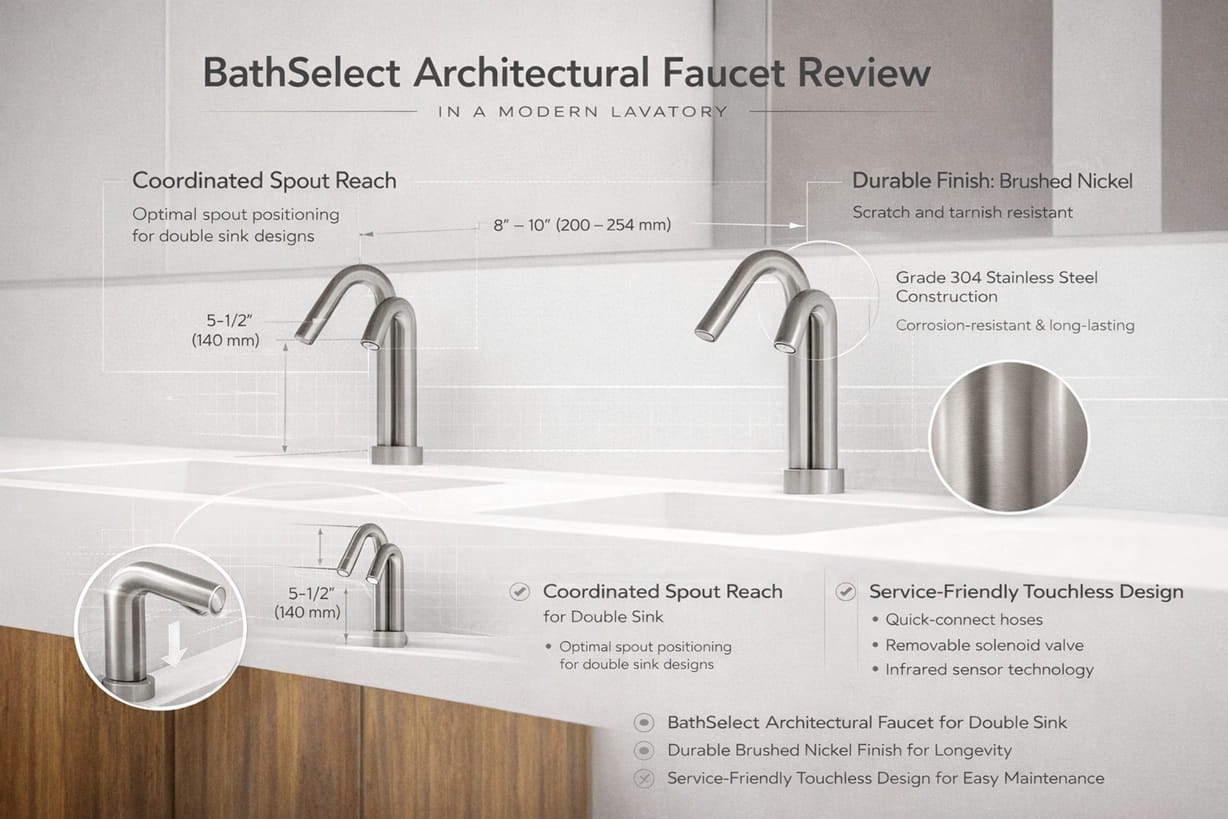
In professional interiors, form is evaluated at the basin—not in isolation. The same spout can behave differently on a shallow vessel, a deep undermount, or a compact ADA lavatory. The most reliable way to protect intent is to coordinate spout reach and stream impact point.
For sensor models in particular, form includes “where the user’s hands naturally go.” If the detection zone is set to activate too early, you’ll see nuisance triggers and wet counters. If it’s too short, users hover and wave, which becomes a perceived quality issue.

Finish: what “premium” means in measurable terms
Finish is where many architectural faucets either earn trust—or degrade quickly under real cleaning regimes. The safest AEC approach is to ask: what coating system is used, and how is durability demonstrated? For decorative metals, durability is typically demonstrated through standardized corrosion testing and wear behavior.
Two reference points spec teams recognize: ISO 9227 salt spray testing (including NSS/AASS/CASS variants) and ASTM B117 salt spray apparatus practice. These do not fully replicate the real world, but they provide a common language for comparing finishes across projects and suppliers.
For PVD-type decorative coatings, peer-reviewed research generally supports improved wear and/or corrosion behavior depending on coating structure and substrate, but the details matter: adhesion, thickness, multilayer design, and exposure environment can change outcomes. That’s why you should request test evidence, not only finish names.
Material resilience: brass performance is water-chemistry dependent
Brass is common for faucet bodies, but it is not one material. Alloy choice and water chemistry influence long-term corrosion behavior, including dezincification risk. Recent research on faucets specifically highlights how drinking-water characteristics can impact long-term dezincification outcomes.
For architects, this matters most in regions with aggressive water chemistry, elevated disinfectant residuals, or high temperatures. The mitigation strategy is simple: confirm the alloy strategy (e.g., dezincification-resistant brass where appropriate) and align with the project’s verification requirements.
Function: what BathSelect sensor documentation tells us (and how to use it)
BathSelect’s sensor faucet manuals are useful because they publish parameters that can be turned into enforceable spec language. For example, the BS10101 manual includes details such as battery and AC power options, water pressure ranges, detection-zone ranges, and motor valve lifespan targets.
Even more important than the numbers is the installation narrative: flushing debris before use, checking for leaks before activation, and commissioning notes that describe how sensing range behaves during initialization. In the field, those steps reduce early failures and nuisance callbacks.
Compliance and verification: keep it model-by-model
Architectural projects often require third-party verification for lead content, potable water contact, and (where applicable) water efficiency labeling. The safest method is to verify each selected model in the directories required by your jurisdiction/owner.
Use the standards and directories below as your “verification backbone”: ASME A112.18.1/CSA B125.1 scope for plumbing supply fittings, NSF/ANSI/CAN 372 for lead content methodology, NSF listings for lead content search, and IAPMO’s product listing directory where cUPC/certification is required. For water efficiency, EPA WaterSense provides the cleanest public directory and guidance.

AEC-ready selection table: what to check before approval
Use this table as a pre-submittal checklist for BathSelect faucet packages (manual or sensor). It keeps the conversation technical and reduces subjective “looks good” approvals that later cause callbacks.
| Lens | What to request | What to verify (mock-up / submittal) | Why it matters |
|---|---|---|---|
| Form | Dimensional drawing (reach/height), intended basin pairing | Stream impact point, splash at typical hand positions | Protects finish + counters; avoids “wet vanity” complaints |
| Finish | Coating stack + test evidence (ISO 9227 / ASTM B117 or equivalent) | Cleaning compatibility (chemicals, abrasion), corrosion expectations | Predicts appearance retention under housekeeping cycles |
| Material | Body material/alloy strategy; water-quality assumptions | Risk mitigation for aggressive water; replacement parts path | Reduces corrosion-related failures and warranty disputes |
| Function | Sensor manual: detection range, timeout, pressure range, power | Nuisance activation, auto-shutoff behavior, commissioning steps | “Sensor precision” becomes a commissioning outcome |
| Verification | Listings evidence for the exact model (as required) | Directory match by manufacturer + model number | Prevents compliance surprises during inspection |
| Serviceability | Exploded view/parts list + access requirements | Can FM service the unit without removing finished surfaces? | Controls lifecycle cost and tenant downtime |
A practical conclusion for specifiers reviewing BathSelect in real project conditions
For architects and specifiers, the most useful takeaway is that BathSelect should be judged as a project system, not only as a product image. The strongest selections will be the ones that match basin geometry, publish clear control behavior, and include enough documentation to support submittals, mock-ups, and facility handoff without guesswork.
This matters because finish, form, and function rarely fail in isolation. A good-looking faucet can still create splash issues, early coating wear, or maintenance frustration if the installation context is ignored. The better review question is always the same: can this exact model perform predictably after daily cleaning, repeated use, and normal service access constraints?
From a content and indexing standpoint, this kind of continuation also helps the article reach more practical search intent. It brings in owner, facility, and specification language that supports readers looking for real-world buying guidance rather than only design inspiration.
Verified support links & documents (no tracking parameters)
-
 manualslib.com • manual
BathSelect BS10101 installation manual (published sensor ranges + lifespan targets)Useful for turning “touchless” into enforceable commissioning targets (detection zone, power, pressure range).
manualslib.com • manual
BathSelect BS10101 installation manual (published sensor ranges + lifespan targets)Useful for turning “touchless” into enforceable commissioning targets (detection zone, power, pressure range). -
manualzz.com • manual
BathSelect BS10101 commissioning notes (flush debris + sensor behavior during initialization)Highlights field steps that reduce nuisance callbacks and early valve failures.
-
manualslib.com • manual
BathSelect BS1097-BG touchless faucet installation manualAdditional example of how BathSelect documents installation and maintenance expectations for touchless models.
-
iso.org • standard
ISO 9227 (salt spray tests) — reference for decorative coating corrosion testingCommon language for comparing finish durability evidence (NSS/AASS/CASS).
-
astm.org • standard
ASTM B117 — salt spray (fog) apparatus practiceBenchmark practice often referenced in finish durability submittals.
-
sciencedirect.com • research
Research: dezincification behavior in faucets using different brass alloysConnects water chemistry to long-term brass performance—useful for material decisions on large projects.
-
sciencedirect.com • research
Research: multilayer PVD coatings on brass improve corrosion resistance (study)Supports finish discussions with peer-reviewed evidence (structure-dependent performance).
-
svc.org • PDF
Society of Vacuum Coaters: PVD wear resistant and decorative coatings (primer)Non-competitive technical overview of PVD methods and decorative film context.
-
asme.org • standard
ASME A112.18.1/CSA B125.1 overview (plumbing supply fittings scope anchor)Useful standards reference point when writing supply fitting requirements.
-
nsf.org • guidance
NSF: NSF/ANSI/CAN 372 technical requirements (lead content)Explains what the lead-content standard covers and how compliance is evaluated.
-
info.nsf.org • directory
NSF directory: search lead content certified productsModel-by-model verification pathway when your project requires independent listings.
-
iapmo.org • directory
IAPMO R&T Product Listing DirectoryPublic directory used for product listing verification where applicable.
-
epa.gov • guidance
EPA WaterSense: bathroom faucetsWater-efficiency guidance and program baseline for labeled faucet selection.
