A quiet faucet is rarely “just a nicer faucet.” It’s a sign that pressure, velocity, control logic, and mounting details are working together. The same engineering choices that reduce hiss, whine, and pipe rattle can also reduce water and hot-water energy—without making the user experience feel weak.

1) Start with the real problem: how plumbing noise reaches occupants
“Noisy faucet” complaints typically come from two paths: airborne noise at the point of discharge (hiss, spray, whistling) and structure-borne noise that travels through pipe, framing, and finishes (rattle, ticking, banging). The fix depends on which path dominates.
In practice, faucet systems generate noise from flow turbulence at restrictions, pressure fluctuations from fast valve closure, vibration at pipe supports, and (in some cases) cavitation at high pressure drops. Multi-tenant buildings tend to be more sensitive: occupants are closer to risers, shafts, and back-to-back wet walls, so “small” vibration events can become audible.
2) Noise at the spout: what “hiss” usually means
A hiss or whine at the outlet is often a signature of high turbulence and pressure drop at the flow device (aerator, laminar device, spray former) or within the faucet’s internal pathways. Importantly, this can happen even at efficient flow rates if the system pressure is high and the restriction is doing too much work.
In an efficient design, the goal is not only to cap gpm—it’s to make the fixture’s performance stable across realistic pressure conditions. When the flow device is pressured into being the primary pressure regulator, noise becomes more likely.
- Match basin + spout geometry to reduce splash, which reduces “masking” behavior (users opening the valve further).
- Use pressure-compensating control where appropriate so flow stays consistent without excessive turbulence at the outlet.
- Address upstream pressure with pressure-reducing strategy rather than relying on the terminal restriction alone.
3) Quiet efficiency depends on pressure realism, not “best-case” assumptions
Water efficiency targets can be achieved without degrading user experience, but only if the fixture is expected to perform under the building’s lowest and highest practical pressures. That’s why some efficiency programs specify both a maximum flow rate at a reference pressure and a minimum flow rate at lower pressure to maintain usability.
From an acoustics standpoint, pressure realism matters because high static pressure makes small restrictions louder, and low pressure can trigger behavior that increases runtime (and total water use). Your best lever is to keep the operating condition in the “quiet zone”: adequate flow without excessive pressure drop at the outlet.

4) Structure-borne noise: pipe support, separation, and vibration “short circuits”
When occupants describe “rattle,” “buzz,” or “ticking,” the sound often comes from pipes and supports, not the spout. The mechanism is simple: turbulent flow or pressure events excite the pipe; the pipe couples into studs, slabs, and wall finishes; then surfaces radiate sound into the room.
The most cost-effective controls are usually coordination details: keep penetrations clean, avoid rigid bridging, provide resilient isolation where needed, and place supports so the system is stable but not acoustically “hard-coupled” into the structure.
- Support spacing + stability: reduce micro-movement that becomes audible at elbows, tees, and stop valves.
- Resilient separation: avoid hard contact between pipe and framing at penetrations.
- Wet wall planning: treat back-to-back assemblies as acoustically sensitive, especially in multi-family and hospitality.
5) Water hammer: the loudest event, and the easiest to misdiagnose
“Banging” is usually a transient pressure wave caused by rapid velocity change when a valve closes quickly. Sensor faucets, solenoid valves, and some ceramic-disc mechanisms can be fast-closing by nature—especially when paired with high pressure. If the piping is not well restrained or if there are air pockets, the event becomes more audible and more damaging.
Water hammer control is not one thing; it’s a stack of safeguards: manage pressure, limit velocity where feasible, restrain and isolate piping appropriately, and use rated arrestors near quick-closing fixtures.
- Placement matters: an arrester is most effective close to the quick-closing valve it protects.
- Specification clarity: reference recognized performance standards so “generic air chambers” don’t slip in as substitutes.
- Maintenance realism: ensure access and avoid buried “fixes” that can’t be verified later.
6) A field-ready troubleshooting matrix for AEC teams
In commissioning and post-occupancy, noise problems are easiest to solve when you map the sound to the mechanism. Use the table below in a mock-up review or a site walk. The “verify” column is the difference between guesswork and a repeatable result.
| What occupants hear | Typical mechanism | Design / retrofit levers | What to verify on site |
|---|---|---|---|
| High-pitched whistle at faucet | Resonance at flow device or sharp restriction | Swap flow device type; reduce upstream pressure; confirm alignment of components | Pressure at stop; confirm consistent outlet components across units |
| Broad hiss (like air) when running | Turbulence from high pressure drop | Pressure management; pressure-compensating control; smoother transitions | Sound level vs pressure; compare at different floors/time-of-day |
| Rattle in wall when turning on/off | Pipe vibration + loose support contact | Improve restraint; add resilient separation; avoid hard “bridges” at penetrations | Access panel inspection; identify contact points and movement |
| Single loud bang at shutoff | Water hammer pressure wave | Rated arrestors near quick-closing valves; pressure reduction; restraint strategy | Valve closure time; arrester location; repeated event logging |
| Buzzing near sensor valve or control box | Solenoid/transformer vibration or mounting resonance | Mounting isolation; secure housings; avoid rigid coupling to thin panels | Listen at power supply and valve body; confirm mounting details |
7) A simple workflow that protects both acoustics and water targets
Quiet, efficient faucet systems are easiest to deliver when the team treats them like a “mini-system”: a defined operating pressure band, a selected flow strategy, and a short list of installation details that are non-negotiable.
- Design phase: define pressure assumptions (high/low), target flow strategy, and where pressure control occurs.
- Mock-up phase: validate perceived flow, splash, and tone (whistle vs hiss) in a representative basin configuration.
- Submittal phase: confirm outlet components and control logic match the performance intent (not just the finish).
- Installation phase: enforce support and penetration details that prevent vibration short circuits.
- Commissioning: tune pressure/control settings and document “as-left” values for O&M.

8) Why quiet faucet design improves perceived quality in premium spaces
In hospitality, residential towers, executive offices, and wellness-focused interiors, sound is part of the brand experience. A faucet that opens with a smooth stream and minimal noise makes the space feel better built, even when the fixture itself is modest in size.
That matters because users often connect noise with poor pressure control, low product quality, or aging plumbing. By contrast, a quieter faucet suggests stability, cleaner detailing, and stronger engineering behind the wall. This is one reason acoustic performance should be reviewed alongside finish, flow rate, and durability during fixture selection.
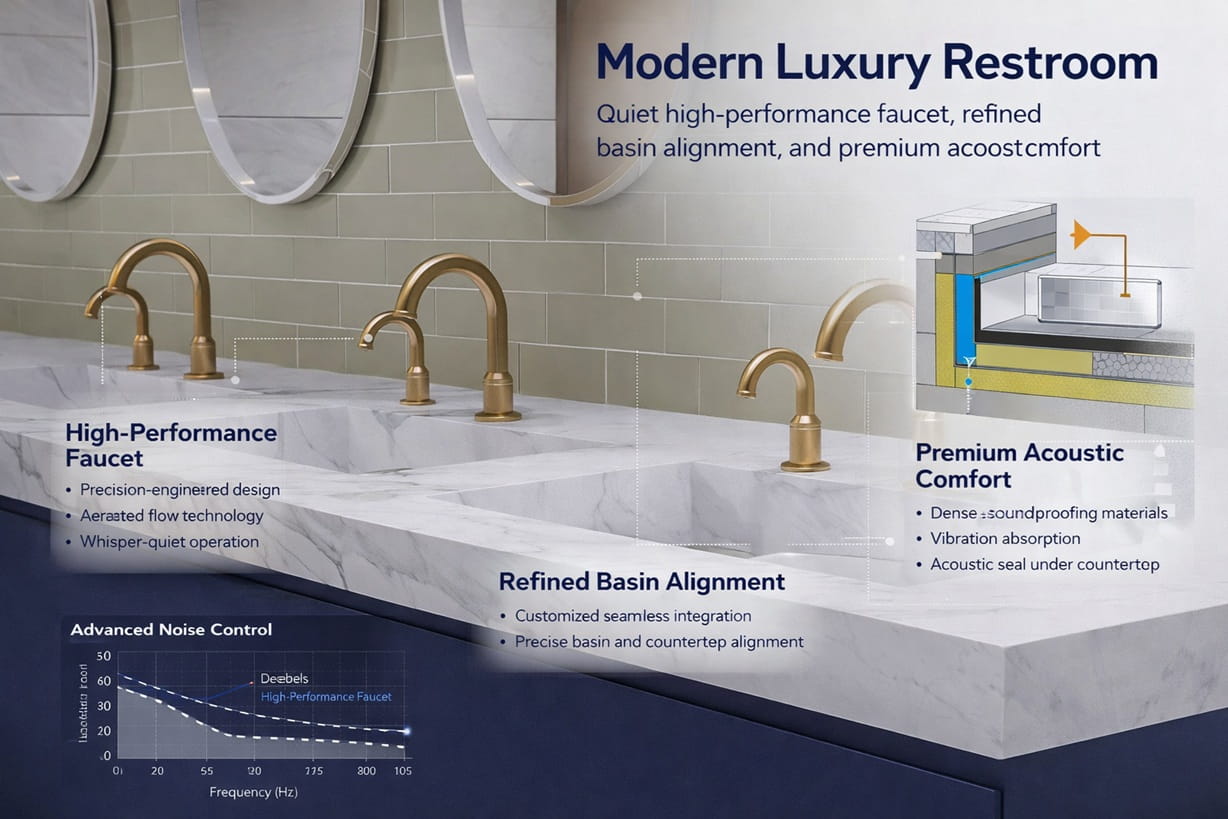
For retrofit and new-build projects alike, the takeaway is straightforward: quieter performance is not only an acoustic benefit. It can also support water efficiency goals, reduce complaints, and strengthen the overall perception of design quality across the space.
Conclusion: quiet is a performance metric you can design for
The best acoustic outcome is not silence at any cost—it’s a stable, predictable system where users get a consistent washing experience and the building avoids stress events like water hammer. When pressure management, flow strategy, and installation detailing are aligned, you get quieter spaces and lower resource use at the same time.
- Keep pressure honest: don’t let the outlet become the primary pressure regulator.
- Design the interface: spout + basin geometry can prevent “turn it up” behavior.
- Stop vibration short circuits: support and penetration details matter as much as STC ratings.
- Specify verified protection: use recognized arrester performance references for fast-closing valves.
- Measure and tune: a short commissioning checklist beats repeated call-backs.
Verified research links & support documents (no competitors, no tracking parameters)
-
 wbdg.org
WBDG: Acoustic comfortCross-discipline design strategies, including plumbing noise control and water hammer mitigation.
wbdg.org
WBDG: Acoustic comfortCross-discipline design strategies, including plumbing noise control and water hammer mitigation. -
asme.org • PDF
ASME: design considerations for acoustics of piping systems (PDF)Multi-tenant context and noise mechanisms tied to building piping behavior.
-
iso.org
ISO 3822-2: fixture noise test conditions (draw-off taps & mixing valves)Standardized mounting/operating conditions for measuring noise from taps and mixing valves.
-
iso.org
ISO 3822-3: noise tests for in-line valves & appliancesUseful when diagnosing valve-related tonal noise and pressure-control components.
-
iso.org
ISO 16032: measurement of sound from service equipment in buildingsEngineering method for measuring sound pressure levels from sanitary installations and other services.
-
iso.org
ISO 10052: field survey method for service equipment soundPractical on-site measurement framework for post-occupancy acoustic checks.
-
pdionline.org
PDI standards listing (includes WH201 water hammer arresters)Reference hub for a widely used water hammer arrester performance standard.
-
pdionline.org • PDF
PDI WH201 (PDF)Direct document for specification and submittal alignment.
-
ansi.org
ASSE 1010 (performance requirements for water hammer arresters)Standard reference for arrester performance scope and classification.
-
epa.gov • PDF
WaterSense at Work: Faucets (PDF)Flow criteria and performance framing useful for efficient, low-pressure-satisfying systems.
-
epa.gov • PDF
WaterSense faucet specification support statement (PDF)Background and intent document to support spec narratives and owner documentation.


Piero Lissoni is an internationally acclaimed Italian architect, designer, and art director recognized for shaping contemporary luxury architecture and interior design through his refined approach to “humanistic minimalism.” As co-founder of Lissoni & Partners, he has influenced the global AEC industry with sophisticated hospitality, residential, retail, and commercial projects that emphasize clean lines, spatial harmony, and timeless materiality. His expertise spans architecture, interior environments, furniture systems, lighting, and premium bathroom fixture integration, where every element is carefully coordinated to create cohesive and functional spaces. Through his multidisciplinary design philosophy and attention to detail, Piero provides valuable insight into modern commercial restroom aesthetics, high-end hospitality environments, integrated architectural product design, and the balance between minimalism, comfort, and long-term design relevance in contemporary built spaces.